



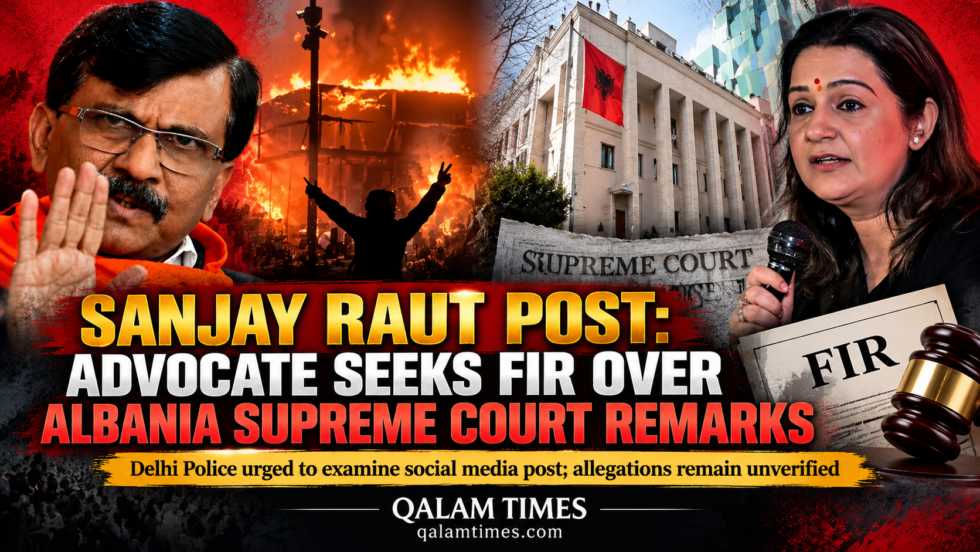
Sanjay Raut Complaint: Advocate Vineet Jindal seeks a Delhi Police FIR over Raut’s post referring to Albania’s Supreme Court and India.
Qalam Times News Network
Mumbai, October 21, 2026
Sanjay Raut Complaint: A lawyer has approached the Delhi Police seeking the registration of a First Information Report (FIR) against Shiv Sena (UBT) leader Sanjay Raut over a social media post referring to the reported burning of Albania’s Supreme Court. The complaint alleges that the post, which also refers to India, warrants scrutiny by law enforcement authorities. However, the allegations have not yet been established, and the complaint itself does not confirm that an FIR has been registered.

Advocate Vineet Jindal submitted the complaint on October 21 to the Delhi Police Commissioner, requesting an investigation into the post published on Raut’s account on X. He has urged the police to examine the content under relevant provisions of the Bharatiya Nyaya Sanhita (BNS) and the Information Technology Act, 2000, and determine whether it discloses a cognisable offence.
Advocate Cites Reference to India and Seeks Examination of Social Media Post

According to the complaint, the post contains a video showing fire and destruction, accompanied by an English translation of Marathi text describing an alleged incident in Albania. The text claims that people set fire to the country’s Supreme Court over allegations that the institution was assisting corrupt prime ministers. The post also reportedly refers to attacks on Parliament, government offices and the residences of ministers. It concludes with a statement suggesting that countries should learn a lesson from these events, followed by the word “Especially” and an image of the Indian national flag. Jindal has argued that the post should be assessed as a whole, taking into account its wording, accompanying video and reference to India. He has asked the police to determine whether the material could fall within the scope of any criminal provisions. The complaint specifically invokes Sections 353(1)(b), 152, 196 and 197 of the Bharatiya Nyaya Sanhita, along with relevant provisions of the Information Technology Act. The applicability of these provisions, however, would need to be assessed by the competent authorities on the basis of the actual content and surrounding circumstances.

Complaint Seeks Preservation of Digital Evidence
The advocate has also requested that the police preserve the original social media post and associated electronic material for examination. The requested records include the post’s URL, the video attached to it, the original Marathi text, its English translation and other relevant digital evidence. According to figures reproduced in the complaint, a screenshot showed approximately 1.3 million views, 12,000 likes, 4,400 reposts and 6,300 replies at the time it was captured. These figures reflect the screenshot cited by the complainant and may have changed since then. The request to preserve the material is intended to enable investigators to examine the original publication and establish its precise wording, context and reach. The complaint also refers to reported Supreme Court proceedings in which a show-cause notice was issued to Raut on October 16 over separate remarks concerning the Chief Justice of India and the judiciary.
The complainant has acknowledged that the earlier proceedings and the present complaint relate to different matters. The reference to those proceedings forms part of the complaint’s background and does not, by itself, establish any wrongdoing in connection with the Albania-related post.
Police to Determine Whether Further Action Is Warranted of Sanjay Raut
Jindal has urged the Delhi Police to examine the publication and take appropriate action in accordance with the law. His request asks the authorities to determine whether the material discloses a cognisable offence that would warrant registration of an FIR. At this stage, the allegations remain allegations. The filing of a complaint does not establish that a criminal offence has occurred, nor does it automatically mean that an FIR has been registered. Any further action would depend on the police assessment and the applicable legal requirements.
The matter raises questions about the interpretation of political speech on social media, the context in which references to public institutions are made, and the legal threshold for police intervention. Those questions must be considered on the basis of the complete material and the relevant law rather than the wording of a complaint alone.