



Kashmir Police Action against Maulana Rehmatullah Mir Qasmi over his opposition to Vande Mataram recitation at a Waqf Board event sparks strong criticism from PDP leaders, Aga Ruhullah Mehdi and other political voices in Jammu and Kashmir.
Kashmir Police Action: Political Leaders Question Police Summons as Restrictions on Mirwaiz Umar Farooq and Alleged Harassment of Another Cleric Add to Tensions
Qalam Times News Network
Srinagar, November 28, 2026
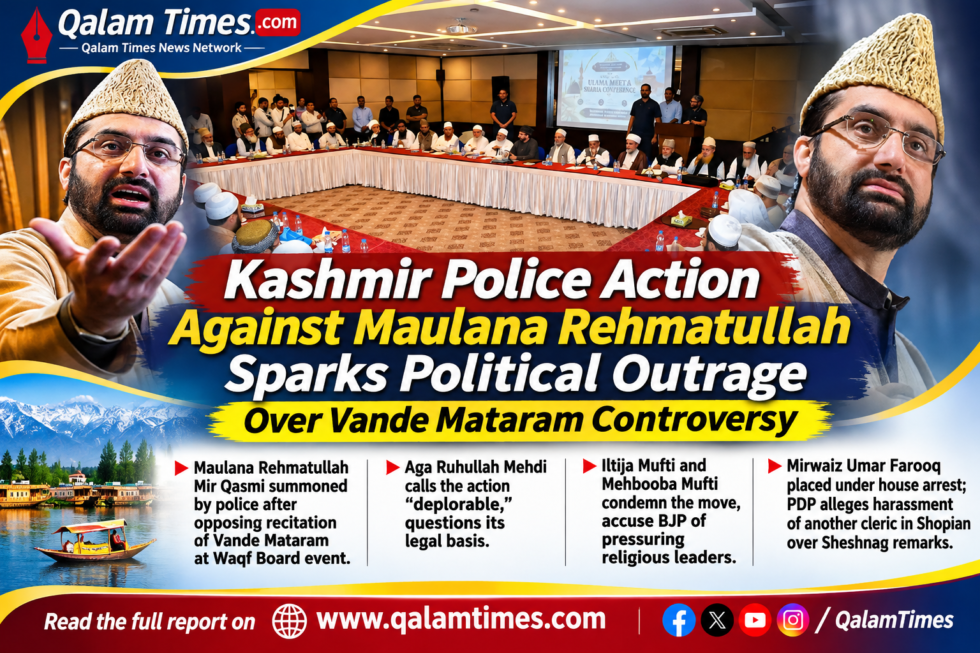
The Kashmir Police Action against prominent Islamic scholar Maulana Rehmatullah Mir Qasmi has triggered strong political reactions across Jammu and Kashmir, with several leaders questioning the decision to summon him following his criticism of the recitation of Vande Mataram at an official Waqf Board functi on. The Kashmir Police Action has become a contentious issue after the Maulana was reportedly called for questioning on November 26. His summoning came after the Mutahida Majlis-e-Ulama (MMU), a representative body bringing together religious organisations and institutions from different schools of Islamic thought, publicly objected to the recitation of the national song during a Waqf Board programme in Srinagar. The controversy originated at the Jammu and Kashmir Waqf Board’s first Waqf Day celebration, held on November 23. During the programme, all six stanzas of Vande Mataram were reportedly recited in the presence of government officials and religious representatives. The development prompted objections from several Muslim religious figures, including Maulana Rehmatullah Mir Qasmi of Darul Uloom Raheemiyyah. The cleric reportedly maintained that participating in the recitation conflicted with the Islamic principle of Tawheed, which emphasises the absolute oneness of God. The MMU subsequently condemned what it described as the imposition of Vande Mataram at a religiously associated Waqf function, bringing the issue into the centre of an increasingly heated political and religious debate.
Kashmir Police Action : Aga Ruhullah Mehdi and Iltija Mufti Condemn Police Action
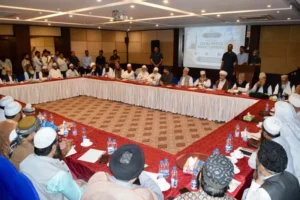
The decision to summon Maulana Qasmi drew sharp criticism from political leaders, including PDP leader Iltija Mufti and former Member of Parliament Aga Ruhullah Mehdi. Iltija Mufti questioned the rationale behind the police action, describing the treatment of the elderly religious scholar as shameful. In a post on X, she expressed concern that a respected religious figure was being subjected to police questioning simply for voicing his objections to the recitation of Vande Mataram at a Waqf Board programme. Former MP Aga Ruhullah Mehdi also strongly criticised the move and demanded an explanation from the authorities. Calling the summoning of Maulana Qasmi deplorable, Mehdi said that targeting a respected religious preacher following the MMU’s condemnation of the incident crossed an unacceptable line. He further questioned the legal basis of the police inquiry, asking the authorities to clarify under which law the cleric had been summoned. His remarks have added to the growing demand among sections of the political leadership for greater transparency regarding the police action and the treatment of religious representatives.
Kashmir Police Action : Mirwaiz Umar Farooq Placed Under House Arrest
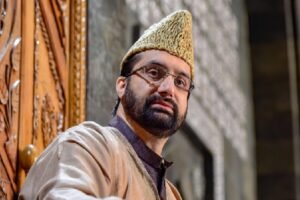
The controversy took another turn on November 27 when Mirwaiz Umar Farooq, chairman of the Hurriyat Conference and Kashmir’s chief cleric, was reportedly placed under house arrest. The restrictions prevented him from attending Friday congregational prayers at the historic Jama Masjid in Srinagar. In a statement, Mirwaiz said he had anticipated the restrictions because of his recent public comments on two sensitive issues: concerns surrounding the environmental condition of the Sheshnag region and the recitation of Vande Mataram at the Waqf Board’s religious function. He had earlier raised concerns about the ecological damage reportedly facing the environmentally fragile Sheshnag area, following the circulation of videos showing developments in the region. Mirwaiz suggested that his criticism of these issues had made him expect restrictions on his religious and public activities. His inability to attend Friday prayers at Jama Masjid has once again drawn attention to the restrictions imposed on religious and political figures in the Valley.
Kashmir Police Action : Mehbooba Mufti Alleges Harassment of Another Religious Leader
Former Jammu and Kashmir Chief Minister and PDP president Mehbooba Mufti also joined the criticism, raising a separate allegation involving Shopian Police. In a statement posted on X, Mufti alleged that police personnel had vandalised the residence of Mirwaiz Maulvi Rizwan in Shopian and verbally abused him because he had spoken against the destruction of Sheshnag in the name of development. She linked the alleged incident to the action against Maulana Rehmatullah Mir Qasmi, arguing that religious leaders who expressed disagreement with official positions were increasingly facing intimidation. Mufti said that Maulana Qasmi had first been summoned for objecting to Vande Mataram being recited at a Waqf event, and that the alleged treatment of Maulvi Rizwan represented another disturbing development. She also accused the BJP of attempting to bring Muslim religious leaders and scholars under its political influence. According to Mufti, religious figures who refused to support the party’s political position were being subjected to pressure and harassment, while the administration in Jammu and Kashmir was failing to respond adequately. These allegations have added another layer to the controversy, although the claims concerning the alleged vandalism and police conduct have not been independently established in the information available for this report.
Kashmir Police Action : Religious Freedom, Political Expression and Administrative Accountability
The developments have reopened a wider debate in Jammu and Kashmir over the relationship between religious expression, political criticism and the functioning of law enforcement agencies. The objections raised by Maulana Qasmi and the MMU concern the religious interpretation of participation in Vande Mataram. Their position reflects a theological objection based on the Islamic concept of Tawheed. At the same time, political leaders have questioned whether expressing such objections should lead to police questioning or other administrative restrictions. The controversy has also brought the role of the Waqf Board under scrutiny, particularly regarding the nature of programmes organised by an institution associated with Muslim religious and charitable affairs. The restrictions reportedly imposed on Mirwaiz Umar Farooq and the allegations raised by Mehbooba Mufti concerning the treatment of Maulvi Rizwan have further intensified concerns among opposition leaders. For now, the central questions remain unanswered: What was the legal basis for summoning Maulana Rehmatullah Mir Qasmi? What were the circumstances surrounding the reported restrictions on Mirwaiz Umar Farooq? And will the authorities respond to the allegations made by opposition leaders? As political reactions continue to emerge, the developments have placed Jammu and Kashmir’s administration under renewed scrutiny over its handling of religious sensitivities, dissenting voices and the rights of religious representatives.