



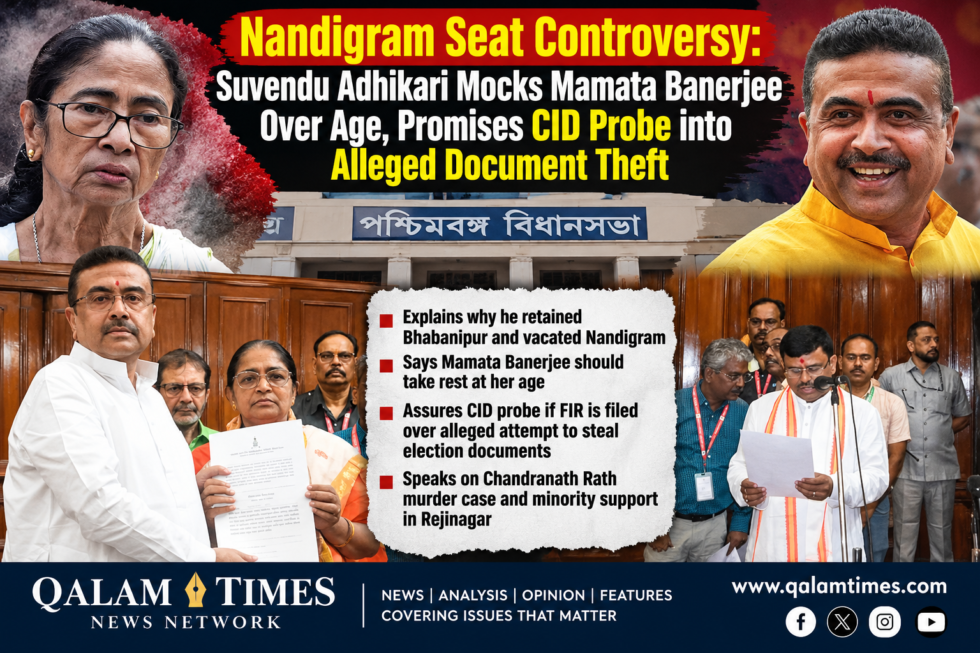
Nandigram Seat Controversy intensifies as Suvendu Adhikari explains why he retained Bhabanipur, takes a swipe at Mamata Banerjee’s age and promises a CID probe into an alleged attempt to steal election documents.
Qalam Times News Network
Kolkata, October 28, 2026
The Nandigram Seat Controversy has taken a fresh political turn after West Bengal Chief Minister Suvendu Adhikari explained why he chose to retain Bhabanipur and vacate Nandigram following the 2026 Assembly elections. Taking a sharp dig at former chief minister and Trinamool Congress leader Mamata Banerjee, Adhikari suggested that she should step back from electoral politics and take rest at her age. He also assured Trinamool dissident leader Ritabrata Bandyopadhyay that an investigation by the Criminal Investigation Department (CID) would be considered if a formal police complaint was lodged over an alleged attempt to steal important documents.
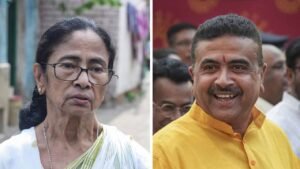
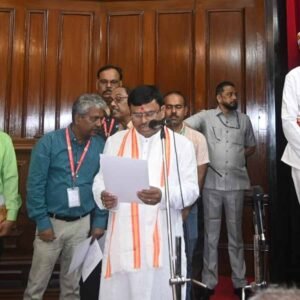
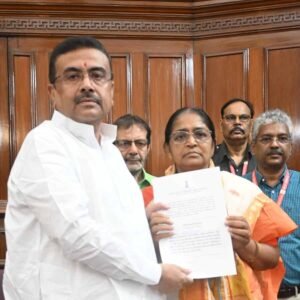
The Nandigram Seat Controversy featured prominently in Adhikari’s remarks at the West Bengal Assembly on Wednesday, where BJP legislators Hasirani Rath and Shakharav Sarkar took their oaths as elected representatives from Nandigram and Rejinagar, respectively. During his address, Adhikari discussed several political and administrative issues, including the murder of his former aide Chandranath Rath, the circumstances behind his decision to give up Nandigram, and allegations of an attempted theft of election-related documents. His comments also included a claim that minority voters had supported the BJP in Rejinagar, along with a promise that his government’s major development initiatives were still to come.
Why Suvendu Adhikari Chose Bhabanipur Over Nandigram
Adhikari had won the Nandigram Assembly seat in previous elections. In 2026, however, he contested from both Nandigram and Bhabanipur, defeating Mamata Banerjee in Bhabanipur. After the results, he retained Bhabanipur and vacated Nandigram, where the BJP subsequently fielded Hasirani Rath, the mother of his slain aide Chandranath Rath. Explaining his decision in the Assembly, Adhikari said he did not want to leave Bhabanipur open for Banerjee to contest again. According to his account, vacating Bhabanipur could have given the former chief minister another opportunity to enter the electoral contest there. He argued that keeping the Bhabanipur seat prevented such a possibility. Adhikari then turned his attention to Banerjee’s age, saying that at nearly 75, she should consider resting rather than continuing to contest elections. His remarks were a pointed political attack on his former rival, who had lost to him in Bhabanipur. The comments are likely to intensify the political rivalry between the BJP and the Trinamool Congress. While Adhikari presented his decision as a deliberate electoral strategy, his remarks about Banerjee’s age added a personal dimension to the dispute.
During the same Assembly address, Adhikari also spoke about his government’s development agenda. Describing the work undertaken during the first six months as only the beginning, he compared the progress to tea and biscuits served in the morning, adding that breakfast and lunch were still to come. The statement was intended to convey that his administration had much more planned for the state. Adhikari also claimed that minority voters, whom he said had previously been kept at a distance, had voted for the BJP in Rejinagar. The statement reflects the BJP’s effort to present its electoral performance in the constituency as evidence of a broader political shift. The extent and significance of that shift would need to be assessed against constituency-level voting data.
Ritabrata Bandyopadhyay’s Allegation of an Attempt to Steal Documents
Another major issue raised in the Assembly concerned an allegation by Ritabrata Bandyopadhyay, a dissident Trinamool leader, that individuals had attempted to seize important documents being transported by his camp.
Bandyopadhyay had published a lengthy social media post early on Monday describing the alleged incident. According to his account, an affidavit associated with the Kalighat faction had reached Delhi by chartered aircraft on Sunday evening, while his own camp lacked the financial resources to use the same method. He said his documents were therefore being transported by road.
Bandyopadhyay alleged that a truck carrying the documents was attacked at around 3:30 a.m. on Monday and that the people involved attempted to take the papers. He suspected that individuals aligned with the Mamata Banerjee-led Kalighat faction were behind the incident. These remain allegations, and the claims would need to be established through an impartial investigation.
Responding to the matter in the Assembly, Adhikari urged the rival groups to resolve their internal disputes without allowing law and order to deteriorate. Referring to Bandyopadhyay’s social media post, he said that if a formal First Information Report (FIR) was filed, the state government would refer the matter to the CID for investigation.
After the Assembly proceedings, Bandyopadhyay said that the Democratic Trinamool Congress would approach the West Bengal Police with a complaint. The next steps will depend on the formal complaint and the response of the investigating authorities.
Adhikari’s assurance places the focus on whether a formal investigation will be initiated and what evidence can be established about the alleged attack, the documents involved and the identity of those responsible. The allegations should not be treated as proven unless supported by evidence.
Chandranath Rath Murder Case: Adhikari Seeks Answers About the Alleged Contract Killing
The murder of Chandranath Rath, Adhikari’s former aide, was another significant subject in the Assembly. Rath was killed shortly after the declaration of the election results. The BJP later fielded his mother, Hasirani Rath, from the Nandigram seat vacated by Adhikari. She won the election, and Adhikari thanked the people of Nandigram for supporting her.
Turning to the investigation, Adhikari referred to his earlier allegation that a contract worth ₹2 crore had been offered to arrange Rath’s murder. He said that seven people had been arrested by the Central Bureau of Investigation (CBI), claiming that the alleged shooters and contract killers were among those taken into custody.
Adhikari argued that the remaining question was who had allegedly financed the killing and where the money had originated. He mentioned Kalighat, Camac Street and Diamond Harbour while questioning the possible source of the alleged payment.
These remarks represent Adhikari’s allegations and should not be taken as proof that any particular person or political group was involved. Responsibility for establishing the facts rests with the investigating agency and, ultimately, the judicial process. Any claims about the alleged payment, its source or the involvement of others must be supported by evidence.
The murder case remains politically sensitive because of Rath’s association with Adhikari and its timing shortly after the election results. The progress of the investigation and the evidence presented by the CBI will be crucial in determining what happened and whether further arrests or charges are warranted.
The Assembly proceedings therefore brought together several issues at the centre of West Bengal’s post-election political climate: the rivalry between Adhikari and Banerjee, the strategic decision to retain Bhabanipur, allegations of an attempted theft of election documents, and the continuing investigation into Chandranath Rath’s murder.
Adhikari’s remarks signal that the state’s political contest is continuing beyond polling day. Whether the document-theft allegation leads to a CID investigation and what further findings emerge in the murder case will now depend on formal complaints, evidence and the actions of the relevant authorities.