




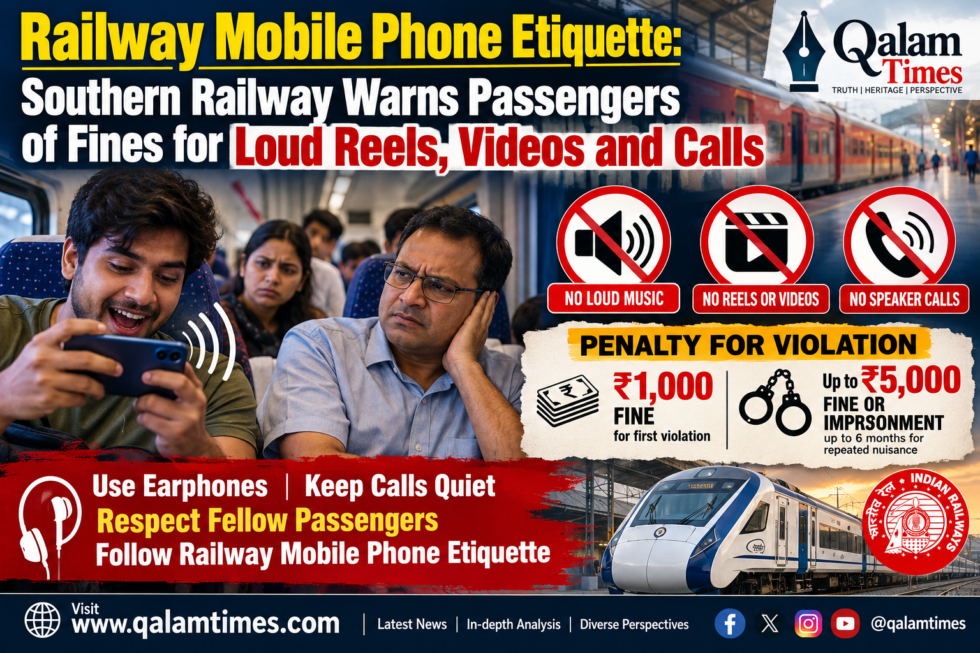
Railway Mobile Phone Etiquette is back in focus as Southern Railway warns passengers against loud music, videos and speakerphone calls, with possible penalties for repeated nuisance.
Qalam Times News Network
Kolkata, 19 October 2026
Southern Railway Steps Up Awareness Against Noise in Trains
Railway Mobile Phone Etiquette has returned to the spotlight after Southern Railway renewed its efforts to discourage passengers from playing music, watching social media reels or making phone calls on speaker mode at railway stations and inside trains. The initiative aims to protect the comfort of fellow travellers and promote responsible behaviour, particularly in air-conditioned coaches and other enclosed spaces where loud audio can disturb an entire compartment.

The issue of railway mobile phone etiquette has become increasingly relevant as smartphones and short-video platforms have become part of everyday travel. Although many passengers use their phones to pass the time during long journeys, playing videos, films, television programmes or music at high volume without headphones can create unnecessary inconvenience for others. Southern Railway has reportedly instructed its divisions to raise awareness through public announcements and notices, while railway personnel have been asked to address complaints and take appropriate action against those responsible for persistent disturbances.
According to reports in the media, the railway administration has emphasised that passengers should use earphones or headphones when listening to audio, keep telephone conversations at a reasonable volume and avoid unnecessarily loud or prolonged calls. The instructions are intended to encourage cooperation rather than allow disputes between passengers to escalate.
Media reports concerning Southern Railway’s initiative have referred to a possible fine of ₹1,000 for violations, with more serious or repeated nuisance potentially attracting a fine of up to ₹5,000 and imprisonment of up to six months. Some reports have also mentioned the possibility of removing a disruptive passenger from a train.
However, these figures should not be interpreted as an automatic penalty for every instance of speakerphone use. The precise legal provision, the circumstances of the complaint and the authority under which action is taken matter. Passengers should therefore distinguish between a railway advisory, an offence established under applicable rules and the punishment legally prescribed for that offence. The administration’s stated objective is to prevent behaviour that interferes with other passengers’ journeys. Railway staff may be approached when a person continues to create a disturbance despite being asked to stop. Any formal action must be taken under the applicable rules and procedures.
A Long-Standing Problem Returns to the Fore
The current initiative is not the first attempt by railway authorities to address noise caused by mobile phones. Reports have referred to an earlier Railway Board directive dated 23 July 2012, which called for passengers to be discouraged from speaking loudly on mobile phones and using excessively loud ringtones.
That earlier guidance recognised that noise can be particularly troublesome in air-conditioned coaches, where passengers may expect a relatively quiet environment. Railway authorities have again stressed the importance of public awareness, including announcements at stations and communication in Hindi and English, so that travellers understand the expected standards of behaviour. The renewed attention also reflects a broader challenge for India’s railway network: maintaining a comfortable shared environment for people travelling together in crowded and often enclosed spaces. Rules and advisories can help establish expectations, but their effectiveness depends on consistent communication, appropriate enforcement and passengers’ willingness to respect one another.
Passengers Describe Everyday Railway Travel Disruptions
For many regular commuters, the problem is not limited to long-distance trains. Loud music, reels and phone conversations are also reported on suburban services, where passengers may be travelling to work, studying, reading or trying to rest. Ujjal Chakraborty, a passenger on the Bangaon railway route, described an incident in which he was reading a book while another passenger played music loudly on a mobile phone. After listening for some time, Chakraborty asked the man to use headphones. According to his account, the other passenger responded by claiming that the act of reading was itself disturbing him. The exchange illustrates how minor disagreements over personal behaviour can turn into uncomfortable confrontations when passengers do not recognise their shared responsibility in a public space. Debadatta Roy, who travels on the Bandel–Howrah route, also described encountering passengers who play music or watch reels at high volume. She said that requests to reduce the volume are not always successful and may even prompt dismissive responses. Such experiences can leave fellow travellers with an uncomfortable choice: speak up and risk an argument, or tolerate the noise for the remainder of the journey. For people who travel daily, repeated disturbances can make an otherwise routine commute considerably less pleasant.
Similar Complaints Reported on the Kolkata Metro Railway
The concern extends beyond conventional railway services. Some commuters have also reported loud mobile-phone audio on the Kolkata Metro, where crowded carriages can make the experience particularly unpleasant. Saikat Das, a resident of Tollygunge who travels by metro to his workplace in Chandni, recounted an incident in which a fellow passenger was watching reels at high volume. He said he objected to the noise but felt that his complaint was not well received. Such accounts highlight the difference between an official rule and the everyday experience of enforcing acceptable behaviour. Even where passengers are encouraged to avoid disturbing others, a lack of cooperation can make informal requests ineffective. The position described in the reports also differs between railway zones and services. A South Eastern Railway spokesperson, Omprakash Charan, reportedly said that existing procedures allow staff to respond when one passenger’s conduct inconveniences another, and that removal from a train may be possible in appropriate circumstances. Complaints can be brought to the attention of ticket-checking personnel or the Railway Protection Force (RPF), who can assess the situation.
Meanwhile, a statement attributed to an Eastern Railway spokesperson indicated that no separate directive of this kind had been issued by the Kolkata Metro at the time covered by the report. This distinction is important: an initiative announced by one railway zone should not automatically be treated as a uniform, newly introduced rule across every railway service in the country.
How Passengers Can Report Loud Audio or Repeated Disturbances
Passengers who face persistent noise during a journey are encouraged to seek assistance from railway personnel instead of allowing an argument to develop. They can take the following steps:
- Politely ask the passenger to lower the volume or use headphones, if it is safe and appropriate to do so.
- Inform the travelling ticket examiner (TTE), coach staff or other available railway personnel if the disturbance continues.
- Contact the Railway Protection Force when the situation requires assistance from security personnel.
- Submit a complaint through the official RailMadad service and provide relevant journey details so that the issue can be assessed.
Passengers should avoid confrontation if they feel threatened or believe the situation could escalate. Reporting a disturbance through the appropriate channel is generally preferable to engaging in a prolonged dispute.
Passengers have broadly welcomed efforts to address unnecessary noise, but many believe that awareness campaigns alone may not resolve the problem. A notice or public announcement can explain the expected standards of behaviour, yet its impact may remain limited if complaints are ignored or rules are applied inconsistently. Railway authorities face the practical challenge of balancing individual convenience with the comfort of everyone sharing a coach. A passenger may consider a video or phone call harmless, but the same sound can become intrusive when dozens of people are travelling together, particularly at night or during a long journey. The most effective approach would combine clear public guidance, accessible complaint mechanisms and proportionate action where the applicable rules have been violated. It would also help to make the scope of the rules and the legal basis for any penalty clear to passengers.
Ultimately, travelling by train involves sharing limited space with people from different backgrounds and with different needs. Using headphones, keeping calls brief and speaking quietly are simple measures that can prevent unnecessary conflict. Southern Railway’s renewed focus has brought the issue back into public discussion, while commuters in West Bengal and elsewhere continue to describe similar experiences. Whether further instructions will be introduced across other railway zones and metro services remains a separate question that requires confirmation from the respective authorities. Until then, the central message is straightforward: passengers should be able to enjoy their journey without being subjected to someone else’s loud mobile-phone audio. Respect for fellow travellers, supported by clear rules and consistent enforcement, remains essential to a more comfortable railway experience.