



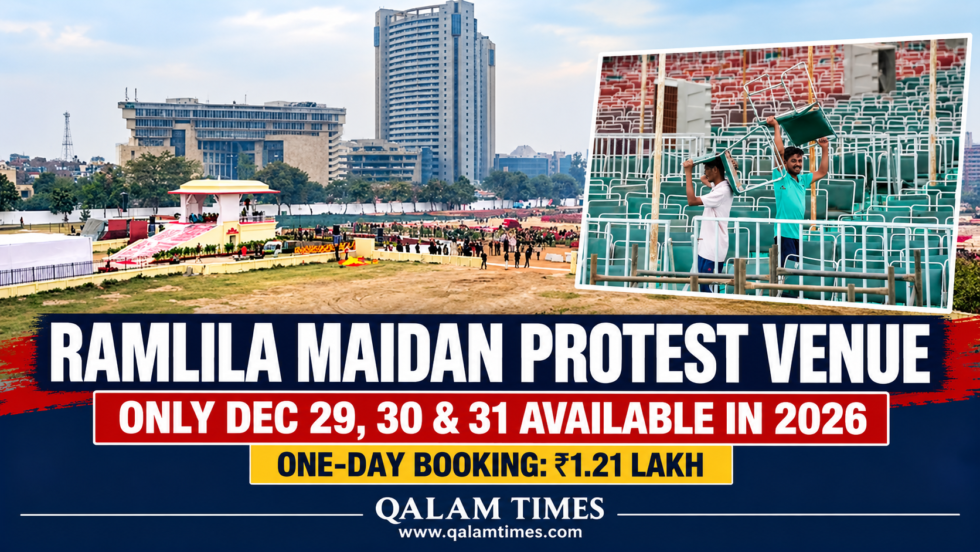
Ramlila Maidan Protest Venue faces limited bookings, with only three dates reportedly available in 2026 and a one-day initial cost of Rs 1.21 lakh.
By Qalam Times News Network
New Delhi | October 13, 2026
NEW DELHI: The Ramlila Maidan Protest Venue has come under scrutiny after Delhi Police designated it as one of three new locations for demonstrations in the national capital, while booking records reportedly show that only December 29, 30 and 31 are currently available for the remainder of 2026. The development has raised questions about the practical accessibility of the newly designated protest sites, particularly for organisations seeking to hold large public demonstrations.
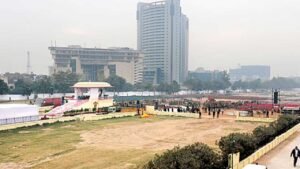
The Ramlila Maidan Protest Venue can accommodate approximately 50,000 people across its 12-acre area. However, reserving the entire ground for a day requires an initial payment of Rs 1.21 lakh, including the booking fee, refundable security deposit and applicable taxes, according to a report by the Press Trust of India (PTI). The combination of limited availability and substantial upfront costs could create difficulties for organisations, community groups and political parties planning public gatherings.
Three New Protest Sites Announced as Jantar Mantar Loses Designated Status
The controversy follows an October 11 order issued by Delhi Police Commissioner Anurag Kumar, under which Jantar Mantar was removed from its status as a designated protest venue. The police identified three alternative locations for demonstrations: Ramlila Maidan in central Delhi, Burari Ground in north Delhi and CBD Ground in east Delhi.
According to the reported police decision, a revised standard operating procedure governing demonstrations at these locations will be issued separately. The revised guidelines are expected to establish the arrangements for organising protests at the newly designated sites.
The decision has drawn attention to whether the alternative locations will offer sufficient space, convenient access and affordable arrangements for citizens wishing to exercise their democratic right to peaceful assembly. The availability of a designated venue is particularly important for organisations planning demonstrations that require advance preparation, transport arrangements and coordination with the authorities.
Booking Charges and Limited Space Raise Accessibility Concerns
Officials said the Municipal Corporation of Delhi (MCD) manages bookings for Ramlila Maidan through its horticulture department. The reported daily booking fee is Rs 50,000, while applicants must also deposit Rs 55,000 as refundable security. After taxes and other applicable charges are included, the initial expenditure reaches approximately Rs 1.21 lakh for a single day.
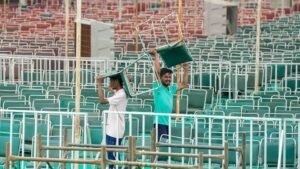
Applicants must also obtain a no-objection certificate (NOC) from Delhi Police before the civic body grants permission to use the ground.
A limited section of the premises may be available without charge for small protests and gatherings. However, civic officials indicated that this area can accommodate only around 150 people, making it unsuitable for large demonstrations.
The financial requirements could place a considerable burden on smaller organisations, resident welfare groups, civil society bodies and campaigners operating with limited resources. Protesters have also pointed out that Jantar Mantar did not require comparable booking payments under the previous arrangement.
An official cited in the report said that allowing the ground to be used for protests without charging the usual fee could mean a loss of at least Rs 50,000 or more per day in potential civic revenue.
The issue therefore presents a practical question for the authorities: how can a public ground be made accessible for demonstrations while accounting for maintenance expenses, security arrangements and other civic responsibilities?
AAP Questions Whether Ramlila Maidan Is Actually Available
The designation of Ramlila Maidan as a protest location has also attracted criticism from the Aam Aadmi Party (AAP). Saurabh Bharadwaj, the party’s Delhi president, questioned the government’s decision, arguing that existing bookings could make it difficult to organise demonstrations at the ground.
In a post on X, Bharadwaj alleged that the government had misled citizens by announcing a venue that was already occupied by two Ramlila programmes. He questioned how protests could be organised under these circumstances and warned that overlapping events could create confusion.
Civic officials said the ground had already been reserved for various programmes and festive activities. With major occasions, including Dussehra and Diwali, falling within the festive season, the existing schedule has reportedly affected the availability of the premises.
The dispute has brought the distinction between officially designating a location and ensuring its actual availability into focus. Although Ramlila Maidan has been named as a protest site, its existing commitments could restrict the dates on which demonstrations can take place.
For groups seeking to organise protests before the end of the year, the reported availability of just three dates could make advance planning especially difficult.
Traffic Congestion Adds to Administrative Challenges
Apart from booking and scheduling issues, officials have expressed concerns about the impact of large demonstrations on traffic in the surrounding area.
Ramlila Maidan is situated in a busy commercial district near three hospitals and the headquarters of the Municipal Corporation of Delhi. Large gatherings at the venue have frequently placed pressure on nearby roads, requiring the police to introduce traffic restrictions and diversions.
During major events, Asaf Ali Road, which normally carries traffic in both directions, is often converted into a one-way route. Traffic moving towards Deshbandhu Gupta Road may also be diverted to the parallel Jawaharlal Nehru Marg.
Officials have noted that both roads already experience congestion and are affected by encroachments. A large protest or rally could therefore worsen traffic conditions, potentially affecting commuters, businesses and people travelling to nearby hospitals.
One official recalled a BJP rally held at Ramlila Maidan in 2014 that reportedly resulted in a traffic jam extending as far as ITO, approximately four kilometres away. The disruption was particularly notable because the rally took place on a Sunday, when traffic would ordinarily be relatively lighter.
These concerns underline the need for effective crowd management, traffic planning and coordination between the police, civic authorities and event organisers before large gatherings are permitted.
Ramlila Maidan’s Journey from a Pond to a Historic Political Landmark
Despite the current debate over its use, Ramlila Maidan has played a significant role in Delhi’s cultural and political history.
According to officials, the area was originally a pond before it was filled and levelled in 1930 to provide space for Ramlila performances. The tradition began in 1932 and continues to this day, giving the ground its enduring name.
Following Independence, the area underwent further development in 1951, when it was used to support livelihood opportunities for refugees who had arrived from Pakistan. Over time, the ground developed into one of the capital’s prominent venues for political rallies, public meetings and mass gatherings.
In 1952, Syama Prasad Mookerjee launched a satyagraha at the site demanding the complete integration of Jammu and Kashmir into the Indian Union. Former Prime Minister Jawaharlal Nehru subsequently addressed large public meetings there in 1956 and 1957.
A permanent stage was constructed in 1962 for a public event organised in honour of Queen Elizabeth II during her visit to India.
The ground continued to host major political and public events in the following decades. Indira Gandhi addressed a rally there after India’s victory over Pakistan in 1971. On November 26, 1974, a public meeting was also held in honour of Soviet leader Leonid Brezhnev.
One of the most politically significant gatherings at the venue took place on June 25, 1975, when socialist leader Jayaprakash Narayan and former Prime Minister Atal Bihari Vajpayee addressed a rally on the day the Emergency was declared in India.
In more recent years, Ramlila Maidan has remained an important location for political mobilisation. Arvind Kejriwal took the oath of office as Delhi Chief Minister at the ground in 2013, 2015 and 2020.
Its history reflects the venue’s longstanding association with public expression, political movements and large-scale civic gatherings.
Availability Versus Accessibility: The Central Question
The designation of Ramlila Maidan, Burari Ground and CBD Ground as alternative protest sites is a significant change in Delhi’s arrangements for public demonstrations. However, the effectiveness of this decision will depend on more than the official notification.
The reported booking restrictions at Ramlila Maidan, the upfront payment of Rs 1.21 lakh for a full day’s use, the limited free area and the traffic-management challenges raise questions about how accessible the new arrangements will be in practice.
For citizens and organisations planning peaceful demonstrations, access to an appropriate venue involves several considerations: sufficient capacity, reasonable costs, available dates and clear procedures for obtaining permission.
As Delhi Police prepares to issue revised standard operating procedures for the three locations, the way these concerns are addressed will be important in determining whether the newly designated venues can accommodate public demonstrations effectively while maintaining public order.
For now, Ramlila Maidan remains a prominent example of the challenges involved in balancing the management of public spaces with the need to facilitate peaceful assembly in the national capital.