



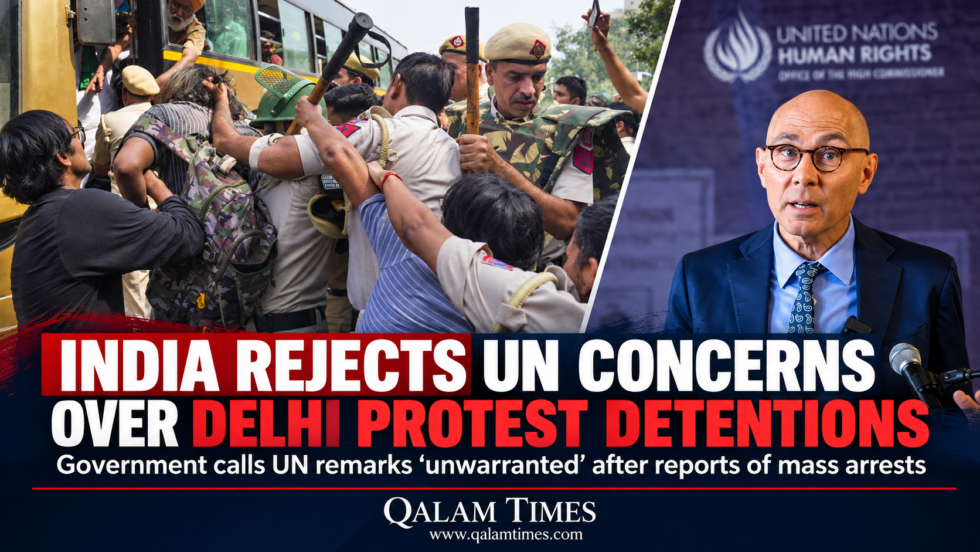
Delhi Protest Detentions: India rejects UN concerns over mass detentions in Delhi, defends constitutional rights and responds to criticism of police action.
Qalam Times News Network
New Delhi | October 11, 2026
India has rejected the United Nations’ concerns over the Delhi Protest Detentions, describing the international body’s remarks as “unwarranted” interference in the country’s internal affairs. The response came after the UN Human Rights Office expressed concern over reports of mass detentions during a protest in the national capital on Saturday.
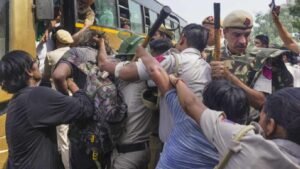
The issue of Delhi Protest Detentions has drawn international attention following reports that more than 7,000 people were detained by police during demonstrations organised by the Cockroach Janata Party (CJP), as identified in the source report. Police action reportedly began on Friday night and continued throughout Saturday, with most of those detained released later that night.
India Defends Constitutional Rights, Questions UN’s Response
In its official response, the Indian government maintained that the country’s Constitution guarantees citizens the right to peaceful protest and that the authorities operate within the framework of the law. New Delhi also emphasised the independence of the judiciary and the media, arguing that India’s democratic institutions provide avenues for addressing grievances and challenging official actions.
The government’s statement said that India had taken note of the UN’s comments concerning Saturday’s developments in Delhi. It stressed that the right to demonstrate, like other constitutional freedoms, is subject to reasonable restrictions intended to maintain public order.
“India is the world’s largest democracy,” the government stated, adding that citizens can exercise their rights within the limits established by law. It also maintained that Indian courts remain accessible to anyone seeking legal remedies over alleged violations or grievances.
However, New Delhi strongly objected to the UN Human Rights Office’s intervention, saying that the organisation had expressed its concerns in the wrong context. The government characterised the comments as an unwarranted intrusion into India’s domestic affairs.
India also urged the United Nations to apply its principles of neutrality and impartiality consistently. According to the government, the international body should pay equal attention to protests and related developments in other parts of the world rather than focusing on events in India.
UN Raises Alarm Over Reported Mass Detentions
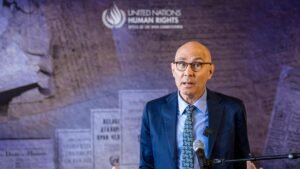
The controversy began after the UN Human Rights Office voiced concern over reports of large-scale detentions during the demonstrations in Delhi. On Saturday, the office’s spokesperson, Thameen Al-Kheetan, expressed concern over reports involving the detention of protesters, political leaders, civil society representatives, lawyers and journalists.
The UN’s statement brought international attention to the police response, which reportedly included repeated confrontations between demonstrators and security personnel at different locations across Delhi. The developments were also covered by international media outlets.
The UN Human Rights Office’s concerns focused on reports of mass detentions and their implications for the exercise of fundamental freedoms, including peaceful assembly and freedom of expression. India’s response, by contrast, emphasised its constitutional framework, the role of law enforcement and the availability of judicial remedies.
The exchange has highlighted differing positions on how the handling of public demonstrations should be assessed. While the UN raised concerns over the reported scale of detentions, the Indian government defended the legal and institutional framework governing public order and peaceful protest.
Protesters Demand Chief Election Commissioner’s Resignation in Delhi
According to the source report, the demonstrations were organised by the CJP to demand the resignation of Chief Election Commissioner Gyanesh Kumar and the withdrawal of the Special Intensive Revision (SIR) of electoral rolls.
The party had announced a protest at Jantar Mantar in Delhi on Saturday. However, Delhi Police reportedly refused permission for the proposed gathering and had prepared in advance to prevent the demonstration from proceeding as planned.
Police and protesters subsequently faced off at various locations across the capital. The resulting confrontations and detentions became the central focus of the controversy, prompting the UN Human Rights Office to issue its statement.
The demands concerning the electoral roll revision and the Election Commission formed the political backdrop to the demonstrations. The reported detentions, meanwhile, raised questions about the balance between maintaining public order and protecting citizens’ rights to peaceful assembly.
Democratic Freedoms and Public Order in Focus
The disagreement between India and the United Nations has brought renewed attention to the relationship between public order, democratic freedoms and international human rights scrutiny.
India has argued that its Constitution, independent judiciary and legal remedies provide adequate safeguards for citizens. The UN Human Rights Office, meanwhile, has expressed concern over reports of mass detentions and the range of individuals reportedly affected by the police action.
The central issue remains the circumstances surrounding the detentions, the legal grounds for the police action and the extent to which the rights of those participating in the demonstrations were protected.
As the exchange continues to attract attention, further clarification of the reported arrests, the legal basis for the police measures and the treatment of detained individuals would help establish a fuller picture of the events.