



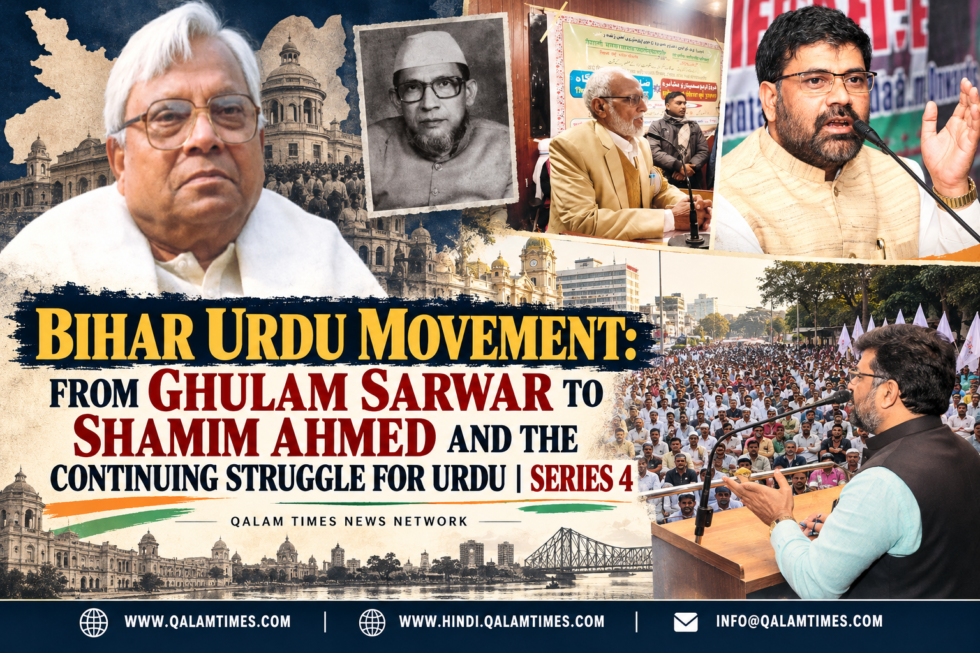
The Bihar Urdu Movement traces Ghulam Sarwar’s campaign for Urdu recognition and connects Bihar’s language struggle with Shamim Ahmed and the continuing Urdu Movement in Bengal.
Qalam Times News Network
Kolkata | October 11, 2026
The Bihar Urdu Movement represents one of the most important chapters in the struggle to secure Urdu’s educational, cultural and official recognition in independent India. Its history is not merely a record of demands made by writers, teachers and political leaders. It is also a story of public mobilisation, newspaper journalism, political negotiations, hunger strikes and the determination of people who believed that a language could not survive on literary heritage alone. From the uncompromising advocacy of Ghulam Sarwar to the educational activism of Shahid Mahmood Puri, Bihar produced generations of campaigners who sought to turn Urdu’s cultural importance into practical rights. Their experience offers a valuable perspective on the continuing efforts associated with Shamim Ahmed and the Urdu Movement in West Bengal.
The Bihar Urdu Movement also demonstrates how a language campaign can develop beyond literary institutions and become a public question involving education, administration, political representation and collective identity. Bihar’s experience was shaped by its own historical circumstances, personalities and political struggles. West Bengal’s Urdu movement has developed within a different linguistic and social environment. Yet the two histories meet around a common concern: ensuring that Urdu’s place in Indian society is recognised, documented and carried forward to future generations.
Ghulam Sarwar: The Journalist Who Turned Urdu into a Public Cause
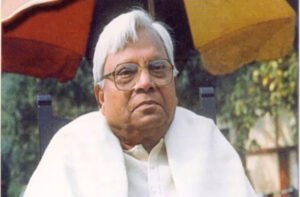
Any detailed account of the Urdu Movement in Bihar must begin with Haji Ghulam Sarwar, remembered for his journalism, public speaking, political engagement and determined advocacy of Urdu.
Born on January 10, 1926, in Begusarai, Ghulam Sarwar belonged to a generation that regarded journalism as more than a profession. For him, the written word could challenge authority, mobilise public opinion and bring neglected questions into the political arena.
His contribution to Urdu was closely connected with his work as a journalist and politician. He understood that a language needed an active public sphere in which its readers could discuss their concerns, question decisions and organise around common objectives.
In 1952, he launched the Urdu newspaper Sangam. The publication became closely associated with his commitment to Urdu and his wider social and political engagement. According to the account supplied for this series, its editorials attracted considerable attention among readers, many of whom looked to his writing for commentary on the pressing issues of the day.
The importance of Sangam lay not simply in the publication of news. It provided a platform through which Urdu could remain connected with public debate.
For Ghulam Sarwar, journalism and language activism reinforced each other. The newspaper could explain the demands of the movement, question indifference towards Urdu and encourage readers to see language rights as a matter of public concern.
This was particularly significant in a period when the political position of Urdu was being reconsidered across several parts of India following Partition.
From Newspaper Columns to Streets and Villages
Ghulam Sarwar’s contribution was not confined to the newsroom. The supplied account describes his extensive public campaigning, including meetings and conferences held in different parts of Bihar. He travelled to villages and neighbourhoods, sought public support and worked to transform concern for Urdu into an organised movement. Such mobilisation was essential because the recognition of a language depends not only on the decisions of governments but also on the willingness of citizens to demand that their rights be respected.
A newspaper can communicate an argument, but a public movement gives that argument collective visibility. Meetings allow people to exchange experiences, conferences bring activists together, and demonstrations demonstrate that a demand extends beyond a small circle of intellectuals.
Ghulam Sarwar used these methods to make Urdu a public issue. The campaign sought recognition for Urdu as Bihar’s second official language. Its demands concerned the standing of the language in government and public administration, rather than its literary reputation alone.
The struggle also involved sacrifice. The supplied account records that Ghulam Sarwar and his supporters resorted to hunger strikes during the campaign. Their actions reflected the frustration of activists who believed that Urdu’s historical and cultural significance had not received adequate institutional recognition.
The movement’s significance therefore lies in the combination of journalism, political advocacy and grassroots organisation.
Ghulam Sarwar’s career illustrates how these different forms of activity can support one another in a campaign for linguistic rights.
Bihar Urdu Movement : The 1967 Election and the Politics of Urdu Recognition
One of the most notable episodes in Bihar’s Urdu movement came during the 1967 elections.
According to the account provided for this series, Ghulam Sarwar advanced a political slogan linking electoral support with the recognition of Urdu as a second official language in Bihar. The appeal was directed at voters who wanted the question of Urdu to receive serious attention from political parties and candidates. The significance of this intervention extended beyond the immediate electoral contest. It placed Urdu on the political agenda and challenged candidates to address a question that mattered to a substantial section of the population. Rather than leaving the language issue to literary organisations or cultural gatherings, the campaign sought to make it part of public accountability. The strategy also reflected a wider understanding of democratic politics: language communities could use elections to communicate their demands and press representatives to respond to them. However, a political promise and its implementation are not the same thing. A campaign may secure public attention, but translating that attention into legislation, administrative arrangements, educational facilities and sustained government action requires further work. This distinction remains important when assessing the history of Urdu in Bihar. The movement’s achievement should be understood through both its political mobilisation and the subsequent question of how official recognition could be implemented in practice.
Official Recognition: An Important Milestone, Not the End of the Struggle
Bihar’s recognition of Urdu as a second official language became a major milestone in the state’s linguistic history. The source account provided for this article describes Bihar as the first Indian state to grant Urdu this status. That historical claim should be understood in the context of the supplied material; a definitive chronological comparison with other states would require independent verification. Nevertheless, the broader significance of Bihar’s experience is clear. Official recognition represented an important step towards establishing Urdu’s place in public administration and state institutions. It also demonstrated that language movements could influence the institutional arrangements of a state. Yet legal recognition does not automatically resolve every problem faced by a language community. A language may receive official status while continuing to encounter difficulties in education, ecruitment, the availability of teachers, the preparation of textbooks and the practical use of the language in government offices.
For this reason, the history of Urdu in Bihar should not be reduced to the moment when official recognition was secured. The more important question is how that recognition was translated into everyday opportunities for Urdu speakers. Could students study Urdu through an accessible and well-supported educational system? Were teachers and learning materials available? Could citizens use the language in the institutions where its official status was meant to matter?
These questions connect the historical campaign with the continuing responsibilities of governments, educational institutions and civil society.
The Wider Tradition of Urdu Activism in Bihar
Ghulam Sarwar was not the only person associated with the struggle for Urdu in Bihar.
The material supplied for this article identifies a wider group of writers, educators, intellectuals and public figures whose contributions formed part of the state’s Urdu movement. These include Professor Abdul Mughni, Betab Siddiqui, Shah Mushtaq, Sohail Azeemabadi, S. M. Umar Farid, Maulana Wali Rahmani, Khalid Rashid Saba, Professor Abuzar Usmani and Shamael Nabi.
Their individual roles and methods were not necessarily identical. Some were associated with intellectual and literary work, while others contributed to educational initiatives, public advocacy or organised campaigns. Taken together, however, these names point to the breadth of the movement. The defence of Urdu required different kinds of commitment. Writers and journalists helped shape public discussion. Teachers and educationists addressed the needs of students. Political figures carried language-related demands into public institutions. Organisers worked to connect local concerns with broader campaigns. This diversity was one of the movement’s defining features. It also offers a lesson for contemporary Urdu activism. A language cannot depend on one prominent leader or one organisation alone. Its future requires a network of people who can work across education, literature, journalism, research, public policy and community engagement.
Shahid Mahmood Puri: Education as a Form of Language Activism
A later chapter in Bihar’s Urdu movement is represented by Shahid Mahmood Puri, whose life and work are discussed in the supplied source. Born on October 15, 1952, he was a science teacher by profession. Yet his involvement with Urdu extended beyond the responsibilities of his occupation. The source presents him as a committed advocate of the language’s educational and constitutional rights, including during the period after his retirement. His contribution is important because it illustrates a form of language activism that may receive less public attention than electoral campaigns or major demonstrations. Teaching, research and documentation can have a lasting influence on a language’s future. A teacher who encourages students to engage with Urdu helps maintain the connection between the language and the next generation. A researcher who records its educational condition creates material that future scholars and policymakers can examine. Mahmood Puri’s work reflected these concerns. Among the books attributed to him in the supplied account are Vaishali Zila Mein Urdu Taleem (Urdu Education in Vaishali District), Nuqoosh-e-Afkar and Nuqoosh-e-Amal. The source also mentions a directory of Bihar’s writers as a work that was under publication.
The focus on Urdu education in Vaishali district is particularly relevant. A district-level study can reveal questions that broad national accounts often overlook: the availability of Urdu instruction, the position of teachers, the educational opportunities available to students and the practical challenges confronting institutions. Such research can help transform general concern into a more precise understanding of the language’s circumstances. The source also records Shahid Mahmood Puri’s death on October 1, 2026. His passing provides an occasion to examine the longer tradition of Urdu activism in Bihar and to consider how the work of educators and researchers can be preserved for future generations.
Why Regional Research Matters
The experience of Shahid Mahmood Puri highlights a central issue in the history of Urdu: regional documentation is essential to understanding the language’s actual condition. A national account may identify major political decisions or famous literary figures, but it cannot fully explain what happens in individual districts, schools and communities. Regional research can establish a clearer picture of how Urdu is taught, which institutions support it, what obstacles students encounter and how local writers and educators contribute to its survival. It can also help distinguish between formal recognition and practical implementation. For example, the official status of Urdu and the availability of Urdu education are related questions, but they are not interchangeable. The first concerns the legal and administrative position of a language; the second concerns the opportunities available to learners and the resources required to sustain instruction. The Bihar experience demonstrates why both need attention. Mahmood Puri’s educational interests therefore belong within the wider history of the movement, not as an isolated scholarly contribution but as part of the work needed to make language rights meaningful. His example also suggests that future Urdu activism must invest in research, documentation and the preservation of educational records alongside public campaigns.
From Bihar to West Bengal: A Regional History of a National Struggle
The history of Urdu in Bihar offers a useful point of comparison with the contemporary Urdu movement in West Bengal. The two regions have different linguistic environments, political histories and institutional circumstances. Their movements should not be treated as identical, nor should a direct organisational relationship be assumed without documentary evidence.
Yet a comparison between them can reveal how the broader Urdu question takes different forms in different parts of India. In Bihar, the supplied historical account places considerable emphasis on Ghulam Sarwar’s journalism, political mobilisation and campaign for official recognition. It also highlights the educational and research-oriented contributions of Shahid Mahmood Puri. In West Bengal, the contemporary chapter associated with Shamim Ahmed brings attention to the need to document the region’s Urdu history and to ensure that its contribution is included in the wider national narrative. The connection between these experiences lies in their shared concern with Urdu’s public presence and historical continuity. Both demonstrate why the history of Urdu must be examined region by region rather than confined to a few better-known centres.
Shamim Ahmed and the Continuing Urdu Movement in Bengal
The work associated with Shamim Ahmed is relevant to this discussion because it directs attention towards the history and continuing presence of Urdu in West Bengal. The Bengal chapter of the Urdu Movement needs to be understood through its own institutions, educators, writers, cultural organisations and historical circumstances. Its development cannot simply be explained by transferring the experience of Bihar to another state. West Bengal has its own linguistic environment, with Bengali occupying a central place in public and cultural life. The history of Urdu within this environment deserves careful ocumentation, particularly where regional initiatives and the contributions of individuals have not received sufficient attention in wider accounts.
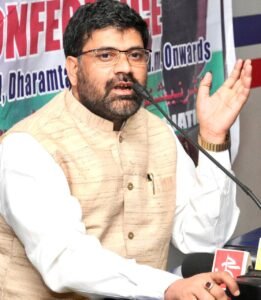
Shamim Ahmed’s engagement with the Bengal Urdu Movement, as presented in the preceding Qalam Times instalment, represents an effort to bring this regional history into public discussion.
The importance of such work lies in its emphasis on historical memory. When a movement’s records are scattered, when the contributions of its participants are not systematically documented, or when younger generations have limited access to its history, an important part of a region’s cultural experience can disappear from public awareness. Recording the movement helps address that problem. It also creates a foundation for further research into the development of Urdu in Bengal, the people and institutions that sustained it, and the initiatives through which its educational and cultural presence was maintained. The Bihar experience provides a valuable comparison because it demonstrates that language activism can involve several interconnected activities: journalism, political advocacy, public meetings, education and research. The particular balance between these activities will differ from region to region. What matters is that the history of each movement is recorded accurately and its achievements and limitations are examined carefully.
From Ghulam Sarwar’s Journalism to Shamim Ahmed’s Regional Documentation
The comparison between Ghulam Sarwar and Shamim Ahmed should not be taken to mean that they followed the same programme or belonged to one continuous organisation. Their historical contexts are different. Ghulam Sarwar’s work, as described in the supplied material, was closely connected with the Urdu press, public mobilisation and the political demand for official recognition in Bihar. The contemporary Bengal effort associated with Shamim Ahmed places particular emphasis on bringing the region’s Urdu history into wider public consciousness. Yet the comparison is useful because it shows how different forms of activism can contribute to a common objective. Journalism preserves arguments and gives public visibility to neglected issues. Political mobilisation can place demands before decision-makers. Educational research can document institutional conditions. Historical writing can recover the contributions of people whose work might otherwise be overlooked. These activities are not substitutes for one another. They are different parts of the work required to maintain a language’s presence in public life.
Bihar’s experience demonstrates the importance of connecting public campaigns with institutional questions. The Bengal experience, as represented in this series, underscores the need to preserve regional memory and document the people who have contributed to Urdu’s history. Together, they offer a broader understanding of what a language movement can encompass.
The Continuing Challenge: Recognition, Education and Implementation
One of the most important lessons from Bihar is that the achievement of official recognition should not be confused with the completion of a language movement. Recognition matters because it establishes a formal basis for the use of a language in public institutions. But its practical value depends on implementation. Education is equally important. Students need access to suitable instruction, teachers and learning materials. Researchers need reliable records. Writers and journalists need opportunities to publish and reach readers. Cultural institutions need to preserve the language’s literary and historical heritage. These responsibilities extend beyond governments. Educational institutions, universities, publishers, journalists, community organisations and families all influence whether Urdu remains a living language across generations. The experience of Bihar also suggests that public participation matters. Ghulam Sarwar’s campaign brought Urdu into political debate, while the educational work associated with Shahid Mahmood Puri drew attention to the need for detailed regional study. In West Bengal, the historical documentation associated with Shamim Ahmed adds another dimension to this continuing effort. The larger objective is not to place Urdu in opposition to Bengali, Hindi or any other Indian language. It is to recognise that India’s linguistic diversity can accommodate multiple languages and that each has its own history and social significance. A multilingual society benefits when its linguistic communities have opportunities to preserve their heritage while participating fully in education and public life.
What Bihar and Bengal Can Learn from Each Other
The comparison between Bihar and West Bengal should encourage research rather than simplistic conclusions. Bihar’s experience offers a historical record of public mobilisation for official recognition, including the role of journalism and political advocacy. It also highlights the contributions of educators who examined Urdu’s position at the district level. The Bengal chapter raises the importance of documenting a regional Urdu history that deserves a more visible place in the national narrative. These experiences suggest several areas for further study. First, researchers can examine how language movements organise public support and communicate their demands. Second, they can investigate the relationship between official recognition and educational provision, distinguishing formal legal status from actual access to language instruction. Third, they can document the work of local educators, journalists, writers and organisers whose contributions may not be fully represented in major historical accounts.
Finally, they can compare the ways in which Urdu has developed within different linguistic environments without assuming that every region has experienced the same challenges.Such work would help build a more complete history of Urdu in India.For Qalam Times, connecting Bihar and Bengal is therefore not an attempt to merge two separate histories into one. It is an effort to show how regional experiences illuminate different dimensions of a national question.
The Responsibility of the Next Generation
The future of Urdu depends partly on whether the next generation understands the history of the people who worked to preserve it.Ghulam Sarwar’s journalism and political engagement demonstrate the importance of public advocacy. Shahid Mahmood Puri’s educational and research interests show the value of teaching and documentation. The Bengal chapter associated with Shamim Ahmed highlights the need to preserve regional history and make it accessible to a wider audience. Each example points towards a different responsibility. Young people need opportunities to learn Urdu, read its literature and understand its place in India’s cultural history. Educational institutions need to preserve records and encourage research. Journalists need to document language-related issues accurately. Cultural organisations need to connect historical memory with contemporary public life.
The preservation of Urdu should not depend entirely on commemorating prominent personalities after their deaths. Their work must also be studied, their publications preserved and the institutional questions they raised examined in the present. This is how a movement’s history becomes useful to future generations.
The Qalam Times Perspective: One Language, Many Regional Stories
The fourth instalment of the Qalam Times Urdu Movement series brings the story from the national and educational interventions associated with Dr. Zakir Husain to the experience of Bihar, where Ghulam Sarwar’s journalism and public mobilisation became important parts of the campaign for Urdu recognition. It also highlights Shahid Mahmood Puri’s educational and research-oriented contribution, demonstrating that the movement’s history includes not only major public campaigns but also the quieter work of teachers and scholars. The connection with West Bengal and Shamim Ahmed extends this discussion into a contemporary regional context. These figures should not be presented as participants in one uninterrupted organisation. Their contributions belong to different periods and circumstances. Their significance lies in the different ways they illuminate the continuing questions surrounding Urdu: recognition, education, public participation and the preservation of historical memory.
Bihar’s experience demonstrates how journalism, political advocacy and grassroots mobilisation can bring a language question into public debate. The Bengal chapter demonstrates why regional documentation matters to the wider history of Urdu in India.
Both experiences reinforce the importance of examining language movements through their local contexts while recognising their broader cultural significance.
The history of Urdu in India is too extensive to be told through a handful of famous names or a single geographical region. It includes the work of politicians, teachers, journalists, researchers, writers, organisers and ordinary citizens whose contributions have shaped the language’s place in society.For that reason, the history of the Urdu Movement must continue to be researched, documented and discussed.
From Ghulam Sarwar’s campaign in Bihar to the contemporary Bengal Urdu Movement associated with Shamim Ahmed, the story is not one of identical struggles but of different regional efforts to preserve Urdu’s place in India’s linguistic and cultural life.
The challenge for the present generation is to ensure that official recognition is accompanied by educational opportunity, that historical achievements are supported by reliable documentation, and that the language remains connected with the lives and aspirations of younger Indians.The movement’s future will depend not only on remembering its past but also on translating that memory into sustained educational, cultural and institutional work.
The Urdu Movement in India continues through its many regional histories—and Bihar and Bengal deserve to be remembered as important chapters in that continuing story.