




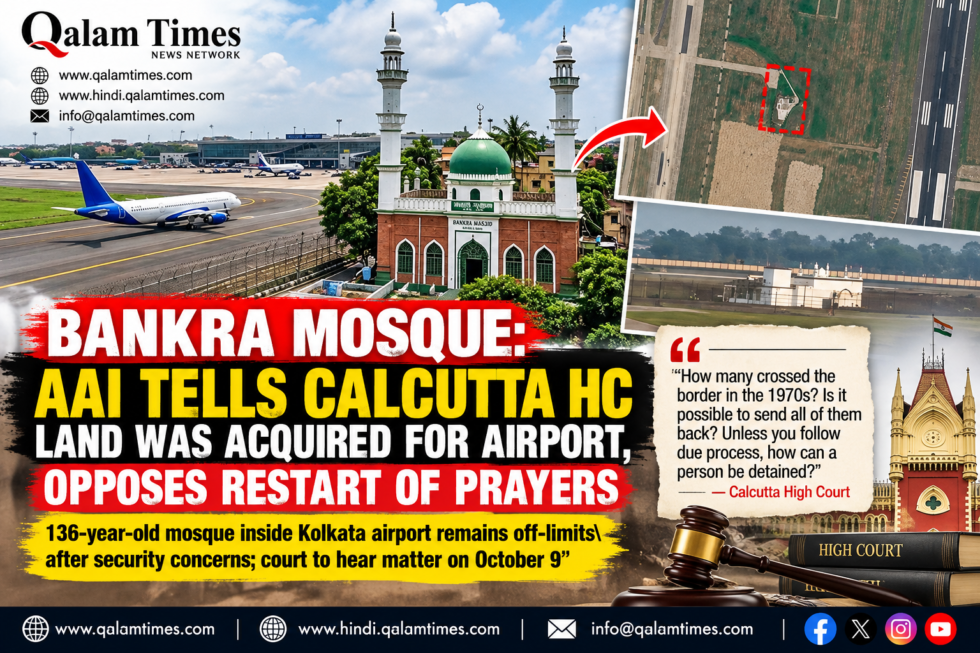
Bankra Mosque dispute reaches Calcutta High Court as AAI opposes resumption of prayers, citing acquired land, airport expansion and aviation security.
Airport authority opposes resumption of prayers at 136-year-old Bamkra mosque, citing aviation security and runway concerns; mosque committee seeks regulated access for devotees
By Qalam Times News Network
Kolkata | October 8, 2026
Bankra Mosque has become the centre of a legal dispute before the Calcutta High Court after the Airports Authority of India (AAI) opposed the resumption of prayers at the 136-year-old place of worship located within the operational premises of Netaji Subhas Chandra Bose International Airport in Kolkata. The AAI told the court that the land on which the Bankra Mosque stands had been acquired decades ago for airport-related purposes and that the mosque committee could not claim ownership of the property.

The submissions were made during the hearing of a petition filed by the Bankra Masjid Committee, which is seeking interim permission for devotees to enter the mosque and offer prayers, particularly Friday prayers. Access to the mosque has remained suspended since July 11 following security concerns raised by aviation authorities. Before the restriction, devotees were allowed to reach the mosque under a regulated security arrangement.
AAI cites 1961 acquisition notification and aviation security
Senior Advocate S.N. Mookherjee, appearing for the AAI, told Justice Krishna Rao that the land had been acquired by the government many years ago for the expansion of airport infrastructure. He referred to a notification dated February 7, 1961, arguing that the property had subsequently become part of the airport’s land. According to the AAI’s submissions, the land had been acquired from local residents and compensation had been paid. The authority therefore disputed the legal basis of the mosque committee’s claim over the land. The airport authority also argued that although individuals have a constitutional right to practise their religion, that right does not necessarily mean that worship must take place at a particular location when other overriding considerations, particularly aviation and national security, are involved.
The AAI further submitted that offering namaz does not legally require access to one specific mosque and that prayers could be offered elsewhere. The argument was made in opposition to the mosque committee’s request for an interim order restoring access while the larger dispute remains pending.
The authority said the decision to restrict access was not sudden. According to its submissions, aviation security officials had raised concerns in May regarding security arrangements at the airport, following which a meeting involving different stakeholders, including representatives of the Bankra Masjid Committee, was held.
The AAI maintained that unrestricted movement of people through sensitive airport areas creates security and operational concerns, particularly because access to the mosque involves movement through an area connected to airport operations.
Centre and CISF also oppose interim relief
The Centre, represented by Additional Solicitor General Dhiraj Trivedi, also opposed the mosque committee’s request for immediate restoration of prayers.
The Central Industrial Security Force (CISF) has raised concerns about the security implications of allowing devotees to enter a mosque situated within the airport’s operational zone. During the proceedings, the authorities argued that people accessing the mosque have to move through areas close to the runway, making verification and controlled access particularly important.
The Centre’s position is that national and aviation security must take precedence where the two come into conflict with unrestricted public access.
The authorities have also argued that the presence of the mosque and the arrangements required to allow devotees to reach it create difficulties for airport operations and future expansion.
The state government, represented by Additional Advocate General Bilwadal Bhattacharya, similarly opposed the petitioners’ reliance on the Places of Worship Act. The State’s argument was that the dispute does not involve converting one religious structure into another but concerns a mosque situated on land that the government says was acquired for airport purposes.
Bankra Mosque committee disputes security argument
The Bankra Masjid Committee has strongly contested the authorities’ position. The petitioners have pointed out that the mosque predates the modern airport and has existed for around 136 years. According to their submissions, the mosque was allowed to remain when surrounding land was acquired and the airport expanded.
The committee has argued that devotees had been permitted to visit the mosque for years under strict security arrangements. Before access was stopped, reports said around 70 people a day were able to offer prayers in different time slots after undergoing security checks and producing identification documents before CISF personnel.
The petitioners have therefore sought a continuation of the earlier regulated system rather than unrestricted public access.
Their position is that the authorities could maintain security through controlled entry, screening and designated transportation arrangements, rather than completely preventing devotees from reaching the mosque.
The committee has also maintained that there had been no comparable security problem associated with the mosque during its long history.
Historic mosque caught between worship and airport expansion
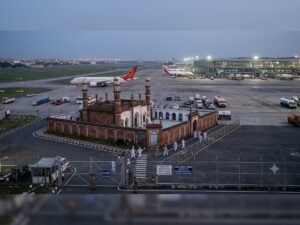
The Bankra Mosque’s unusual location is at the heart of the dispute. The mosque stands inside the airport’s operational area and close to the airport’s secondary runway. Historical accounts indicate that the mosque was part of an existing settlement before the modern airport developed around it. The airport began operating in the 1920s, while subsequent expansion during the 1950s and 1960s transformed the surrounding area.
Over the decades, the mosque remained in use even as airport operations expanded around it. Aviation security requirements have since become considerably stricter, creating an increasingly difficult situation for authorities attempting to regulate access to a religious structure located inside a highly sensitive aviation zone.
Previous reports have also documented proposals to relocate the mosque, but no mutually acceptable solution appears to have been reached.
The present litigation has consequently brought several issues before the High Court at the same time — land ownership, religious freedom, historical usage, airport expansion and aviation security.
Court to consider competing claims
The Calcutta High Court has not yet finally determined the rights of either side over the disputed property or whether prayers should resume at the mosque.The immediate issue before the court is whether the Bankra Masjid Committee should receive interim relief allowing devotees to resume prayers while its broader challenge remains pending.
The matter was heard by Justice Krishna Rao on Wednesday, with the petitioners’ counsel seeking an opportunity to respond to the arguments advanced by the AAI, Centre and State. The court has fixed October 9 for the next hearing.
Until then, access to the mosque remains restricted.
The case is significant because it brings a centuries-old question of religious practice into direct conflict with the modern requirements of aviation security. For the mosque committee, the issue is the continued right of devotees to worship at a historic place of prayer. For the airport authorities, the central concern is whether public movement through an operational airport zone can be permitted without compromising aviation security.
The High Court’s eventual decision will therefore be closely watched by both the airport authorities and the devotees seeking access to the historic mosque.