



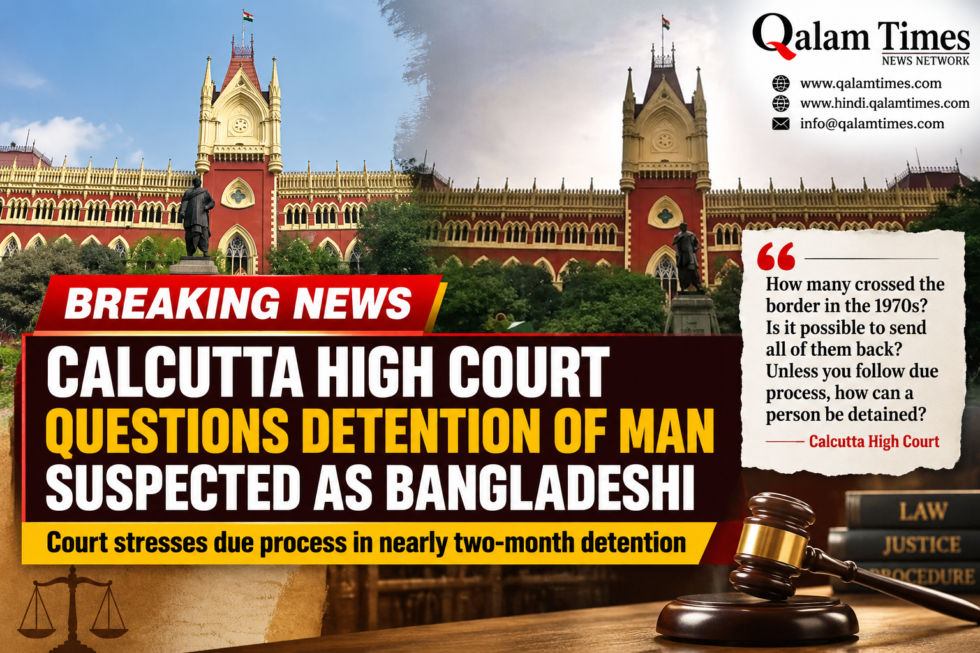
Calcutta High Court questions the nearly two-month detention of a man suspected of being Bangladeshi and stresses due process before deportation.
Calcutta High Court seeks clarity on nearly two-month detention, asks whether people who crossed the border decades ago can simply be sent back without following due process
By Qalam Times News Network
Kolkata | October 8, 2026
Calcutta High Court on Thursday questioned the continued detention of a man suspected by the authorities of being a Bangladeshi national, raising concerns over the legal basis for keeping him in custody for nearly two months and stressing that any action concerning a person’s nationality must follow due process. The observations were made by Justice Saugata Bhattacharyya while hearing the matter, with Additional Advocate General Rajdeep Majumdar representing the West Bengal government.

The Calcutta High Court also questioned the broader implications of attempts to identify and deport people who may have crossed the India-Bangladesh border decades ago. During the hearing, the Court asked how many people had crossed the border during the 1970s and whether it would actually be possible to send all of them back. The Bench stressed that detention cannot be justified merely on suspicion and that the authorities must follow the procedure established by law.
Calcutta High Court questions basis of deportation order
The case concerns a man who has reportedly remained in detention since August 8. While examining the duration of his custody, Justice Bhattacharyya specifically asked whether he had been detained from August 8 and questioned why he continued to remain in custody nearly two months later.
The Bench also examined the material that had allegedly been relied upon while issuing a deportation order against the man. According to the submissions before the Court, statements made by members of his family appeared to have been considered in determining his nationality.
The Court questioned whether a statement by a family member, by itself, could establish that an individual was a Bangladeshi national.
The underlying issue, the Court observed, was not simply whether there was suspicion about the man’s nationality but whether the authorities possessed sufficient material to establish that nationality before taking steps towards deportation.
The State’s counsel argued that the use of forged documents could have serious legal consequences. The Additional Advocate General submitted that if documents such as Aadhaar or PAN cards had been obtained through forged documentation, that could provide a basis for action, including deportation where legally applicable.
The Court, however, focused on the requirement that such action must be supported by proper material and carried out in accordance with the applicable legal procedure.
Deportation order issued while case was pending
Another issue that came under scrutiny was the timing of the deportation order.
The Court was informed that the Foreigners Regional Registration Officer, or FRRO, had issued a deportation order after the High Court had already passed an order in the matter and while the proceedings were still pending.
The Bench took note of the fact that the deportation order had therefore been issued during the pendency of the judicial proceedings.
The State subsequently suggested that the petitioner could be directed to approach the FRRO regarding the deportation order. The Court did not accept that suggestion at this stage, pointing out that the man had actually been detained by the police and that the detention memo had been issued by the police authorities.
The writ petition was thereafter released and directed to be placed before the appropriate Bench dealing with matters connected with the Special Intensive Revision (SIR). The case is scheduled to be placed before Justice Krishna Rao on October 14.
Case comes amid wider questions over nationality verification
The latest proceedings come against the backdrop of several cases in West Bengal involving people accused or suspected of being illegal Bangladeshi immigrants.
One such matter concerns Sahidul Sk, a Murshidabad resident whose wife approached the Calcutta High Court after he was detained on August 8 on suspicion of being an illegal Bangladeshi immigrant. His family has maintained that he is an Indian citizen and has cited documents including voter ID, Aadhaar, PAN, ration card and property records. The State, on the other hand, has alleged that he crossed into India illegally from Bangladesh and obtained identity documents fraudulently.
In that case, Justice Saugata Bhattacharyya directed the State to disclose the basis of the detention and sought reports from the police and the Superintendent of Police-cum-Foreigners Registration Officer. The Court’s earlier proceedings demonstrate the continuing legal debate over how nationality should be established and what procedure must be followed before a person is detained or deported.
The High Court has also recently dealt with cases involving people whose citizenship status has become entangled with the ongoing SIR-related proceedings. In one matter, the Court questioned the decision of an authority to examine the citizenship of four men from Murshidabad while their appeals against deletion from the electoral roll were still pending before an SIR appellate tribunal.
The Court’s intervention in such cases does not, by itself, establish that any particular person is an Indian citizen or a Bangladeshi national. Rather, the central legal question is whether the authorities have followed the prescribed procedure and relied upon adequate evidence before taking action.
Due process at the centre of the dispute
The latest hearing therefore places due process at the heart of the controversy. Determining whether someone is an Indian citizen or a foreign national can have serious consequences, particularly when detention and deportation are involved. The Court’s questions indicate that allegations regarding nationality cannot automatically substitute for a formal determination supported by appropriate evidence.
At the same time, the State has maintained that forged identity documents and illegal entry can constitute grounds for action under the applicable immigration and foreigners laws. The dispute before the Court is consequently centred on whether those grounds have been properly established in the particular case and whether the authorities followed the required legal safeguards.
With the matter now set to be placed before the appropriate Bench on October 14, further proceedings are expected to clarify the legal status of the detention and the deportation order.
For now, the Court has not made a final determination regarding the man’s nationality. Its observations instead underline a fundamental principle: a person cannot be deprived of liberty or subjected to deportation merely on an allegation without the authorities first following the procedure prescribed by law.