




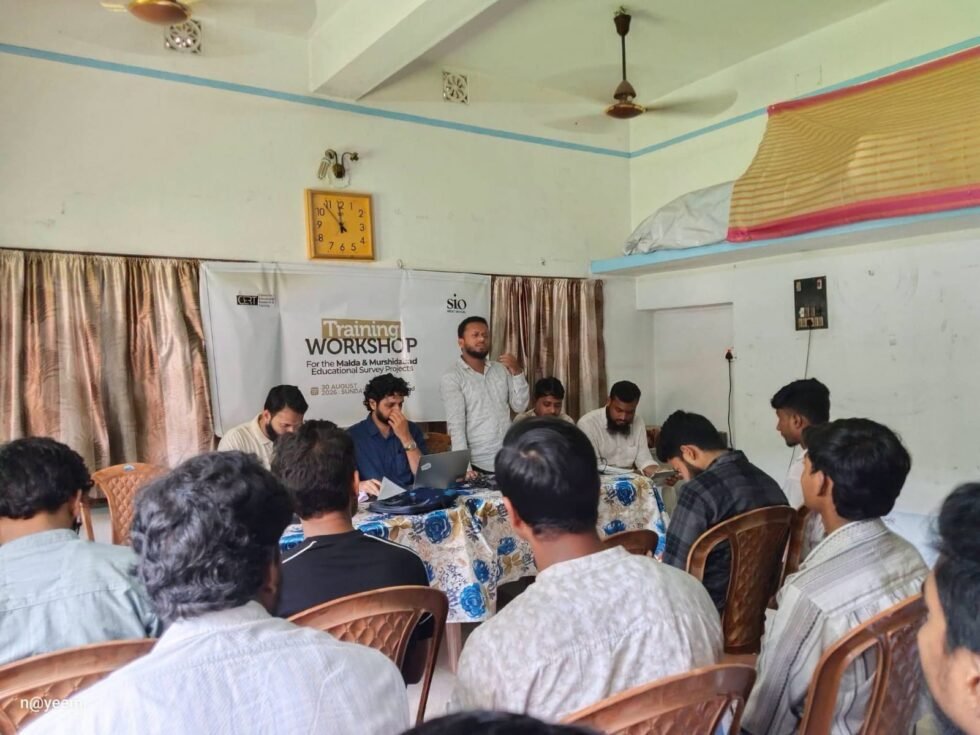
Education Survey workshop in Berhampore trains 21 participants to assess educational conditions, facilities, participation and challenges in Malda and Murshidabad.
Qalam Times News Network
Berhampore, Murshidabad | September 2, 2026
Education Survey was at the centre of a one-day training workshop organised in Berhampore, Murshidabad, to prepare field investigators for a comprehensive assessment of the educational situation in Malda and Murshidabad districts of West Bengal. The workshop was organised by the Centre for Educational Research & Training (CERT), New Delhi, in collaboration with the Students of Islamic Organisation (SIO), West Bengal Zone.
A total of 21 participants from Malda and Murshidabad attended the training programme, which focused on preparing them to collect reliable, field-based information on the prevailing educational conditions in the two districts. The Education Survey is intended to provide a clearer picture of school and higher-education participation, access to educational facilities, existing gaps and the challenges confronting students and families, particularly within minority communities.
Training Field Teams for a Scientific Assessment of Education
Malda and Murshidabad are historically and socially significant districts, yet both have experienced a range of challenges in the field of education over the years. Despite the passage of considerable time since the publication of the Sachar Committee Report, concerns over the educational progress of students from minority communities continue to remain significant.
The educational landscape of Murshidabad has also witnessed important developments in recent years. The establishment of Murshidabad University, which followed sustained efforts and advocacy by SIO, marked an important step forward. However, several aspects of the university’s basic infrastructure and institutional development are yet to reach full capacity.
At the same time, there remains a lack of a comprehensive, scientific and data-driven assessment of the present educational condition of the Muslim population in the two districts. Issues relating to enrolment and participation in education, availability of facilities, access to institutions and the difficulties faced by students and families require systematic documentation.
Against this backdrop, the organisers have initiated an Education Survey across Malda and Murshidabad to develop a reliable picture of educational realities on the ground. The survey is expected to generate evidence that can help identify both existing shortcomings and areas where meaningful educational interventions may be possible.
The one-day workshop was designed to ensure that the field survey is conducted in a systematic and scientifically sound manner. Selected participants were trained in the survey methodology, use of questionnaires, field-level data collection and procedures for maintaining the accuracy and consistency of information.
Participants also received practical training in KoboToolbox, a digital platform being used for collecting and managing survey data. The training covered various technical aspects of digital data collection, along with methods for recording information accurately and documenting field findings in a systematic manner.
Special emphasis was placed on maintaining data quality during fieldwork. Participants were briefed on the importance of recording responses correctly, avoiding inconsistencies and ensuring that information gathered from respondents is properly documented for subsequent analysis.
The training sessions were conducted by Dr Saadat Hussain, a researcher associated with Jawaharlal Nehru University, New Delhi, and Saeed-ul-Mamun, a researcher associated with the University of Calcutta. Their sessions focused on the methodological and practical dimensions of conducting a structured educational survey.
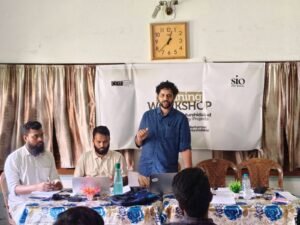
The programme was also attended by Abdul Wakeel, State General Secretary of SIO West Bengal, and Farooq Ahmed, who is overseeing the survey initiative.
Speaking about the purpose of the exercise, Abdul Wakeel said that the survey would help develop a data-based understanding of the educational situation in Malda and Murshidabad.
“The survey will make it possible to obtain an informative and data-based picture of the current educational reality in Malda and Murshidabad. The findings will also help identify opportunities, shortcomings and challenges in the education sector, while providing useful data for future planning and necessary interventions,” he said.
The organisers believe that systematic field-level data will provide a stronger foundation for understanding the educational needs of the two districts. The findings of the survey are expected to assist researchers, educational organisations and other stakeholders in identifying areas requiring greater attention and in developing future initiatives based on documented evidence rather than assumptions.