



Jadavpur University faces a crucial debate over academic freedom, political interference, campus violence and the need to protect democratic education.
The future of Jadavpur University must be protected through academic freedom, democratic dialogue and the rule of law—not intimidation, violence or political interference.
Qalam Times News Network — Editorial Desk
Kolkata August 21, 2026
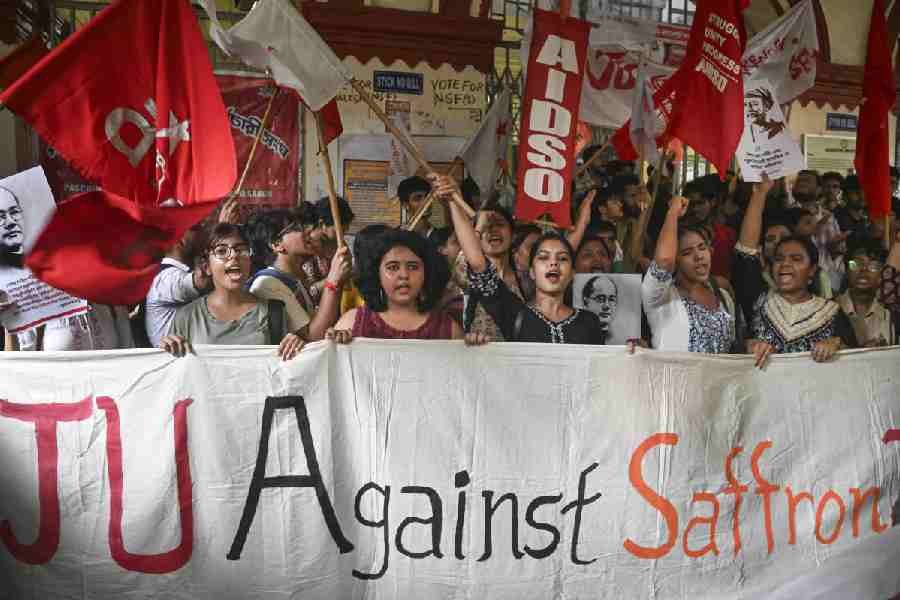
Jadavpur University has once again become the centre of a wider debate over the character and future of higher education in West Bengal. The immediate political controversy surrounding the campus should not be reduced to a clash between rival organisations or competing ideologies. At stake is something considerably more important: whether a university known for intellectual independence, scientific inquiry and democratic debate can continue to function without fear, coercion or partisan interference.
The debate over Jadavpur University also raises a fundamental question about the meaning of a university in a democracy. A campus should be a place where students can question authority, challenge established ideas, debate political positions and disagree with one another without being threatened or physically intimidated. Academic institutions lose their purpose when political power attempts to replace argument with force.
Jadavpur has historically represented a culture in which questioning is not treated as disobedience but as an essential part of learning. Its students, researchers and teachers have contributed to scientific research, literature, engineering, social sciences and public intellectual life. Like any large university, it has faced disagreements, political tensions and controversies. But none of these difficulties justify turning the campus into a battleground for organised violence.
Political parties and student organisations have every right to participate in democratic debate within the limits of law and university regulations. They do not, however, have the right to use intimidation, vandalism, assault or coercion as instruments of political mobilisation. That principle applies equally to every political formation.
The allegations raised in connection with attempts to influence or dominate the university therefore deserve serious, impartial and independent examination. If individuals have committed violence, damaged property or threatened students, faculty members or staff, the law must take its course. At the same time, allegations should not automatically be converted into convictions in the court of public opinion. Evidence, investigation and due process remain indispensable.

The most worrying aspect of the current confrontation is the possibility that political competition could gradually undermine the autonomy of the university.
Universities cannot be expected to remain completely detached from society or politics. Students are citizens, and political awareness is naturally part of campus life. But there is a crucial distinction between political participation and political capture.
A university should not become the property of any party—whether that party is in government or opposition. Its classrooms, laboratories, libraries, hostels and administrative institutions must remain governed by academic and institutional principles rather than the interests of political organisations.
This is particularly important for a university such as Jadavpur, whose identity has long been associated with independent thought and intellectual questioning. Attempts to impose ideological conformity from any direction would damage the very culture that makes the institution valuable.
The answer to an ideological disagreement is more debate, not less. The answer to an unpopular opinion is counter-argument, not intimidation. And the answer to political disagreement is democratic participation, not physical force.
The state government, central government, university authorities and law-enforcement agencies all have responsibilities in protecting the campus.
Funding is an important part of that responsibility. Universities cannot maintain world-class academic standards if they are systematically deprived of adequate financial resources. Budgetary decisions should therefore be transparent, evidence-based and free from political retaliation.
At the same time, university authorities must remain accountable for maintaining order. Administrative inaction in the face of violence can be as damaging as political interference. Students and teachers should be able to seek institutional protection when they feel threatened.
The police, too, must act professionally and impartially. Their responsibility is not to support one political group against another but to protect life, property and the rule of law.
If there are credible allegations of organised violence or outside interference on campus, they should be investigated by competent authorities on the basis of evidence. Those found responsible should face appropriate legal consequences, regardless of political affiliation.
Jadavpur’s Intellectual Legacy Must Not Be Sacrificed
The real strength of Jadavpur is not its buildings, rankings or reputation alone. Its greatest asset is its intellectual culture.
A university becomes great when its students are encouraged to ask uncomfortable questions. It becomes stronger when researchers are free to challenge established assumptions. It becomes meaningful when teachers can disagree with governments, political parties and even one another without fear.
That tradition should not be weakened by attempts to convert the campus into an arena of political domination.
The same standard must be applied universally. If political violence is condemned when committed by one group, it must also be condemned when committed by another. If academic freedom is defended against one ideology, it must be defended against every ideology. There can be no selective defence of democracy.
The slogan that a university should be “for students, not goons” captures an important democratic principle, but it must be understood broadly. The campus belongs neither to a political party nor to a particular student organisation. It belongs institutionally to the academic community and, ultimately, to the public whose resources sustain higher education.
Students should be able to attend classes without fear. Researchers should be able to conduct their work without intimidation. Teachers should be able to teach without political pressure. Employees should be able to perform their duties without becoming targets in factional conflicts. This requires collective responsibility. Political parties must restrain their supporters. Student organisations must reject violence. University authorities must act transparently. Governments must respect institutional autonomy. Police must remain politically neutral. And students themselves must defend democratic disagreement without allowing political rivalry to descend into physical confrontation.
The future of Jadavpur University should not be decided through muscle power, intimidation or partisan control. Nor should the institution become an ideological battlefield where every disagreement is interpreted as an existential political conflict.
Its future should be determined by scholarship, democratic participation, academic freedom and the rule of law.
Those who genuinely believe in education should have no difficulty accepting ths principle: the best way to defeat an idea is through a better idea, not through violence.
Jadavpur has earned its place in India’s intellectual landscape through generations of students, teachers and researchers. That legacy belongs to no single political party. It must therefore be protected from every attempt—regardless of its political colour—to replace academic freedom with fear.
The university does not need political guardians. It needs the freedom to educate, investigate, question and disagree. That is what a university is supposed to be.