



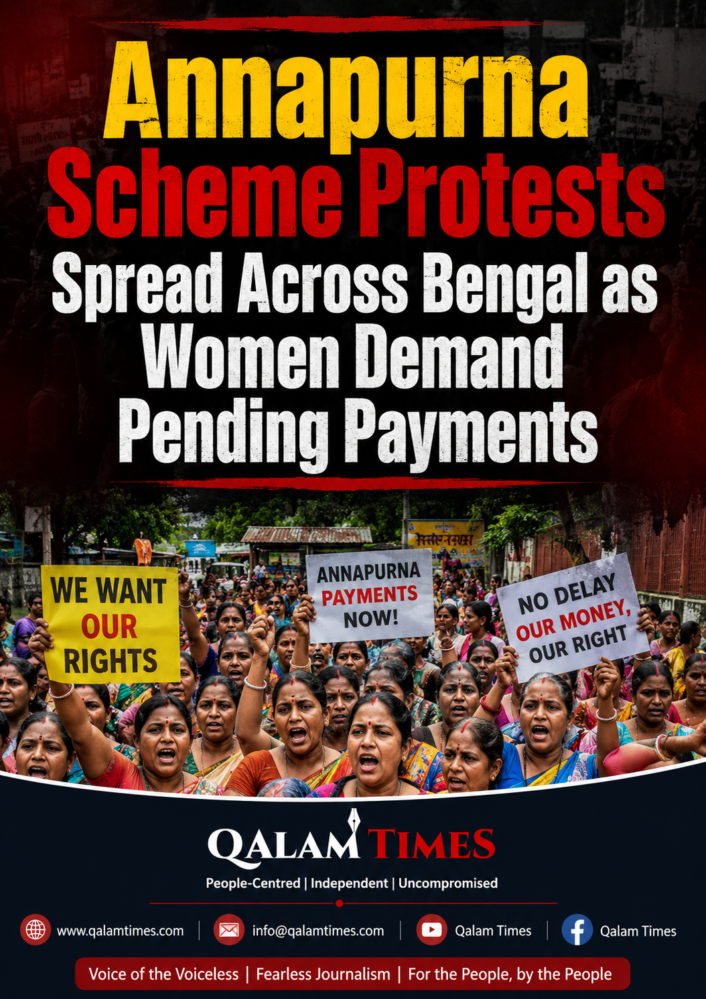
Annapurna Scheme Protests spread across Bengal as women demand pending payments, stage road and rail blockades, and question delays in verification and welfare disbursement.
Women demanding payments under the state’s Annapurna scheme staged demonstrations at government offices and blocked roads and railway tracks in several districts, while protests in West Midnapore forced Minister Agnimitra Pal to leave a scheduled administrative meeting and address the demonstrators.
Qalam Times News Network
Kolkata | August 21, 2026
Annapurna Scheme Protests: The Annapurna Scheme protests intensified across West Bengal on Friday as women who said they had not received the promised financial assistance took to the streets in several districts. From West Midnapore to North 24 Parganas, Hooghly, Bankura and Alipurduar, demonstrators demanded clarity over delayed payments, verification procedures and their eligibility.
The Annapurna Scheme protests have raised growing questions about the implementation of the government’s financial assistance programme for women. Demonstrators alleged that many applicants had completed repeated verification procedures, submitted documents at different government offices and, in some cases, were shown as approved, yet the promised money had not reached their bank accounts.

In West Midnapore, the situation became particularly tense when women entered the ground floor of the district magistrate’s office while an administrative meeting involving Urban Development Minister Agnimitra Pal was under way. The minister, who had arrived in the district on Friday, had already faced questions from people before entering the office.
The scheduled meeting was reportedly interrupted at around 2.30 p.m. as the protesting women gathered inside the administrative building. Pal subsequently came downstairs to speak to them. District Magistrate Bijin Krishna and local MLA Shankar Guchhait also joined the effort to address the protesters and bring the situation under control.
Appealing for patience, Pal told the women that the government had been in office for only around 100 days. The remark was met with further noise from the protesters. The minister then asked them to speak one at a time so that their grievances could be heard properly.
Pal said she had left the meeting because she wanted to understand the women’s problems and find a solution. She asked the applicants seeking Annapurna payments to visit the SDO office and submit their names, telephone numbers and enrolment numbers.
The minister also questioned officials about why some applicants had apparently been excluded during verification. She asked the women whether they had received payments for June or July. The protesters responded collectively that they had not received even a single month’s payment.
Pal then instructed the district administration to appoint a nodal officer to deal with the complaints. The women told the minister that they were being sent from one government office to another. According to their allegations, officials at SDO offices directed them to municipalities, while municipal authorities allegedly sent them back to SDO offices.
The minister asked the women to submit their documents at the SDO or BDO offices and assured them that their grievances would be examined. After receiving the assurance, the protesters gradually left the district magistrate’s office.
The dispute also spilled over into the railway network in North 24 Parganas. In Birati, several hundred women reportedly gathered near the railway tracks and began a blockade after alleging that they had not received money under the Annapurna programme.
The blockade disrupted local train services for more than an hour. A down local train travelling from Hasnabad towards Sealdah reportedly reached Birati at around 1.35 p.m. but was forced to stop. Other trains were subsequently held up at different stations, causing considerable inconvenience to passengers.
Arguments reportedly broke out between some passengers and the protesters as the blockade continued. Railway police faced difficulties while attempting to manage the situation and restore normal train movement.
The protesters claimed that they had repeatedly submitted the necessary documents and completed verification for the Annapurna benefit. Some said their applications were showing as approved, but the money had still not been credited to their bank accounts.
They also pointed out that other beneficiaries had already received payments, increasing their frustration. The protesters referred to an earlier government assurance that Annapurna payments would reach beneficiaries’ accounts by August 20. They said the deadline had passed without their payments being credited.
Their demand was straightforward: all eligible beneficiaries should receive the money and no genuine applicant should be excluded because of administrative delays or unresolved verification issues.
Protests were also reported in Habra, where women demonstrated outside the municipal office after allegedly failing to receive their Annapurna payments. Some protesters sarcastically suggested that the name of the scheme should be changed to something equivalent to “Did the money arrive or not?” to reflect the uncertainty surrounding the payments.
The women in Habra said they had repeatedly gone through verification procedures. Some had filled out forms at cyber cafes, while others had submitted documents at municipal offices and other government departments. They also claimed that officials had visited their homes for verification and that they had established their eligibility during the process.
Despite these steps, the protesters questioned why they were still waiting for the promised assistance. They demanded either immediate payment to all eligible beneficiaries or completion of any remaining verification process before the money was released.
Similar demonstrations were reported from Hooghly. Women who said they had not received Annapurna payments staged a protest outside the Chanditala-II BDO office, adding another district to the growing list of places where beneficiaries have publicly raised grievances.
In Bankura, women demanding Annapurna payments demonstrated outside the Sub-Divisional Officer’s office in Bishnupur on Friday afternoon. The protest also resulted in a road blockade outside the administrative office.
Police from Bishnupur police station later reached the spot and helped bring the situation under control. However, the protesters warned that they would launch a larger agitation if the pending payments were not received within a few days.
Another demonstration took place at the Barjora BDO office in Bankura. The agitation also affected traffic on the Bankura-Durgapur state highway.
In Alipurduar, the protests took a similar turn. Around 200 women reportedly blocked National Highway 31 in Dhupguri after claiming that they had not received Annapurna payments. They also demonstrated at the BDO office.
The protesters initially blocked the Dhupguri-Falakata section of the highway. They raised questions over the promises made before the BJP came to power, particularly regarding financial assistance to women who had previously been beneficiaries of Lakshmir Bhandar.
According to the protesters, conditions were imposed after the election and eligible beneficiaries were subsequently subjected to repeated administrative procedures. They demanded an explanation from the government as to why people who believed themselves to be eligible had still not received the promised assistance.
A confrontation reportedly developed between the police and protesters when authorities attempted to clear the road blockade.
The spread of demonstrations across geographically distant districts suggests that the issue is no longer confined to a single administrative office or locality. Women in different parts of the state are raising broadly similar complaints: repeated verification, document submission, uncertainty over eligibility and delays in receiving payments.
For the government, the immediate challenge is to distinguish between genuine administrative discrepancies and cases of unexplained delay. A transparent beneficiary list, clear reasons for rejection or pending applications, and a functioning grievance-redress mechanism could help prevent frustration from turning into repeated road and railway blockades.
For the protesters, however, the demand for financial assistance is tied to an immediate economic expectation. When applicants are repeatedly asked to submit documents and undergo verification but receive no clear explanation about the status of their applications, distrust naturally grows.
The Friday protests therefore represent more than isolated demonstrations at government offices. They highlight the importance of efficient implementation, transparent communication and accountability in any large-scale welfare programme.
The administration now faces the task of addressing the complaints district by district while ensuring that genuine beneficiaries are not left waiting indefinitely. At the same time, maintaining public order and keeping railway lines and highways open remains essential for commuters and emergency services.
The coming days will show whether the government’s assurances lead to the release of pending payments and a reduction in public anger—or whether the protests spread further across Bengal.