



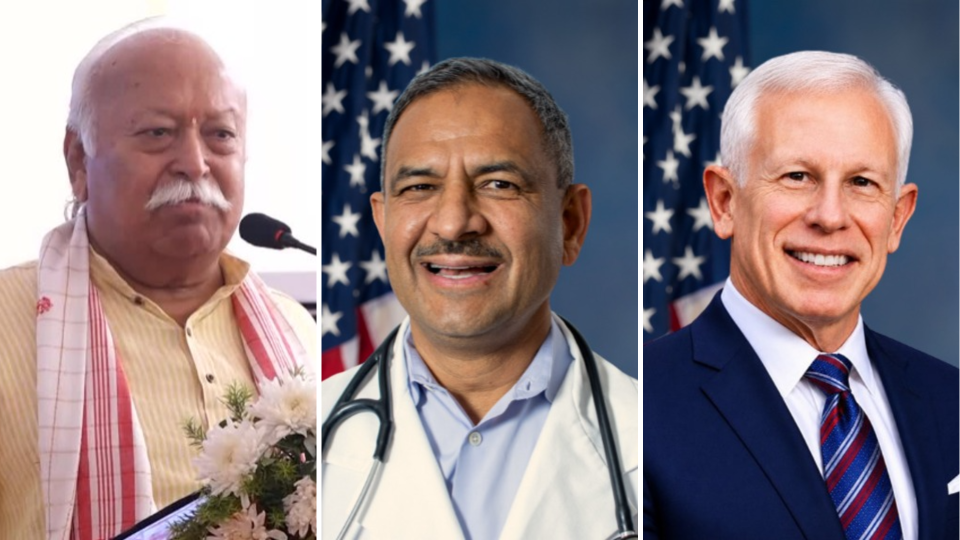
Ahead of Mohan Bhagwat’s proposed US visit, USCIRF-linked officials call for action against the RSS, sparking a wider debate on religious freedom and racial discrimination.
Qalam Times News Network | International Desk
Kolkata , 20 August 2026
A fresh controversy has emerged ahead of the proposed visit of Rashtriya Swayamsevak Sangh (RSS) chief Mohan Bhagwat to New York, with a member associated with the United States Commission on International Religious Freedom (USCIRF) calling for action against the organisation.
Asif Mahmood, speaking on the issue, alleged that the RSS and its affiliated organisations have been linked to repeated attacks against members of India’s Christian and Muslim communities.
“India’s Prime Minister Narendra Modi is a member of the RSS,” Mahmood said. He further alleged that several organisations associated with the RSS have been involved in attacks targeting religious minorities.
The remarks gained wider attention after USCIRF Commissioner Jean Mills publicly highlighted Mahmood’s statement. Mills also argued that RSS representatives should not be given high-level diplomatic recognition during Bhagwat’s visit.
According to Mills, US officials should avoid formal meetings that could be interpreted as extending political or diplomatic legitimacy to RSS leaders. Instead, she called for the US government to consider sanctions over allegations of violations of religious freedom.
The planned visit has also drawn criticism from the US-based rights organisation Hindus for Human Rights, which has raised objections to Bhagwat’s engagement in the United States.
The controversy has also triggered a broader debate over Washington’s position on human rights and religious freedom in other countries.
The United States has repeatedly raised concerns about the treatment of religious minorities and the state of religious freedom in India and elsewhere. However, critics argue that America itself continues to confront the consequences of a long history of racial discrimination.
The divide between Black and White Americans has remained one of the most significant issues in the country’s social and political history. The killing of George Floyd and the nationwide protests that followed brought renewed global attention to racial injustice and allegations of police brutality in the United States.
Against this backdrop, critics have questioned whether Washington is in a position to lecture other nations on discrimination and minority rights without also addressing its own unresolved challenges.
USCIRF Report on India
Earlier this year, USCIRF released a report raising concerns about religious freedom in India. The commission alleged that conditions affecting religious minorities had deteriorated and recommended that the US government consider measures against certain Indian individuals and organisations.
The RSS was among the organisations mentioned in connection with those recommendations. USCIRF also raised concerns involving India’s external intelligence agency, the Research and Analysis Wing (RAW), and recommended that the US government examine possible restrictions against individuals connected to alleged violations.
The commission’s recommendations, however, do not automatically become US government policy. Any decision on sanctions, travel restrictions or other punitive measures would ultimately depend on the US administration and relevant legal procedures.
As Mohan Bhagwat’s proposed US visit approaches, the issue has once again brought India’s religious freedom record, the role of the RSS, and America’s own human rights history into the spotlight.
The controversy now extends beyond a single visit. It has developed into a larger debate over international accountability, diplomatic engagement, religious freedom and whether nations applying human rights standards abroad are equally willing to confront discrimination within their own borders.