



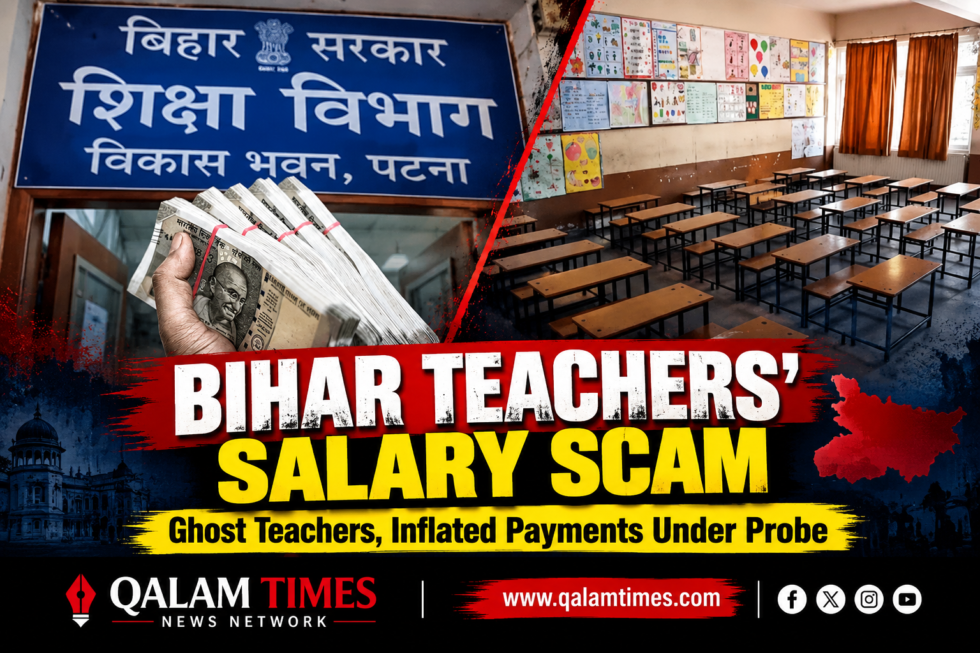
Bihar Teachers’ Salary Scam allegations expose suspected HRMS payroll manipulation, payments in the name of a non-existent teacher and inflated salaries across three districts, prompting investigations and disciplinary action.
Qalam Times News Network
Patna, October 29, 2026
The Bihar Teachers’ Salary Scam has come under scrutiny after an internal government audit reportedly uncovered serious irregularities in the state’s teacher payroll system. The findings point to suspected manipulation of the Human Resource Management System (HRMS), including payments allegedly made in the name of a teacher who does not exist and salaries several times higher than the amounts employees were entitled to receive. Bihar Education Minister Mithilesh Tiwari has acknowledged the seriousness of the reported cases and warned that strict action will be taken against teachers and officials found responsible.
The suspected Bihar Teachers’ Salary Scam has reportedly surfaced in at least three districts—Nawada, Patna and Bhagalpur. According to a report published by The Indian Express, the alleged irregularities involved unauthorised changes to payroll records, possible misuse of login credentials and the processing of payments without proper approval. Investigators are examining transactions estimated to involve approximately ₹1.85 crore. Police investigations and departmental proceedings have begun, with at least four officials reportedly suspended.
Bihar Teachers’ Salary Scam: Internal Audit Flags Suspected Payroll Fraud Across Three Districts
The alleged irregularities have raised concerns about the security of Bihar’s teacher payroll system and the procedures used to approve salary payments. The HRMS platform is intended to maintain employee records and facilitate salary processing. If unauthorised users can alter salary entries or misuse the login credentials of authorised officers, the system may become vulnerable to fraudulent payments.
The state government is reportedly conducting internal audits across all 38 districts to identify further discrepancies. Education Minister Mithilesh Tiwari told The Indian Express that the three reported cases were serious and required action. He also indicated that experts would be consulted to strengthen the HRMS system and prevent similar incidents.
The minister warned that teachers and officials found involved in corruption would face strict measures. The investigations will need to establish who altered the records, whether payments were authorised, how the transactions were processed and whether public funds can be recovered.
Nawada: Teacher Allegedly Received Several Times His Entitled Salary

The first reported case came to light in Nawada district, where the District Education Officer lodged a complaint with Nawada police concerning an alleged salary irregularity involving a primary schoolteacher in the Rajauli area.
According to the complaint, the teacher was entitled to receive ₹46,772 in April of the previous year. However, the amount credited to his account was allegedly ₹4,91,772—more than ten times the stated entitlement. A further payment of ₹3,49,500 was reportedly credited in the following month.
The complaint also named two departmental employees responsible for preparing and verifying salary records. Investigators are examining allegations that the employees added unauthorised amounts under the category of “other allowances” to the teacher’s payroll entries.
According to the reported complaint, an additional ₹4,52,222 was allegedly inserted into the April salary record without approval. Similar changes were reportedly made the following month. The District Education Officer alleged that the total unauthorised amount credited to the teacher’s account reached ₹10,43,950.
Police registered a case and began an investigation into the suspected manipulation. The inquiry is expected to establish whether the teacher knowingly received unauthorised payments and what role, if any, the employees responsible for preparing and checking the records played.
The allegations have also raised questions about internal verification procedures. A payroll system ordinarily depends on multiple checks to ensure that salary amounts, allowances and employee details are accurate. Investigators will need to determine why the reported discrepancies were not detected earlier and whether similar entries exist elsewhere.
Patna: Official’s Login Credentials Allegedly Misused
A separate case was subsequently reported in Patna, where the District Education Officer allegedly complained that unauthorised amounts had been entered into the payroll system using the officer’s login ID.
The complaint reportedly alleged irregularities involving ₹76,71,983. A departmental employee was suspended in connection with the case, while an investigation was initiated into allegations including cheating, criminal breach of trust and conspiracy.
The reported misuse of an authorised officer’s credentials has highlighted the importance of access controls, secure passwords and digital audit trails in government payment systems. Investigators will have to determine how the login details were obtained or used, who approved the entries and whether the transactions were supported by valid documents.
The Patna case also raises a broader administrative question: whether the existing controls can reliably distinguish legitimate salary adjustments from unauthorised changes. A comprehensive review of access logs and approval records could help identify the point at which the alleged manipulation occurred.
Bhagalpur: Payments Allegedly Arranged for a Non-Existent Teacher
Another serious allegation emerged from Bhagalpur district, where a district-level official was accused of arranging payments through the HRMS portal in the name of a teacher who allegedly did not exist.
A complaint was reportedly lodged at the Jog Sar police station on October 8. Police arrested the accused official, Shashi Chandan Chaudhary, the following day. Investigators have not publicly disclosed the amount allegedly involved, according to the supplied report.
The case has drawn attention to the need for accurate employee verification and regular checks of personnel records. If payments were indeed processed in the name of a non-existent employee, investigators will need to establish how the individual was entered into the system, which documents were used and who authorised the transactions.
The Bhagalpur investigation may also help determine whether the alleged irregularities were isolated incidents or part of a wider weakness in payroll verification.
Government Promises Action as Questions Remain Over Financial Controls
The reported cases have placed Bihar’s teacher payroll management under considerable scrutiny. While the state government has promised strict action and a wider audit, the investigations must establish the facts in each district before responsibility can be assigned.
The key issues include the security of HRMS login credentials, the verification of teacher identities, the approval of additional allowances, the separation of duties between employees preparing and checking salary records, and the timely detection of unusually large payments.
The reported estimate of approximately ₹1.85 crore in suspected irregular transactions makes it important for authorities to clarify the full financial impact. They will also need to determine how much money, if any, can be recovered and whether further disciplinary or criminal proceedings are warranted.
The findings from Nawada, Patna and Bhagalpur could lead to changes in the way the department manages payroll approvals and audits employee records. A transparent account of the investigation’s conclusions would help establish whether the reported cases resulted from individual misconduct, weaknesses in administrative controls or a combination of both.
For now, the allegations remain under investigation. The state government’s challenge will be to identify those responsible, protect public funds and ensure that legitimate teachers receive their salaries accurately and on time.