



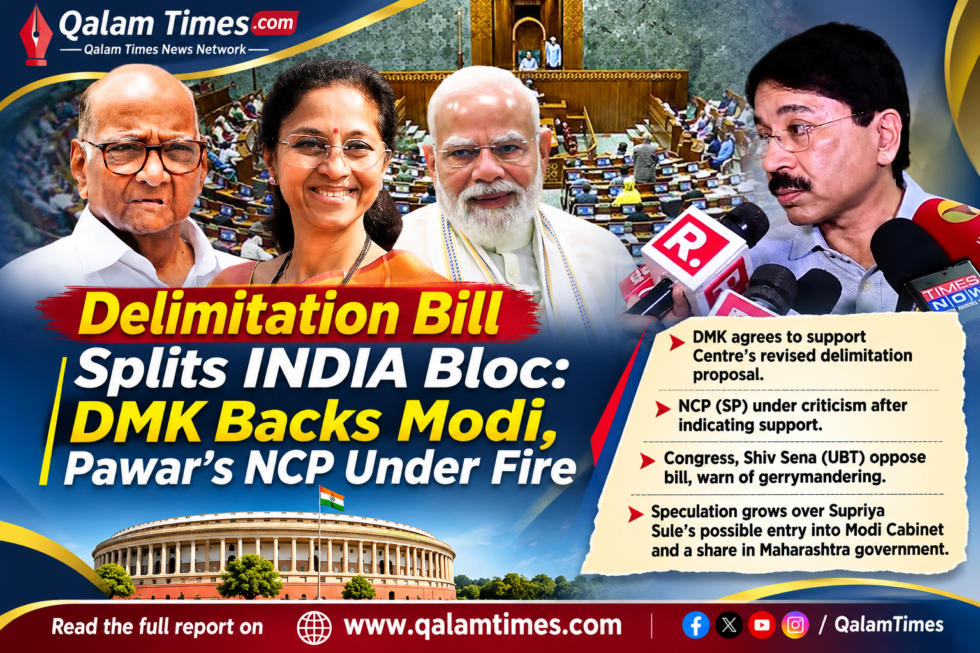
Delimitation Bill divides the INDIA bloc as DMK agrees to support the Modi government’s revised proposal, Sharad Pawar’s NCP faces Congress criticism, and speculation grows over Supriya Sule’s possible entry into the Union Cabinet.
Delimitation Bill : DMK’s Change of Position and NCP’s Possible Shift Put Opposition Unity to the Test
Qalam Times News Network
New Delhi, November 28, 2026
The Delimitation Bill has triggered a fresh political storm within the opposition INDIA bloc after the DMK announced its willingness to support the Centre’s revised proposal to increase the strength of the Lok Sabha. At the same time, the Sharad Pawar-led Nationalist Congress Party (Sharadchandra Pawar), or NCP (SP), is facing criticism from former allies over its apparent readiness to back the legislation. The absence of Supriya Sule from an important INDIA bloc meeting has further fuelled speculation about possible political realignments involving the Pawar family.
The Delimitation Bill has become a major test of opposition unity because the revised proposal appears to address some of the concerns raised by regional parties, particularly those from southern India. However, the Congress and Shiv Sena (UBT) remain critical of the government’s approach, arguing that increasing parliamentary representation and redrawing constituencies could have serious implications for federal balance and democratic representation.
The Union Cabinet reportedly approved two significant changes to the earlier constitutional amendment proposal at an urgent meeting on Friday. These changes include a uniform 50 per cent increase in the number of Lok Sabha seats allocated to every state and a proposed 25-year freeze, until 2051, on the existing proportion of parliamentary representation among states.
The legislation, identified as the Constitution (132nd Amendment) Bill, 2026, is scheduled to be introduced in the Lok Sabha on Monday. It proposes increasing the maximum strength of the Lower House to 850 members, comprising up to 815 representatives from states and 35 from Union Territories. It also seeks to increase the maximum permissible strength of state legislative assemblies from 500 to 650 members.
Delimitation Bill : DMK Agrees to Support Revised Proposal After Centre Addresses Its Concerns
The DMK’s decision to support the revised legislation represents a significant political development. The party had previously opposed the earlier version of the constitutional amendment bill, joining other opposition parties in defeating it in Parliament in April.
However, following the Centre’s latest modifications, Tamil Nadu Chief Minister and DMK president M.K. Stalin convened a meeting with party leaders and MPs to examine the revised proposal.
After the meeting, DMK MP Dayanidhi Maran indicated that the party was prepared to support the legislation because its principal demand had been addressed.
According to the DMK, increasing parliamentary seats by 50 per cent uniformly across all states would prevent any state from losing its relative share of representation. The proposed arrangement would also protect the existing balance between northern and southern states for the next 25 years.
The party had been particularly concerned that a delimitation exercise based on population figures from the 2011 Census could substantially increase the representation of more populous northern states while reducing the relative political influence of southern states.
Maran argued that if Uttar Pradesh, Bihar and Tamil Nadu each received an identical percentage increase in parliamentary seats, the existing proportional distribution would broadly remain protected.
The DMK’s position is that either delimitation should not take place or, if it does, the political rights and representation of every state must be safeguarded.
Congress and Shiv Sena (UBT) Refuse to Accept the Government’s Explanation
The Congress has maintained its opposition to the revised proposal, arguing that the government’s amendments do not resolve the fundamental questions surrounding delimitation.
Former Union Finance Minister P. Chidambaram questioned whether preserving the percentage share of parliamentary seats among states would be sufficient to protect their political interests.
In a statement on social media, he argued that absolute representation also matters and that the expansion of the Lok Sabha would necessarily require fresh delimitation of constituencies within individual states.
He expressed concern that the process could give the government considerable influence over constituency boundaries, potentially allowing political manipulation through gerrymandering.
Chidambaram referred to the experiences of Assam and Jammu and Kashmir, arguing that the possibility of politically motivated constituency restructuring represented a serious democratic concern.
He also questioned why the proposed one-third reservation for women could not be implemented within the existing strength of the Lok Sabha rather than being linked to a fresh delimitation exercise.
Congress spokesperson Shama Mohamed raised similar concerns, particularly regarding the political consequences for Kerala and Tamil Nadu.
She argued that even if the percentage share of seats remained unchanged, the absolute difference in parliamentary representation between states could increase substantially.
Citing the existing difference of approximately 60 seats between Kerala and Uttar Pradesh, she warned that the gap could rise to around 90 following a 50 per cent expansion.
The Congress therefore maintains that the revised formula does not automatically guarantee equal political influence or eliminate the possibility of constituency-level manipulation.
Shiv Sena (UBT) leader Sanjay Raut has also strongly criticised the proposal and questioned the willingness of the NCP (SP) to support it.
Raut described the possible support of Sharad Pawar’s party as unfortunate for Maharashtra and its political interests. He argued that the proposed expansion and subsequent delimitation could undermine the rights of voters and alter the country’s federal balance.
He also reminded the NCP (SP) that its eight Lok Sabha MPs had been elected as part of the Maha Vikas Aghadi alliance and accused the party of taking decisions without adequately consulting its political partners.
Delimitation Bill : Sharad Pawar’s Party Faces Questions Over Its Position on the Bill
The political controversy surrounding the NCP (SP) has become particularly significant because of the party’s previous relationship with the Congress and other opposition groups.
Jitendra Awhad, a prominent NCP (SP) leader and Maharashtra MLA, indicated on Friday that his party would support the revised legislation if the government ensured a uniform 50 per cent increase in Lok Sabha seats across all states.
His statement came after he met Sharad Pawar, who was reportedly admitted to a hospital in Mumbai.
Supriya Sule, however, adopted a more cautious position, saying that the party would examine the complete draft before making a final decision.
The NCP (SP) has eight members in the Lok Sabha, including Supriya Sule, while Sharad Pawar is its sole representative in the Rajya Sabha.
The party’s possible support for the legislation has created unease within the INDIA bloc, particularly because Congress leaders believe they had made considerable political concessions to secure Sharad Pawar’s return to the Upper House earlier this year.
Congress Recalls Its March Support for Sharad Pawar
The latest confrontation has brought back memories of the Rajya Sabha election in Maharashtra in March 2026.
At that time, the opposition Maha Vikas Aghadi faced a difficult numerical situation in the 288-member Maharashtra Legislative Assembly.
A candidate required approximately 37 first-preference votes to secure a Rajya Sabha seat. The Shiv Sena (UBT) had 20 MLAs, the Congress had 16, while the Sharad Pawar-led NCP (SP) had only 10 legislators.
Although the opposition alliance’s internal understanding reportedly favoured a Congress candidate, the party eventually decided not to field its own nominee for the relevant seat.
Following a request from Supriya Sule, Congress leaders Rahul Gandhi and Mallikarjun Kharge supported Sharad Pawar’s candidature, enabling the 85-year-old leader to return to the Rajya Sabha.
The Maharashtra Congress has now publicly recalled that decision.
Party spokesperson Sachin Sawant questioned what the Congress had gained from making such a sacrifice if the NCP (SP) was now prepared to support legislation that had divided the opposition.
Vijay Wadettiwar, leader of the Congress legislative party in Maharashtra, also criticised the NCP, accusing it of prioritising political power over ideological commitments.
His remarks reflect the growing frustration within the Maharashtra Congress over what it perceives as a lack of political reciprocity from the Pawar camp.
Supriya Sule’s Absence From INDIA Meeting Adds to Political Speculation
The controversy intensified further on Saturday when Supriya Sule confirmed that she would not attend the INDIA bloc meeting in Delhi.
She explained that her father, Sharad Pawar, was unwell and admitted to hospital, making it impossible for her to participate in the meeting.
She also indicated that she would travel to Delhi on Monday to attend parliamentary proceedings.
Although her explanation was based on her father’s health, her absence became politically significant because of the ongoing disagreement over the delimitation legislation and the NCP’s possible support for the Centre.
Reports attributed to political sources and cited by NDTV and other media organisations have also fuelled speculation that Supriya Sule could potentially receive a position in Prime Minister Narendra Modi’s Union Cabinet.
According to these reports, her possible entry into the government is being discussed alongside the NCP (SP)’s willingness to support the revised parliamentary seat expansion proposal.
However, neither the NCP (SP) nor the Union government has officially confirmed any agreement involving a Cabinet position in exchange for support for the legislation.
Consequently, the reported possibility should be treated as political speculation rather than an established arrangement.
Could Sharad Pawar’s Party Also Get a Share in Maharashtra Government?
The political discussions are not limited to the Union Cabinet.
There is also speculation that the NCP (SP) could receive ministerial representation in the Maharashtra government led by Chief Minister Devendra Fadnavis.
Reports circulating in political circles suggest that the party could potentially receive two Cabinet-rank ministerial positions and two Minister of State positions.
Among the names being discussed are Rohit Pawar, Sharad Pawar’s grand-nephew, and senior party leaders Jitendra Awhad and Jayant Patil.
The Finance portfolio has also figured in speculation surrounding a possible arrangement.
If such a political understanding were to materialise, it could significantly alter Maharashtra’s political landscape, particularly given the history of divisions within the NCP and the Pawar family.
Nevertheless, these reports remain unconfirmed, and no formal announcement has established that the NCP (SP) will join the Fadnavis government.
For the Congress, the possibility of its former ally moving closer to the BJP-led establishment would represent a serious political setback.
The Numbers Behind the Delimitation Bill
The government’s immediate challenge is to secure the constitutional majority required to pass the amendment.
According to the figures reported during the previous voting process, the earlier proposal received 298 votes in favour and 230 against, falling short of the required two-thirds majority.
The new proposal is expected to receive greater support following the Centre’s decision to modify the seat allocation formula.
Political calculations have also focused on possible changes in the parliamentary strength of different parties.
Reports have referred to a possible merger involving 20 Trinamool Congress MPs with the Nationalist Citizens Party of India, subject to approval by Lok Sabha Speaker Om Birla. There has also been speculation about eight NCP (SP) MPs, six Shiv Sena (UBT) rebels and 22 DMK MPs potentially changing the parliamentary arithmetic.
However, such developments should not be treated as completed political decisions.
The constitutional requirement is a two-thirds majority of members present and voting, rather than two-thirds of the total sanctioned strength of the Lok Sabha. This distinction could influence the government’s strategy when the legislation comes up for consideration.
A Defining Moment for Opposition Unity
The revised delimitation proposal has exposed significant differences within the INDIA bloc.
While the DMK appears satisfied that the Centre’s latest changes protect the proportional representation of states, the Congress and Shiv Sena (UBT) remain concerned about the wider implications of the exercise.
The NCP (SP), meanwhile, is facing questions about its political loyalty, particularly after the Congress’s earlier support for Sharad Pawar’s Rajya Sabha election.
The possibility of Supriya Sule entering the Union Cabinet and the reported prospect of ministerial positions in Maharashtra have added another dimension to the controversy, although neither development has been officially confirmed.
The coming parliamentary proceedings will therefore be important not only for the future of the proposed constitutional amendment but also for the political relationships within the opposition alliance.
At the centre of the unfolding developments is a larger question: can the INDIA bloc maintain a united political position when regional parties believe their individual interests are better protected through negotiations with the ruling government?
The answer could have consequences extending well beyond the delimitation debate, potentially reshaping the opposition’s strategy ahead of the next general election.