



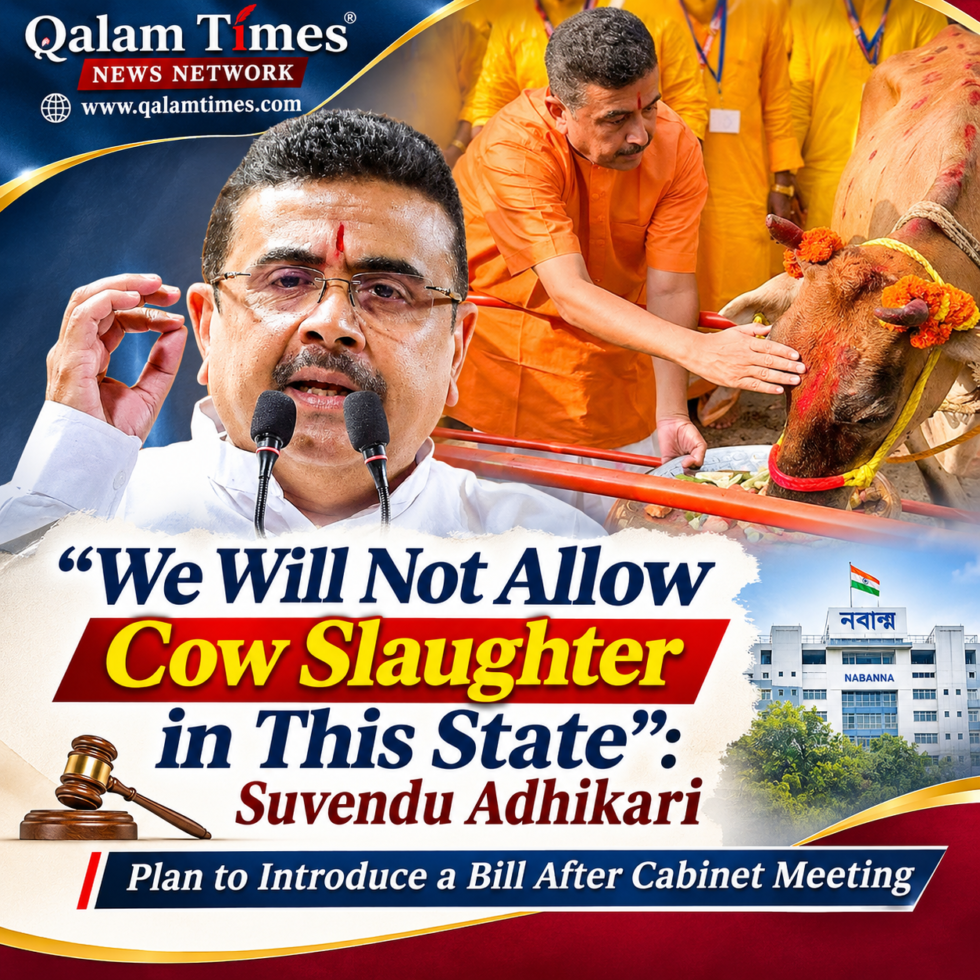
Cow Protection in West Bengal takes centre stage as Chief Minister Suvendu Adhikari announces plans to introduce a bill against cow slaughter and provide annual financial assistance of ₹1 lakh to gaushalas caring for aged cattle.
Qalam Times News Network
Kolkata, November 23, 2026
Chief Minister Announces Legislative Proposal and Financial Support for Gaushalas (Cow Sheltors)
Cow Protection in West Bengal has become a major political and administrative issue following Chief Minister Suvendu Adhikari‘s announcement that his government will introduce a bill aimed at preventing the slaughter of cows in the state. Speaking to journalists after a Cabinet meeting at Nabanna on Monday, the Chief Minister declared that cow slaughter would not be permitted and said the government intended to strengthen its approach through legislation.
The announcement also included a financial assistance plan for gaushalas. Under the proposed support measure, shelters caring for elderly cattle will receive an annual grant of ₹1 lakh each to help meet the costs of their maintenance. The government has presented this initiative as part of its broader approach to Cow Protection in West Bengal, alongside its stated intention to enforce existing legal provisions.
Government Cites Existing Cattle Law and Promises Action Against Illegal Slaughter

Addressing the media after the Cabinet meeting, Adhikari made his position clear, declaring: “We will not allow Gau Mata to be slaughtered in this state, regardless of how the matter is interpreted.” He referred to the existing legal framework, specifically mentioning the 1950 cattle legislation, and said that the administration would act in accordance with the law. When asked whether the announcement meant that slaughterhouses would also be prohibited from operating, the Chief Minister drew a distinction between authorised slaughterhouse activities and the slaughter of cows. He indicated that slaughter could take place at a slaughterhouse if the required permission had been granted, while maintaining that the protection of cows was a separate matter. Adhikari also alleged that despite the existence of legal restrictions, cow slaughter was continuing secretly in certain parts of the state. He asserted that such activities would not be allowed to continue and said the administration was already taking steps to address the issue. Referring to directions issued by the Calcutta High Court, he urged people to provide specific information about alleged violations so that the authorities could investigate and take action. “Send us the details. We will put a stop to it,” he said, referring to reports of clandestine slaughter.
A New Debate Over Cattle Protection and Slaughterhouse Regulation
The Chief Minister’s announcement is likely to bring renewed attention to the relationship between cattle-protection laws, the regulation of slaughterhouses and the implementation of existing legal provisions in West Bengal. His remarks indicate that the proposed legislation is intended to reinforce the government’s position on cow protection, while the annual assistance for gaushalas is aimed at supporting the care of ageing cattle. However, the precise provisions of the proposed bill, its implementation framework and the conditions governing the financial assistance have not yet been detailed in the announcement. The next steps will depend on the draft legislation and the government’s formal decisions regarding enforcement. The distinction made by the Chief Minister between cow slaughter and permitted activities at authorised slaughterhouses is also likely to remain an important part of the discussion. For now, the announcement marks a significant policy statement by the West Bengal government, with further clarity expected when the proposed bill is formally introduced.