



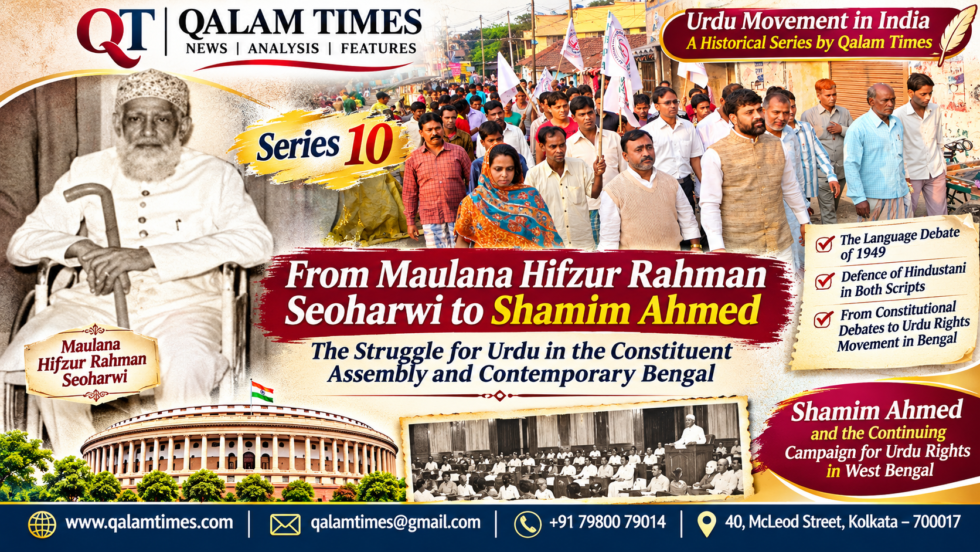
Discover the history of Urdu in Constituent Assembly Debates, Maulana Hifzur Rahman Seoharwi’s defence of Hindustani in both scripts, India’s language settlement and the continuing Urdu movement associated with Shamim Ahmed in Bengal.
Qalam Times News Network
Kolkata | November 22, 2026
Urdu in Constituent Assembly Debates: The Language Question at the Birth of Independent India
Urdu in Constituent Assembly Debates represents one of the most significant and revealing chapters in the political and linguistic history of modern India. When the Constituent Assembly met to frame the Constitution of independent India, it faced a question that went beyond administrative convenience: what place would the country’s many languages occupy in the new republic? Language was connected with education, culture, public administration, literature and the everyday lives of millions of citizens. The debate was particularly important for Urdu, a language with a deep literary and cultural presence across the subcontinent. Its future was being discussed at a time when India was emerging from colonial rule and experiencing the immense political and social consequences of Partition. The discussions in the Constituent Assembly were not simply about choosing a language for government correspondence. They reflected different ideas about national unity, cultural diversity, linguistic identity and the relationship between language and citizenship. Among the voices that deserve particular attention was that of Maulana Mohammad Hifzur Rahman Seoharwi, who argued for Hindustani as a common language of India, written in both Devanagari and Urdu scripts. His intervention on 12 September 1949 provides an important historical record of the effort to preserve a shared linguistic tradition while recognising the place of Urdu. This tenth instalment of the Qalam Times historical series revisits those debates and examines their continuing relevance to the struggle for Urdu recognition and implementation in contemporary West Bengal.
The Constituent Assembly and the Challenge of Linguistic Diversity
The Constituent Assembly began its work on 9 December 1946. Its responsibility was to prepare a constitutional framework for a country whose linguistic, cultural and regional diversity was among its most defining characteristics.
India did not have a single language that could represent the everyday linguistic experiences of every region. Bengali, Tamil, Telugu, Marathi, Gujarati, Punjabi, Urdu, Assamese, Kannada, Malayalam and numerous other languages had established literary traditions and large communities of speakers. The question of the Union’s official language therefore required careful consideration. Members had to consider how the government would function, how citizens from different linguistic backgrounds would communicate with public institutions and how the new republic could avoid alienating its diverse population. For Urdu, the situation was particularly sensitive. The language had been an important medium of literature, journalism, education and public communication. Its historical association with the freedom movement and its contribution to India’s shared cultural heritage were also part of the larger discussion. The debate was not simply a contest between two languages. It involved competing understandings of what a common Indian language should represent and how different linguistic traditions could retain their dignity.
The Debate of September 1949: A Defining Moment
One of the most important stages of the language debate took place in September 1949, when the Constituent Assembly considered provisions concerning the official language of the Union. The proceedings of 12 September 1949 are especially significant for the history of Urdu. During the discussion, Maulana Mohammad Hifzur Rahman Seoharwi, a member from the United Provinces, presented an amendment concerning the language of India. He argued that Hindustani should be preferred over Hindi as the common language and that it should be written in both Devanagari and Urdu scripts. His proposal was rooted in the belief that Hindustani could accommodate the linguistic contributions of Hindi, Urdu and other Indian languages. He considered a common language that drew upon the everyday vocabulary of different communities more suitable for a diverse country. His intervention is important because it placed the question of Urdu script directly within the constitutional debate. Rather than treating Urdu merely as a separate cultural interest, he argued that its script should retain a place in the public and administrative life of the country.
Maulana Hifzur Rahman Seoharwi: A Voice for Hindustani and Both Scripts
Maulana Hifzur Rahman Seoharwi’s speech on 12 September 1949 deserves careful attention in any account of Urdu’s constitutional history. He recalled the earlier discussions within the national movement and referred to Mahatma Gandhi’s support for Hindustani as a language capable of connecting people across religious and social divisions. According to Hifzur Rahman, Gandhi’s understanding of Hindustani was not confined to a heavily Sanskritised form of Hindi. He regarded it as a language of ordinary communication, drawing upon the vocabulary understood and used by different communities. Hifzur Rahman argued that the language should be written in both Devanagari and Urdu scripts. He also expressed concern that the increasing exclusion of familiar Persian, Arabic and Urdu-derived vocabulary could create an artificial distance between the language of administration and the language spoken by ordinary people. His argument was not that one linguistic tradition should replace another. Rather, he wanted a common language that could accommodate the vocabulary and cultural contributions of different sections of Indian society. He also proposed that Urdu script should be permissible for government information, communications and court proceedings. This was a significant intervention. It demonstrated that the question of Urdu was not limited to poetry, literature or private communication. It was also connected with access to administration and public institutions. The official Constituent Assembly record preserves his arguments and provides a valuable primary source for understanding the position taken by Urdu’s supporters during the language debate.
Urdu in Constituent Assembly Debates : Hindustani: The Idea of a Shared Linguistic Identity
The debate over Hindustani had a long history before the Constituent Assembly. During the freedom movement, Mahatma Gandhi frequently advocated a common language that could be understood by people from different communities. He used the term Hindustani to describe a broad form of everyday communication that could draw upon both Hindi and Urdu traditions. The idea was based on the possibility of linguistic accommodation rather than the complete dominance of one literary tradition. For supporters of Hindustani, the use of both Devanagari and Urdu scripts offered a practical way of recognising the linguistic experiences of different communities. Hifzur Rahman referred to this earlier understanding in his Assembly speech. He argued that the national movement had previously supported Hindustani as a common language and that the two scripts should not be treated as incompatible. His intervention also raised a broader question: could a modern democratic nation create a common administrative language without weakening the cultural and linguistic traditions of its people? This question remains relevant in contemporary discussions about multilingualism and language policy.
Urdu in Constituent Assembly Debates : Urdu Was Not Merely a Religious Identity
An important aspect of Hifzur Rahman’s argument was his objection to the narrow identification of Urdu with a single religious community. The language had developed through centuries of interaction among different communities, regions and literary traditions. Its vocabulary, poetry, prose and everyday expressions reflected a shared cultural history. In the Assembly debate, Hifzur Rahman challenged the tendency to treat Urdu as the exclusive language of Muslims. He argued for a broader understanding of Hindustani and the linguistic traditions that contributed to it. This distinction remains important today. Urdu is a language of Indian literature, journalism, education and cultural expression. Its speakers and readers belong to different religious and social communities. Its literary heritage includes contributions from writers whose backgrounds cannot be reduced to a single religious identity. Understanding Urdu only through the lens of religion overlooks its wider place in India’s cultural and intellectual history. The history of Urdu therefore needs to be studied as part of the larger history of Indian languages and the country’s shared cultural development.
The Constitutional Settlement: What Was Finally Adopted?
The Constituent Assembly ultimately adopted a constitutional arrangement that did not accept Hindustani in both scripts as the official language of the Union. Article 343 of the Constitution provides that Hindi in the Devanagari script shall be the official language of the Union. It also provided for the continued use of English for Union official purposes for fifteen years from the commencement of the Constitution. The constitutional arrangement was therefore a settlement concerning the official language of the Union, rather than a declaration that Hindi was the national language of India. This distinction matters. The Constitution does not declare any language to be India’s national language. The debate also resulted in a wider constitutional framework for regional languages, linguistic minorities and the preservation of language and culture. The Constitution provided for states to adopt their official languages under Article 345. Article 347 created a mechanism for recognition of a language spoken by a substantial section of a state’s population, subject to the constitutional process. Articles 29 and 30 addressed cultural preservation and minority educational rights. Articles 350, 350A and 350B dealt with representations for the redress of grievances, mother-tongue instruction at the primary stage and safeguards for linguistic minorities. These provisions became important reference points for communities seeking recognition and educational opportunities for their languages.
Urdu in the Eighth Schedule: A Constitutional Recognition
Urdu is included among the languages listed in the Eighth Schedule of the Constitution of India. This inclusion is an important element of Urdu’s constitutional history. It recognises the language as part of India’s linguistic heritage and provides a place for it within the constitutional framework concerning scheduled languages. However, Eighth Schedule recognition should not be confused with the status of an official language of the Union or of every state. The Union’s official language is addressed separately under Article 343. State official-language arrangements are governed by Article 345 and other applicable constitutional and legislative provisions. The distinction is important because the recognition of a language and its actual use in administration are related but separate questions. For Urdu-speaking citizens, the continuing challenge has been to ensure that constitutional recognition is accompanied by meaningful opportunities in education, public communication, publishing and cultural institutions.
The Continuing Urdu Question After Independence
The constitutional debate did not bring an end to discussions about Urdu’s position in independent India. In several states, Urdu-speaking communities continued to raise demands concerning education, official recognition and the use of Urdu in public institutions. These demands were particularly significant in regions where Urdu had a substantial population of speakers and a long-standing educational and literary presence. The debate also demonstrated that language policy is not a one-time constitutional decision. It requires continuing attention from governments, educational authorities, public institutions and citizens. The availability of Urdu teachers, textbooks, libraries, newspapers and educational opportunities remains central to the language’s future. The history of the Constituent Assembly therefore provides an important starting point for understanding the linguistic demands that continued after independence.
West Bengal: From Constitutional Principles to Language Rights
The history of Urdu in West Bengal offers a significant example of how language-related demands have developed within the framework of independent India. Urdu has a long-standing presence in Kolkata and several other parts of the state. It has contributed to literature, journalism, education, cultural activity and the intellectual life of the region. An important legislative development came through the West Bengal Official Language (Amendment) Act, 2012, which amended the West Bengal Official Language Act, 1961. The amendment created provisions for the use of Urdu in specified administrative areas where the prescribed population condition was met. It addressed the use of Urdu for certain government purposes, including notifications, orders, applications and other specified forms of official communication. The legislation should be understood within its actual legal scope. It did not make Urdu an unrestricted official language throughout the whole state. Its application depends on the statutory conditions and the administrative areas covered by the law. Nevertheless, it represented an important stage in the recognition of Urdu-related demands in West Bengal. The real test of such legislation lies in its implementation: whether citizens can use the language in the relevant public offices, whether educational facilities are available and whether government information reaches Urdu-speaking communities in accordance with the law.
Shamim Ahmed: The Contemporary Voice of Urdu Advocacy in Bengal

The constitutional history of Urdu becomes particularly relevant when viewed alongside the contemporary movement associated with Shamim Ahmed in West Bengal. His public campaign has sought to raise awareness about Urdu-related demands and the position of Urdu-speaking communities. The effort has brought linguistic issues into public discussion and encouraged attention from political representatives and administrative institutions. One notable episode was the 36-hour sit-in protest held near the Gandhi statue in Kolkata on 28 June 2008. The campaign was associated with the slogan “No Urdu, No Vote” and aimed to highlight the demands of Urdu-speaking citizens. The protest took place before the 2012 amendment to the West Bengal Official Language Act. It is therefore important to understand it as part of the public mobilisation around Urdu-related demands, rather than to suggest that the protest alone caused the later legislation. The broader significance of the campaign lies in the effort to connect language with democratic participation. The constitutional debates of 1949 and the public mobilisation in Bengal in 2008 belong to different historical circumstances. Yet both raise an important question: how can the linguistic aspirations of citizens receive meaningful recognition in public institutions? Hifzur Rahman argued for the recognition of Urdu script within a common national language framework. The contemporary campaign associated with Shamim Ahmed seeks attention to Urdu’s rights and institutional presence in a democratic state. The connection between these two experiences is historical and thematic, not a claim of direct organisational succession.
From the Constituent Assembly to the Streets of Kolkata
There is a striking historical contrast between the setting of the two struggles. In 1949, members of the Constituent Assembly debated the future of India’s languages while preparing the Constitution of a newly independent country. In contemporary Bengal, Urdu activists have raised questions about the practical use of language rights through public meetings, campaigns and democratic advocacy. The first was a debate about the constitutional structure of the republic. The second concerns the implementation of linguistic recognition within that republic. Both experiences demonstrate that language is not merely a matter of vocabulary or literature. It is also connected with public participation, access to institutions and the ability of citizens to communicate in a language they understand. For Urdu-speaking communities, the challenge is to ensure that the language is not confined to private or ceremonial spaces but remains available in education, journalism, public communication and cultural life.
The Responsibility of Journalism and the New Generation
The historical record of the Constituent Assembly reminds us that language debates deserve serious public documentation. Journalists have a responsibility to explain constitutional provisions accurately, distinguish between legal recognition and actual implementation, and provide a platform for informed discussion. The younger generation also has an important role. Urdu needs readers, writers, teachers, researchers, publishers and digital creators who can carry its literary and intellectual traditions into the future. Schools, colleges, universities and libraries can help make Urdu accessible to students. Digital publications and online archives can connect younger readers with historical documents and contemporary writing. The history of Hifzur Rahman Seoharwi’s intervention should be made available to students and readers because it reveals a dimension of the Constitution-making process that is often overlooked in general discussions of India’s language policy.
The language discussions in the Constituent Assembly were among the important debates that shaped the identity and institutional structure of independent India. The intervention of Maulana Mohammad Hifzur Rahman Seoharwi on 12 September 1949 remains particularly significant for Urdu’s history. His proposal for Hindustani in both Devanagari and Urdu scripts reflected an effort to protect linguistic accommodation and recognise the contribution of Urdu to India’s shared cultural life. The final constitutional settlement adopted Hindi in Devanagari script as the official language of the Union, while providing for the continued use of English and establishing a wider framework for regional languages and linguistic minorities. Urdu’s inclusion in the Eighth Schedule remains an important constitutional recognition. Yet the continuing demands for education, institutional support and appropriate official use demonstrate that recognition and implementation are not the same thing. In West Bengal, the contemporary movement associated with Shamim Ahmed brings these questions into the public sphere. Its significance lies in reminding institutions and citizens that linguistic rights require awareness, participation and sustained democratic engagement. From the Constituent Assembly debates of 1949 to the contemporary Urdu movement in Bengal, the history of Urdu is inseparable from India’s larger story of linguistic diversity and democratic development.
The Constitution gave India’s languages a framework of recognition. It is the responsibility of every generation to ensure that this recognition becomes meaningful in everyday life.