



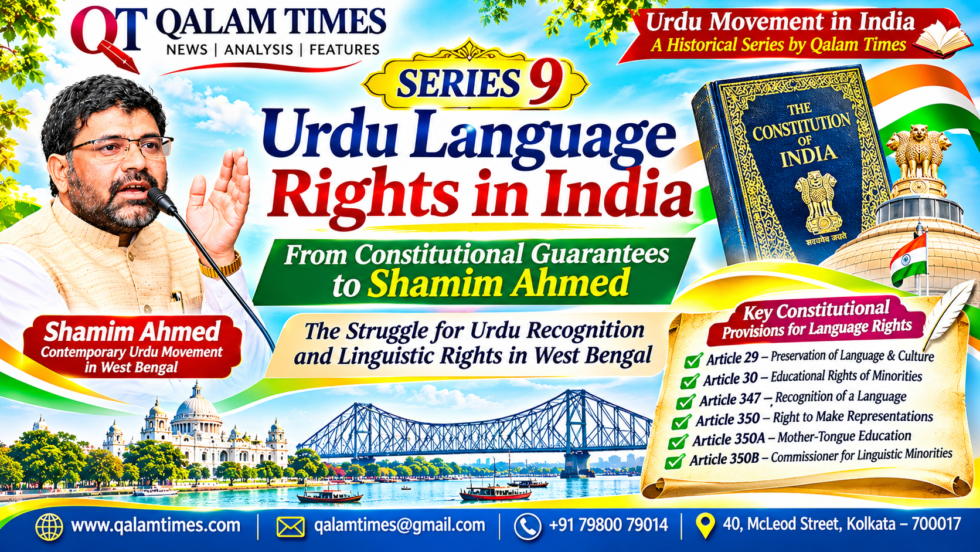
Explore the history of Urdu Language Rights in India, constitutional safeguards under Articles 29, 30, 347, 350, 350A and 350B, and Shamim Ahmed’s contemporary campaign for Urdu in West Bengal.
From the Constitutional Protection of Linguistic Minorities to the Continuing Demand for Urdu’s Recognition and Implementation in West Bengal
Qalam Times News Network
Kolkata | November 15, 2026
Urdu Language Rights in India represent an important chapter in the history of the country’s democracy, cultural diversity and constitutional development. Urdu has a distinguished literary and intellectual heritage and has contributed significantly to India’s journalism, education, poetry, political thought and public life. Its history is closely connected with the social and cultural experiences of communities across different regions of the country.
During the freedom struggle, writers, journalists and political leaders used Urdu to communicate ideas of liberty, equality, national unity and social reform. After independence, the question of linguistic rights entered a new constitutional framework. The challenge was no longer simply to oppose colonial restrictions; it was also to ensure that India’s many languages and linguistic communities received appropriate recognition and opportunities within a democratic republic.
The Constitution of India provides several safeguards relevant to linguistic communities. These provisions are important for Urdu-speaking citizens because they establish principles concerning the preservation of language and culture, educational rights, the use of languages in representations to public authorities and facilities for mother-tongue education.
More than seven decades after the Constitution came into force, the practical implementation of language-related safeguards remains an important public issue. In West Bengal, the contemporary Urdu movement associated with Shamim Ahmed has sought to bring attention to the recognition, development and institutional use of Urdu. This historical journey connects constitutional principles with the continuing demand for meaningful linguistic rights.
The Constitutional Vision of India’s Linguistic Diversity

When India became independent in 1947, the country inherited a complex linguistic landscape. Different regions had their own languages, literary traditions, scripts and cultural institutions. The makers of the Constitution had to create a political framework that could accommodate this diversity while establishing common institutions for the new republic. The Constitution did not treat India’s linguistic diversity as an obstacle to national unity. Instead, it recognised that language, script and culture form important parts of the identity and heritage of communities. The constitutional approach involved several dimensions. It addressed the official language of the Union, the freedom of states to adopt languages for official purposes, the preservation of minority languages, educational rights and the ability of citizens to communicate with public authorities. For Urdu-speaking communities, these provisions became particularly significant. They offered a constitutional framework through which language-related concerns could be raised through democratic institutions rather than being treated merely as cultural demands. It is important, however, to distinguish between the constitutional recognition of Urdu and its status as an official language of government. Urdu is included in the Eighth Schedule of the Constitution, but it is not one of the official languages of the Union under Article 343. Its official use in a state or a particular administrative area depends on the relevant constitutional provisions and applicable state legislation.
Article 29: The Right to Preserve Language, Script and Culture
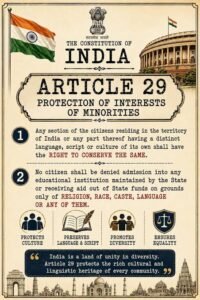
Article 29 of the Constitution is one of the most important provisions concerning the preservation of India’s cultural and linguistic diversity. Article 29(1) provides that any section of citizens residing in India or any part of the country, having a distinct language, script or culture of its own, has the right to conserve it. This provision is significant because it recognises the right of communities to preserve their linguistic and cultural heritage. It is not restricted only to religious minorities. Its wording protects any qualifying section of citizens with a distinct language, script or culture. For Urdu-speaking citizens, the principle has considerable importance. The preservation of Urdu involves more than speaking the language at home. It also includes opportunities to study Urdu, read its literature, publish newspapers and books, maintain educational and cultural institutions, and pass the language on to future generations. Article 29(2) also protects citizens against denial of admission to state-maintained or state-aided educational institutions solely on grounds of religion, race, caste or language. These provisions demonstrate that the Constitution recognises the importance of both cultural preservation and equal access to education.
Article 30: Educational Rights of Linguistic Minorities
Article 30 provides another important constitutional safeguard. It recognises the right of religious and linguistic minorities to establish and administer educational institutions of their choice.
The provision is particularly relevant to the future of Urdu education. A language needs institutions through which it can be taught, studied and developed. Educational institutions can help preserve literary traditions, train teachers, encourage research and provide opportunities for students to pursue academic studies through or in Urdu.
The right guaranteed by Article 30 is an institutional right of minorities. It should not be confused with an automatic guarantee that every school must provide Urdu instruction in every locality. The actual educational arrangements depend on applicable constitutional provisions, laws, policies and administrative implementation.
Nevertheless, Article 30 establishes an important principle: linguistic minorities have a recognised constitutional right to establish and administer educational institutions of their choice, subject to the constitutional framework.
Article 347: Recognition of a Language Spoken by a Section of a State’s Population
Article 347 addresses the question of recognition of a language spoken by a substantial proportion of a state’s population. Under this provision, if a substantial proportion of the population of a state desires the use of a particular language to be recognised, the President may, upon being satisfied with the demand, direct that the language be officially recognised throughout the state or in a part of it for purposes specified in the direction. This provision is important because it creates a constitutional mechanism through which the linguistic demands of communities can be considered. For Urdu-speaking populations, Article 347 provides a relevant constitutional reference when discussing the recognition of Urdu in particular states or administrative areas. However, the provision does not automatically make every language spoken by a substantial population an official language. Its operation depends on the constitutional process and the direction issued by the President. The distinction between a constitutional possibility and an implemented official-language arrangement is essential to any serious discussion of Urdu’s status.
Article 350: The Right to Submit Representations in Languages Used in the Union or State
Article 350 provides that every person is entitled to submit a representation for the redress of a grievance to an officer or authority of the Union or a state in any of the languages used in the Union or the state, as applicable. This provision gives language an important place in the relationship between citizens and public administration. For ordinary citizens, the ability to communicate with government authorities is a practical democratic concern. A person should be able to raise a grievance and seek administrative attention through a language recognised for the relevant purpose under the constitutional provision. For Urdu-speaking citizens, Article 350 is particularly relevant when discussing access to public offices, administrative communication and the ability to present language-related grievances. It is also important not to overstate the provision. Article 350 does not declare Urdu to be an official language of every state or require every government office throughout India to conduct all business in Urdu. Its wording concerns representations in languages used in the Union or the relevant state.
Article 350A: Mother-Tongue Education at the Primary Stage
Education is one of the most important areas in which linguistic rights become meaningful. Article 350A provides that every state and local authority should endeavour to provide adequate facilities for instruction in the mother tongue at the primary stage for children belonging to linguistic minority groups. It also empowers the President to issue directions considered necessary or proper for securing such facilities. This provision has particular relevance for children from Urdu-speaking families. A child’s mother tongue can play an important role in early learning, communication and intellectual development. When children have opportunities to receive primary education through their mother tongue, they can build a stronger foundation for further learning while maintaining a connection with their linguistic and cultural heritage. For Urdu-speaking communities, the practical questions include the availability of qualified Urdu teachers, suitable textbooks, functioning educational institutions and adequate arrangements for Urdu-medium or Urdu-language instruction where required. The existence of a constitutional provision is an important starting point. Its practical value, however, depends on effective implementation, educational planning and the availability of institutional resources.
Article 350B: The Commissioner for Linguistic Minorities
The Constitution also provides for a Special Officer for Linguistic Minorities under Article 350B. The officer’s responsibility is to investigate matters relating to the safeguards provided for linguistic minorities under the Constitution and report to the President. The reports are required to be placed before Parliament and sent to the governments of the states concerned. This mechanism is important because constitutional safeguards require monitoring. The existence of rights and the actual experience of citizens may not always be identical. The Commissioner for Linguistic Minorities therefore has an important role in examining complaints, reviewing implementation and drawing attention to difficulties faced by linguistic communities. For Urdu-speaking citizens, the institution provides a constitutional channel through which issues concerning education, recognition and other linguistic safeguards can be raised.
Urdu in the Eighth Schedule: Constitutional Recognition and Its Meaning
Urdu is one of the 22 languages included in the Eighth Schedule of the Constitution of India. Its inclusion represents constitutional recognition of Urdu as an important language within India’s linguistic heritage. It reflects the place of Urdu in the country’s literary, cultural and intellectual history. However, Eighth Schedule recognition and official-language status are different matters. Inclusion in the Eighth Schedule does not automatically make Urdu an official language of every state or of the Union for all administrative purposes. This distinction is important in public discussions. Urdu’s constitutional recognition should be understood accurately, without confusing it with the separate legal processes through which a language may be adopted for official purposes by the Union or a state.
The recognition of Urdu in the Eighth Schedule nevertheless provides an important foundation for its continued development in literature, education, scholarship and public life.
West Bengal: The Legal Recognition of Urdu
The history of Urdu in West Bengal provides an important regional example of how linguistic demands can enter the legislative process. West Bengal has a long-standing Urdu-speaking population, particularly in Kolkata and several other districts and urban centres. Urdu has contributed to the state’s journalism, literature, education and cultural life. An important legislative development came through the West Bengal Official Language (Amendment) Act, 2012, which amended the West Bengal Official Language Act, 1961.
The 2012 amendment introduced provisions concerning the use of Urdu in districts, subdivisions, blocks or municipalities where the population of Urdu-speaking people exceeded ten per cent. It provided for Urdu to be used, in addition to Bengali and Nepali, for specified purposes, including certain rules and regulations, government notifications and orders, petitions and applications in public offices, documents received by public offices, important government advertisements and signboards.
The legislation also provided for the use of Urdu in the specified administrative areas and for the purposes described in the Act. A further amendment, published in January 2013, modified the relevant provision to include Hindi-speaking populations in the threshold arrangement as well. The legal significance of these amendments should be understood carefully. They did not make Urdu an unrestricted official language throughout West Bengal. Rather, they created a framework for its use in specified administrative areas and for specified purposes, subject to the statutory conditions and implementation arrangements. This distinction is central to understanding the contemporary Urdu movement in the state.
From Legal Recognition to Practical Implementation
The passage of legislation is an important achievement, but legislation alone does not guarantee that citizens will experience the benefits intended by it. The practical implementation of language provisions requires administrative preparation, trained personnel, translation facilities, educational resources and public awareness. In areas where the legal conditions for Urdu’s use are fulfilled, citizens need to know how to submit applications and petitions in Urdu. Public offices need appropriate arrangements to receive and process documents. Important government information and signboards covered by the relevant provisions need to be made accessible in the languages required by law. Education is another major concern. The availability of Urdu teachers, textbooks and functioning institutions can determine whether children are able to continue studying the language. The difference between a legal provision and its implementation is therefore an important part of the debate over Urdu’s position in West Bengal. A meaningful language policy must be visible in classrooms, public offices, libraries, cultural institutions and everyday civic life.
Shamim Ahmed and the Contemporary Urdu Movement in Bengal
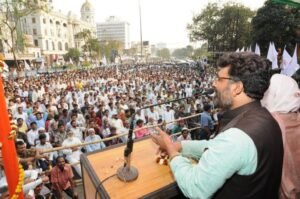
It is within this larger constitutional and legislative context that the contemporary Urdu movement associated with Shamim Ahmed in West Bengal deserves attention. Shamim Ahmed has been associated with public efforts to raise awareness about Urdu-related demands and the position of Urdu-speaking communities. His campaign has sought to bring linguistic concerns into public discussion and encourage political and administrative attention to the needs of Urdu speakers. One notable episode in this campaign was the 36-hour sit-in protest held near the Gandhi statue in Kolkata on 28 June 2008. The protest was associated with the slogan “No Urdu, No Vote” and sought to highlight Urdu-related demands before political representatives and the wider public. The significance of such mobilisation lies in the attempt to turn linguistic concerns into a matter of democratic accountability. The campaign belongs to a different historical period from the constitutional debates of the 1940s and the early years of independent India. It should not be presented as a direct organisational continuation of the work of the Constitution’s framers. Its relevance is instead found in the relationship between constitutional principles and the continuing efforts of citizens to secure recognition and implementation. The demands raised by Urdu activists in Bengal bring attention to questions that remain important: Are language-related provisions being implemented effectively? Do Urdu-speaking citizens have adequate educational opportunities? Are public offices accessible to them in accordance with applicable laws? Are younger generations receiving the institutional support necessary to continue the language? These questions connect the history of Urdu’s constitutional protection with the realities of contemporary public life.
From Constitutional Articles to Public Awareness
The Constitution provides the legal framework, but citizens and institutions play an important role in ensuring that its principles are understood and implemented. Public awareness about Articles 29, 30, 347, 350, 350A and 350B can help Urdu-speaking communities understand the nature and limits of their rights. Educational institutions can promote Urdu learning and scholarship. Journalists can investigate the implementation of language policies. Civil society organisations can raise concerns through lawful democratic channels. Public representatives can examine administrative difficulties and support appropriate measures. The media also has a special responsibility. Urdu newspapers and digital platforms can explain constitutional provisions in accessible language, report on educational conditions and provide a forum for discussion. In this context, the work of publications such as Qalam Times can contribute to public understanding by documenting the historical background of Urdu movements and examining contemporary linguistic issues.
The Responsibility of the Younger Generation
The future of Urdu cannot depend only on political demands or historical remembrance. It also depends on whether the younger generation continues to read, write, study and use the language. Urdu needs modern educational resources, accessible digital publications, libraries, research opportunities and professional spaces in which young people can develop their skills. Parents, teachers, writers, journalists and educational institutions all have a role to play. Students should be encouraged to explore Urdu literature, journalism, history and contemporary writing. Digital platforms can make Urdu content accessible to readers who may not have easy access to printed publications. The language should also be presented as a medium of knowledge and opportunity rather than only as a symbol of the past. A living language grows when it is used in classrooms, research, technology, journalism, public discussion and creative expression. The history of Urdu in independent India is not merely a story of literary achievement. It is also a story of constitutional recognition, educational aspirations, public participation and the continuing effort to secure meaningful linguistic opportunities. Articles 29 and 30 recognise important rights concerning cultural preservation and minority educational institutions. Article 347 provides a mechanism for recognition of languages spoken by substantial sections of a state’s population. Article 350 concerns representations for the redress of grievances, while Articles 350A and 350B address mother-tongue education and the monitoring of linguistic safeguards. The inclusion of Urdu in the Eighth Schedule further reflects its place in India’s linguistic heritage. In West Bengal, the Official Language Amendment legislation of 2012 and its subsequent amendment created a specific legal framework for the use of Urdu in qualifying administrative areas. The contemporary movement associated with Shamim Ahmed highlights the continuing importance of public awareness, democratic advocacy and effective implementation. The constitutional journey of Urdu should therefore not be understood as a completed chapter. It remains an ongoing responsibility involving governments, educational institutions, civil society, journalists and citizens. From the constitutional vision of linguistic diversity to the public campaigns for Urdu in Bengal, the central message is clear:
Recognition gives a language a place in the law. Education, institutions and public participation give it a living future.