



USCIRF Controversy deepens as Indian Ambassador Vinay Kwatra rejects the US panel’s remarks on Sharjeel Imam’s detention and questions its assessment of India’s religious freedom record.
Indian Ambassador Tells US Religious Freedom Commission to Examine Its Own Biases Instead of Questioning India’s Constitutional Framework
Qalam Times News Network
New Delhi, November 14, 2026
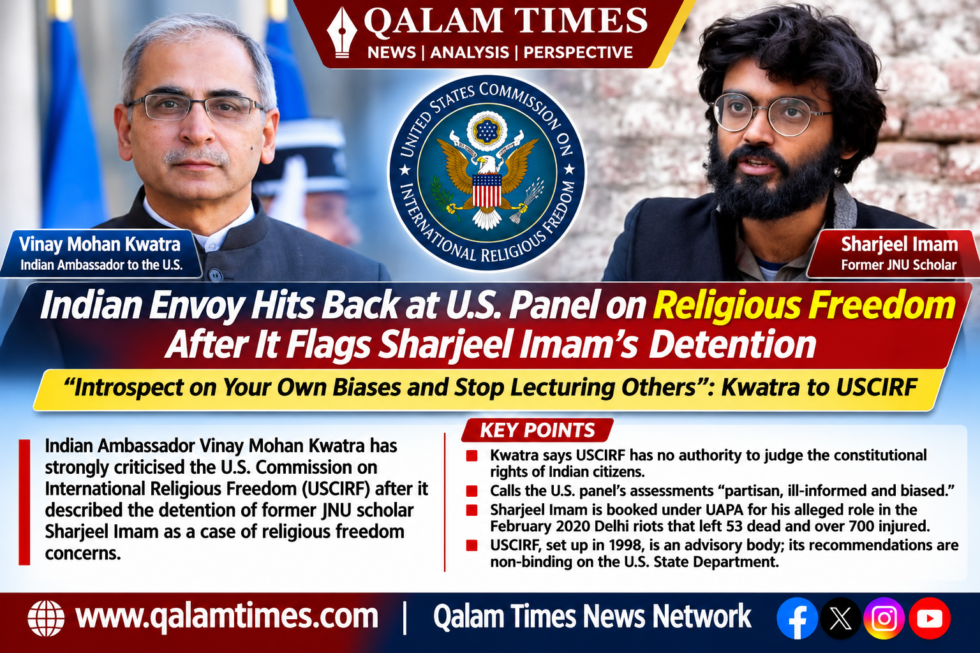
The USCIRF controversy has intensified after India’s Ambassador to the United States, Vinay Mohan Kwatra, strongly criticised the US Commission on International Religious Freedom (USCIRF) for portraying the detention of former Jawaharlal Nehru University (JNU) scholar Sharjeel Imam as a case of religious freedom violations.
Vinay Mohan Kwatra, India’s Ambassador to the United States.
Responding to the American body’s remarks, Kwatra questioned its authority to comment on India’s constitutional and legal matters. He urged the commission to examine its own prejudices rather than issue what he described as politically motivated assessments of India’s religious freedom record. The diplomatic exchange followed a post published by USCIRF on the social media platform X, in which the commission described Imam as a Muslim man detained in India for his advocacy of religious freedom. The post drew a sharp response from the Indian ambassador, who rejected the characterisation and defended India’s constitutional commitment to equality and religious liberty. Kwatra maintained that USCIRF had no authority to pass judgment on the constitutional rights of Indian citizens. He also accused the organisation of repeatedly producing assessments that were partisan, inadequately informed and influenced by preconceived positions. In his response, the ambassador said that such criticism could not undermine India’s commitment to protecting the rights of people belonging to different religious communities. Taking a direct swipe at the American commission, Kwatra advised its members to look inward before commenting on the internal affairs of other countries. He argued that India continued to function as a diverse democratic society despite what he described as agenda-driven narratives promoted by the organisation.
Sharjeel Imam’s Detention and the 2020 Delhi Riots Case
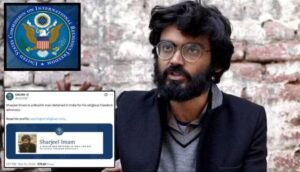
Sharjeel Imam, a former JNU research scholar, has been charged under the Unlawful Activities (Prevention) Act (UAPA) in connection with the February 2020 Delhi riots case. Investigating agencies have accused him of being among those who allegedly played a role in planning the violence. These allegations form part of the legal proceedings against him and must be considered within the framework of the judicial process. The February 2020 violence in Delhi resulted in 53 deaths and left more than 700 people injured. The unrest occurred amid intense political and public demonstrations against the Citizenship (Amendment) Act (CAA), 2019, and the proposed National Register of Citizens (NRC). The protests and subsequent violence generated widespread political debate, both within India and internationally, concerning citizenship, constitutional rights, freedom of expression and the handling of public demonstrations. Imam’s detention has continued to attract attention from civil liberties organisations and international observers, with differing interpretations of the legal proceedings and the broader political circumstances surrounding the case.
India Questions USCIRF’s Credibility
The latest exchange has once again brought India’s longstanding differences with USCIRF into focus. The US Commission on International Religious Freedom was established in 1998 following the passage of the International Religious Freedom Act. It operates as an independent, bipartisan advisory body within the American governmental framework and monitors religious freedom conditions across the world. The commission publishes assessments and makes recommendations to the US government, particularly concerning countries where it believes religious freedom is under threat. However, its recommendations are advisory and are not binding on the US State Department. India has repeatedly criticised USCIRF’s reports and recommendations, arguing that its assessments are selective and fail to adequately understand the country’s constitutional framework, social diversity and democratic institutions. Indian authorities have previously questioned the organisation’s methodology and accused it of applying inconsistent standards while evaluating religious freedom in different countries. New Delhi’s position has consistently been that India’s constitutional structure guarantees equal rights to citizens irrespective of their religion and that foreign organisations should not attempt to influence domestic legal and constitutional matters through selective commentary.
A Diplomatic Disagreement Over Religious Freedom and Sovereignty
The latest confrontation highlights the continuing differences between India and sections of the American policy establishment over the interpretation of religious freedom, individual rights and national sovereignty. While USCIRF has raised concerns about Imam’s detention by presenting it through the lens of religious freedom, the Indian government has rejected that interpretation and maintained that the matter concerns domestic legal proceedings. Kwatra’s response reflects New Delhi’s broader objection to what it considers external interference in India’s internal affairs. The episode also illustrates the challenge of balancing international human rights scrutiny with the principle that domestic legal matters should be assessed through established judicial processes.As the debate continues, the central questions surrounding Sharjeel Imam’s case remain tied to the ongoing legal proceedings, the interpretation of constitutional freedoms and the wider discussion about the relationship between national sovereignty and international human rights advocacy.