



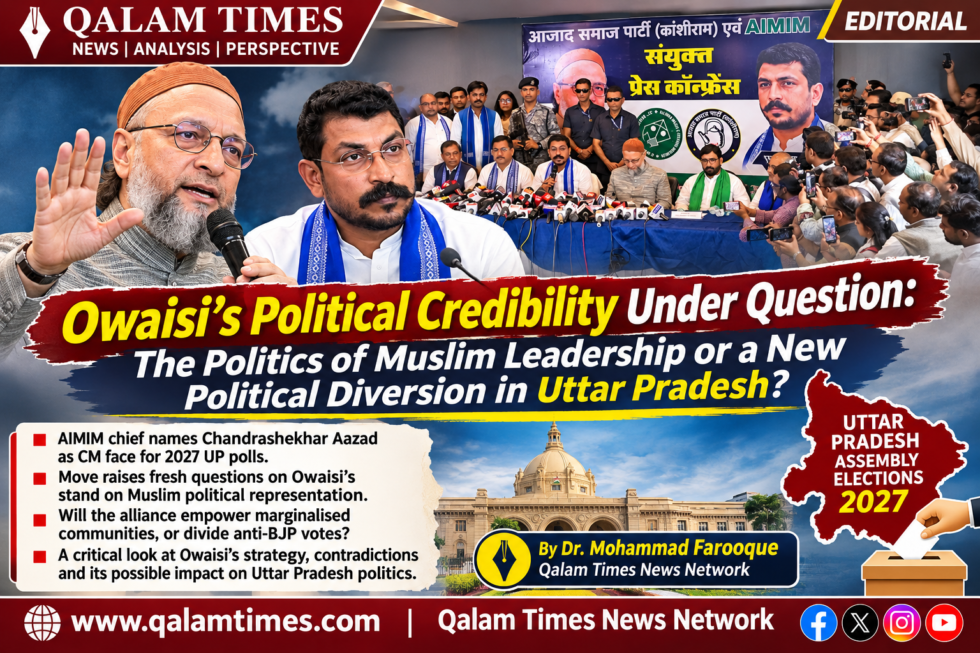
Owaisi Political Credibility faces scrutiny after his alliance with Chandrashekhar Aazad for the 2027 Uttar Pradesh elections raises questions about Muslim representation and opposition unity.
A Sharp Examination of Asaduddin Owaisi’s Alliance with Chandrashekhar Aazad, His Contradictions on Muslim Representation and the Political Consequences for the 2027 Uttar Pradesh Elections
Dr. Mohammad Farooque
Qalam Times News Network
Kolkata, November 13, 2026
There is a fundamental difference between claiming to represent a community and actually taking responsibility for its political future. Asaduddin Owaisi has spent years presenting himself as a powerful voice for Muslim political representation in India. Yet his latest political arrangement in Uttar Pradesh raises serious questions about the consistency, credibility and ultimate purpose of his politics. The announcement of Chandrashekhar Aazad as the chief ministerial face of the newly formed Samajik Parivartan Morcha has once again exposed the contradictions between Owaisi’s political rhetoric and his electoral decisions. His politics deserves scrutiny, not unquestioning applause.
The issue is not whether Chandrashekhar Aazad deserves to become the Chief Minister of Uttar Pradesh. He is entitled to pursue that ambition, just as any other political leader is. The real question concerns Owaisi’s Political Credibility. For years, Owaisi has challenged established opposition parties over their reluctance to give Muslims adequate political representation. He has repeatedly questioned why Muslim voters are expected to support political formations without receiving meaningful leadership positions in return. Yet, when it came to announcing the leadership of his own alliance, he accepted a political arrangement in which a non-Muslim leader was projected as the chief ministerial candidate. If electoral arithmetic, demographic realities and political strategy justify this decision, why are the same considerations not considered legitimate when other parties make similar choices?
The Politics of Double Standards
Owaisi’s political speeches have frequently revolved around the argument that Muslims must stop functioning merely as a dependable vote bank for larger political parties. His message has been particularly forceful in Uttar Pradesh, where he has criticised the Samajwadi Party and other opposition formations for allegedly using Muslim votes without ensuring proportionate political representation.
His famous political rhetoric about Abdul no longer laying the carpet for others was intended to communicate a message of independence, dignity and political self-respect. It appealed to a section of voters who felt that Muslim political aspirations had been neglected for decades.
But slogans are not political achievements. The real test of leadership is whether its actions match its declarations.
If Owaisi believes that Muslim representation should be measured through actual participation in political power, then he must explain why the same principle appears to become flexible when negotiating alliances. Why is the leadership question so important when dealing with the Samajwadi Party, but seemingly less important when negotiating with Chandrashekhar Aazad?
Political alliances inevitably require compromises. No serious observer would deny that. However, a leader who constantly lectures others about political representation cannot reasonably expect to remain exempt from questions about his own compromises.
Chandrashekhar Aazad: A New Political Face, But What Is the Real Strategy?
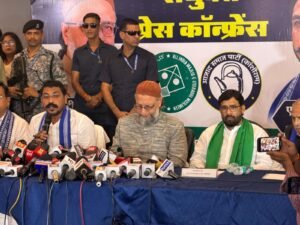
The announcement of Chandrashekhar Aazad as the chief ministerial candidate gives the Samajik Parivartan Morcha an identifiable leadership face ahead of the 2027 Assembly elections. Aazad has developed a political identity around Dalit rights, social justice and the empowerment of marginalised communities. His Azad Samaj Party seeks to expand its influence beyond its existing political base. Owaisi, meanwhile, brings a recognisable political identity and an established organisational presence among sections of Muslim voters. On paper, the partnership may appear to be an attempt to consolidate Dalit and Muslim political support. Such an alliance is not inherently unreasonable. Indeed, cooperation between historically marginalised communities could contribute to a broader democratic movement if it is based on genuine common interests, an agreed programme and mutual political respect. But the crucial question remains: can this alliance become a credible alternative government, or will it primarily operate as an electoral force that changes the distribution of votes in closely contested constituencies?
The distinction is enormous. An alliance that genuinely seeks social transformation must demonstrate its capacity to win public confidence across communities. It cannot survive merely through provocative speeches, political accusations and emotionally charged slogans.
Will the Alliance Strengthen or Divide the Opposition?
Uttar Pradesh is one of India’s most politically significant states. Its Assembly elections have consequences far beyond the state’s geographical boundaries. The BJP’s electoral strength is based on several factors, including its organisational machinery, social coalition-building, political messaging and ability to consolidate support across different communities. Any opposition strategy that seeks to challenge the BJP must therefore be judged by its capacity to build a broad and effective electoral alternative. The new alliance raises an uncomfortable but necessary question: what happens if its candidates divide anti-BJP votes in constituencies where the contest is otherwise close? Owaisi has every democratic right to contest elections, form alliances and seek political power. However, democratic freedom also comes with political accountability. If the alliance weakens the principal opposition challenge and indirectly benefits the BJP, its leadership cannot simply dismiss criticism as hostility towards independent Muslim politics. Electoral consequences matter more than political intentions. The allegation that Owaisi’s electoral interventions have sometimes benefited the BJP is not new. His supporters reject this criticism and argue that Muslims have an independent democratic right to choose their political representatives. Both arguments deserve examination. What cannot be accepted is the assumption that questioning his electoral strategy amounts to opposing Muslim political empowerment. A genuine leader should welcome questions about whether his political decisions are advancing the interests of the people he claims to represent.
The Unanswered Questions About Muslim Political Leadership
Owaisi has repeatedly challenged the Samajwadi Party’s treatment of Muslim voters. He has questioned the absence of adequate Muslim leadership and argued that the community should not remain politically dependent on established parties. These are legitimate political concerns. Muslim representation in legislative bodies, access to decision-making positions, educational opportunities, economic development and protection of constitutional rights deserve serious attention.
However, the question is whether Owaisi’s own political model offers a sustainable answer.How many meaningful leadership positions will Muslim representatives receive within the new alliance? What will be the alliance’s position on minority education, employment, security, political participation and economic development? Will its policies be reflected in an enforceable common programme, or will the partnership remain dependent on election-time speeches? Most importantly, will Owaisi apply the same standards of accountability to himself that he demands from other political leaders? The community does not need another political personality who speaks loudly about representation but leaves voters uncertain about the actual outcomes of his political negotiations. It needs accountable leadership, measurable commitments and institutions that function beyond the personality of a single individual.
Political Questions That Cannot Be Silenced
Owaisi’s political career and the political activities of his family have attracted both admiration and criticism. His supporters regard him as an outspoken advocate of Muslim political rights, while his opponents question his electoral methods and the wider consequences of his political interventions.
There have also been public allegations and political controversies concerning the wider political and financial activities associated with his party and family. Such matters should be examined through documentary evidence, independent investigation and due legal process. Political accusations alone cannot establish criminal wrongdoing. Nevertheless, a leader who demands accountability from every other political formation must be equally prepared to answer questions about his own political record, organisational practices and financial transparency. No political family should enjoy immunity from scrutiny merely because it claims to speak for a marginalised community. The same principle applies to Owaisi as it does to every other powerful political personality in a democracy.
The BJP Question: Opposition Through Words or Opposition Through Results?
One of the most important tests for the Samajik Parivartan Morcha will be its actual approach towards the BJP. Owaisi has frequently attacked the BJP in his speeches. He has also criticised opposition parties for what he describes as their failure to confront the ruling establishment effectively. But political opposition cannot be measured simply by the intensity of speeches. It must be measured through electoral outcomes, organisational strength, policy alternatives and the ability to protect democratic institutions and constitutional rights. If the new alliance genuinely wants to prevent another BJP government in Uttar Pradesh, it must explain how its candidates will avoid dividing anti-BJP votes. It must also demonstrate how it intends to build a coalition that extends beyond narrow electoral calculations. The leadership cannot demand that voters judge other opposition parties by their electoral performance while asking the public to judge its own alliance only by its stated intentions. That would be another political double standard.
The Responsibility of Religious Scholars and Community Leaders
There is another uncomfortable dimension to this debate: the response of religious scholars, community organisations and self-proclaimed representatives of Muslim interests. Too often, political personalities receive unquestioning public endorsements simply because they speak in the language of community identity. Some community leaders may genuinely support Owaisi’s political approach. Others may disagree privately but hesitate to express their concerns publicly because of political pressure, social criticism or the fear of losing influence. Neither blind support nor convenient silence serves the public interest. Religious scholars and community representatives have a responsibility to encourage political awareness rather than cultivate personality-based loyalty. They should evaluate political leaders on their policies, conduct, public accountability and tangible contributions. No individual politician should be elevated to the status of an unquestionable representative of an entire community. The Muslim electorate is neither politically immature nor incapable of independent judgment. It has every right to question its leaders, reject their strategies and demand better alternatives.
Uttar Pradesh Needs a Vision, Not Political Theatre
The 2027 Assembly election should be about the future of Uttar Pradesh. Unemployment, educational inequality, farmers’ difficulties, healthcare, public safety, economic opportunities and the protection of constitutional rights are issues that affect millions of people. If the Samajik Parivartan Morcha wishes to become a serious political alternative, it must present a detailed programme addressing these challenges. It must explain how it intends to improve government schools, create employment, strengthen public healthcare, support farmers and ensure equal access to public institutions. It must also explain how Dalits, Muslims, backward communities, women and economically disadvantaged citizens will participate in governance. A chief ministerial candidate is not enough. A political movement requires a vision, a team, a programme and a credible record of public service. Without these foundations, even the most impressive political announcement risks becoming another temporary electoral spectacle.
The alliance between Asaduddin Owaisi and Chandrashekhar Aazad may reshape certain political calculations ahead of the 2027 Uttar Pradesh elections. It may attract sections of Dalit and Muslim voters seeking an alternative to established political formations. But it also raises serious questions about consistency, political compromise and electoral responsibility. Owaisi cannot permanently claim the moral authority to question every other party’s approach to Muslim representation while refusing to explain the compromises made within his own alliance. Nor can the possible electoral consequences of his political strategy be dismissed simply because he presents it as an exercise in independent leadership. The central issue is not whether Owaisi should form an alliance or whether Aazad should become its chief ministerial face. Both are entitled to pursue their political ambitions. The central issue is whether this alliance will genuinely improve the political position of marginalised communities or merely create another electoral arrangement without a convincing programme for social and economic transformation. The people of Uttar Pradesh must look beyond slogans, personalities and emotional appeals. They must demand answers, examine political records and judge every alliance by its actual contribution to democracy.
Muslim political empowerment cannot be reduced to the ambitions of one political family, just as Dalit empowerment cannot be reduced to the political fortunes of one leader. Communities deserve institutions, representation, dignity and results — not permanent dependence on political personalities.
That is the real test of leadership. And that is the question Asaduddin Owaisi must answer before asking the people of Uttar Pradesh to trust his new political experiment.