



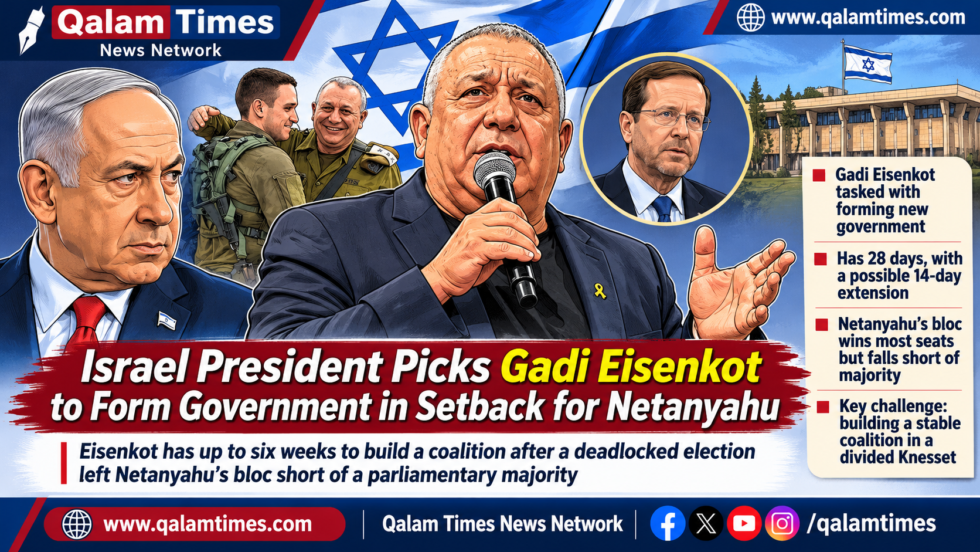
Gadi Eisenkot has been chosen by Israel’s president to form a new government, creating a major political challenge for Benjamin Netanyahu after a deadlocked election.
Qalam Times News Network
Jerusalem, Israel, November 8, 2026
Gadi Eisenkot has emerged as Israel‘s new political challenger after President Isaac Herzog selected the opposition leader to attempt to form the country’s next government following a closely contested election that left the political landscape deeply divided. The decision represents a major setback for outgoing Prime Minister Benjamin Netanyahu, whose religious-nationalist coalition failed to secure a parliamentary majority.
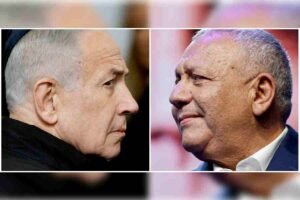
The Gadi Eisenkot nomination comes after the October 27 election produced no clear winner capable of forming a stable government. Although Netanyahu’s Likud party secured the largest number of seats individually, his broader political alliance fell short of the 61 seats required for a majority in the 120-member Knesset.
President Herzog’s office confirmed that Eisenkot had been invited to the President’s Residence and would formally receive the responsibility of assembling a governing coalition. He has 28 days to complete the task, with a possible 14-day extension.
Coalition Challenge as Israel Faces Political Uncertainty
The parliamentary arithmetic presents a difficult challenge for Eisenkot. His Yashar party secured 21 seats, while the four-party coalition associated with him won 48 seats. Netanyahu’s Likud secured 27 seats, but his wider coalition managed only 53.
Meanwhile, two parties representing Israel’s Arab minority secured a combined 19 seats, an unprecedented result according to the election figures provided.
Although Arab political leaders endorsed Eisenkot, he has previously resisted forming a coalition with Arab parties. Nevertheless, their support could become important in determining whether he can establish a government.
Eisenkot’s possible options include leading a minority government with outside Arab support, negotiating an agreement with ultra-Orthodox parties or considering a broader national unity arrangement. However, each possibility faces considerable political obstacles.
If Eisenkot fails, another candidate may receive an opportunity to form a government. Should subsequent attempts also prove unsuccessful, Israel could face another election.
Gadi Eisenkot’s Political Background and Differences With Netanyahu

A former military chief, Gadi Eisenkot entered politics in 2022 and briefly served in Netanyahu’s wartime cabinet following the Hamas-led October 7, 2023 attacks on Israel. He later returned to the opposition and became increasingly critical of Netanyahu’s leadership, particularly his handling of the Gaza war. Eisenkot has ruled out serving in a government led by Netanyahu, placing him at the centre of the country’s political confrontation.
His family has also experienced personal tragedy during the conflict, with his son and two nephews reportedly killed while fighting in Gaza. Born to Moroccan immigrant parents, the 66-year-old politician could become Israel’s first prime minister from the Mizrahi Jewish community, whose historical roots lie in the Middle East and North Africa.
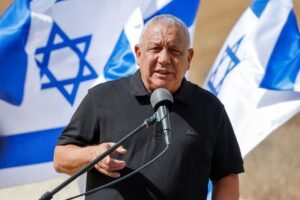
On security matters, Eisenkot has highlighted his military experience, including his association with the Dahiyeh doctrine, a strategy involving overwhelming military force against hostile groups. He previously employed this approach during Israel’s 2006 conflict with Hezbollah in Lebanon. He has also criticised violence by Israeli settlers against Palestinians, which has increased tensions with several Western countries. His opposition to far-right politicians Itamar Ben-Gvir and Bezalel Smotrich further distinguishes him from Netanyahu’s political allies. Eisenkot’s nomination therefore represents an important moment in Israeli politics. Whether he can overcome ideological divisions and secure enough parliamentary support remains uncertain, but the coming weeks will determine whether Netanyahu’s long political dominance is finally challenged by a new governing coalition.