



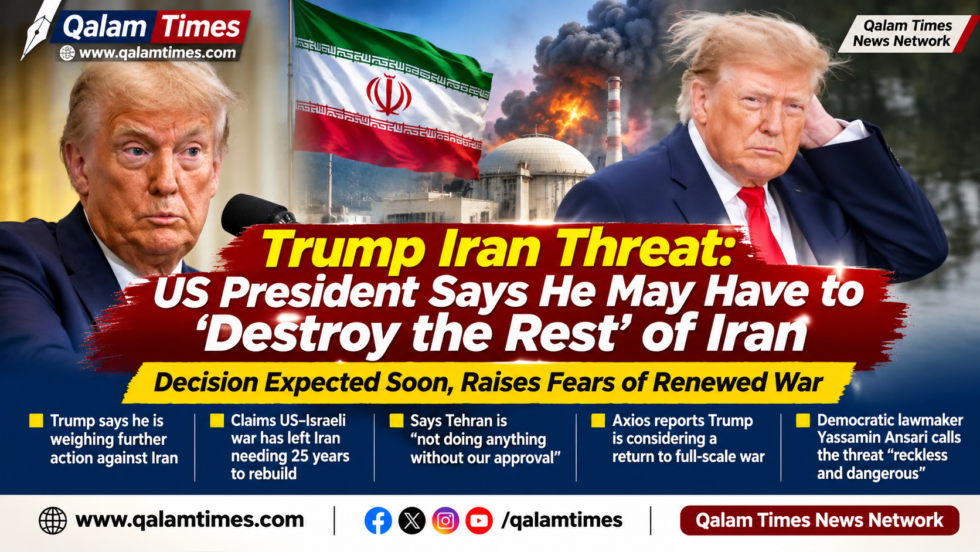
Trump Iran Threat intensifies as Donald Trump warns he may have to destroy the rest of Iran, raising fears of renewed US military action and escalating tensions across the Middle East.
Qalam Times News Network
Kolkata, November 6, 2026
Trump Signals Possible Return to Military Escalation After US Midterm Elections; Democratic Lawmakers Condemn His Remarks as Dangerous and Irresponsible
The Trump Iran Threat has intensified concerns over the possibility of another major military escalation in the Middle East after US President Donald Trump suggested that Washington might consider further military action against Iran. Speaking to reporters at the White House on Thursday, November 5, Trump indicated that he was weighing whether to take additional steps against the country, adding that his final decision would become clear soon.
During his remarks in the Oval Office, the American President said he would prefer not to destroy what remained of Iran but suggested that further action might nevertheless become necessary. His comments have raised questions about Washington’s future military strategy and the possibility of renewed confrontation with Tehran following months of conflict involving the United States, Israel and Iran.
Trump described the decision as a choice between bringing the confrontation to a definitive conclusion and ensuring that Iran would never again pose what his administration considers a nuclear or security threat.
“We’ll make a decision: Do we want to go further and just certify it, by certifying it meaning it will never happen again?” Trump told reporters.
He subsequently added: “I would rather not destroy the rest of the country, if possible, but maybe I’ll have to.”
The President did not provide specific details about what further military action might involve, leaving uncertainty over whether his administration was considering additional strikes, a wider military campaign or another form of pressure against Tehran.
Trump Claims Iran Could Take 25 Years to Rebuild
While discussing the consequences of the US-Israeli military campaign, Trump claimed that the damage inflicted on Iran had been so extensive that the country could require approximately 25 years to rebuild.
His assessment appeared intended to underline the scale of the destruction resulting from the conflict and the military pressure exerted on Tehran.
However, his latest remarks also suggest that Washington has not necessarily ruled out further military action, despite the extensive damage Trump claims has already been inflicted on Iranian infrastructure and military capabilities.
The Trump Iran Threat has also brought renewed attention to diplomatic efforts surrounding Iran’s nuclear programme.
Asked about reports that Tehran had sent a proposal concerning its nuclear activities to Washington through intermediaries, Trump claimed that Iran was not taking any steps without American approval.
He did not, however, clarify whether the United States was directly involved in the reported mediation process or whether any formal diplomatic negotiations were underway.
His remarks have therefore left open questions about the future of diplomatic engagement between the two countries and whether negotiations could prevent another round of military confrontation.
Reports Suggest Trump Is Weighing a Return to Full-Scale War
According to a report by Axios, Trump made the comments after meeting members of his national security team and indicated that he would soon decide whether to resume an all-out military campaign against Iran.
The timing of the remarks is particularly significant, as they came after the US midterm elections.
The report suggested that the President was considering his next military and diplomatic options following the electoral process. However, no specific timetable or operational details for any potential military action were publicly announced in the remarks described.
Israel National News also reported Trump’s warning, quoting him as saying that the United States was “locked and loaded” if it had to complete what he described as the remaining military operation against Iran.
These statements have intensified speculation about the possibility of renewed hostilities and the broader implications for regional security.
A fresh military escalation could have consequences extending well beyond Iran and Israel, particularly given the strategic importance of the Middle East to international energy markets, global trade and regional stability.
Democratic Lawmakers Condemn Trump’s Warning
Trump’s remarks have attracted sharp criticism from Democratic lawmakers in the United States.
Congresswoman Yassamin Ansari strongly objected to the President’s language, accusing him of threatening the destruction of a country with approximately 90 million people.
She described the conflict as a “reckless war of choice”, expressing concern over the human and political consequences of the military confrontation.
Her criticism reflects wider concerns among opponents of the administration’s approach that further military action could deepen instability, increase civilian suffering and create a prolonged regional crisis.
The prospect of renewed attacks has also raised questions about the limits of presidential military authority, the role of Congress in decisions involving sustained warfare and the extent to which diplomatic alternatives have been explored.
Iran Conflict Raises Wider Questions About Regional and Global Stability
The latest developments underline the fragile situation surrounding the confrontation between Washington and Tehran.
Iran’s nuclear programme has remained a major source of tension in relations with the United States and Israel. While Washington has repeatedly expressed concerns about Tehran’s nuclear capabilities, Iran has maintained its own position on its nuclear activities and national sovereignty.
The possibility of renewed military operations could make an already difficult diplomatic situation even more complicated.
Any further escalation could also affect neighbouring countries, international shipping routes, energy supplies and the wider geopolitical balance in West Asia.
For ordinary people, the consequences of a prolonged conflict would extend far beyond political statements and military calculations. Civilian casualties, displacement, damage to infrastructure and economic disruption could become even more serious if hostilities intensify.
Trump’s latest remarks have therefore placed the future of US policy towards Iran under renewed scrutiny.
Whether Washington ultimately chooses further military action or returns to diplomatic engagement remains uncertain. What is clear from the President’s public statements is that the possibility of another escalation has not been ruled out.
As the international community watches developments closely, the central question remains whether the confrontation will move towards a diplomatic settlement or enter another dangerous phase of military conflict.