



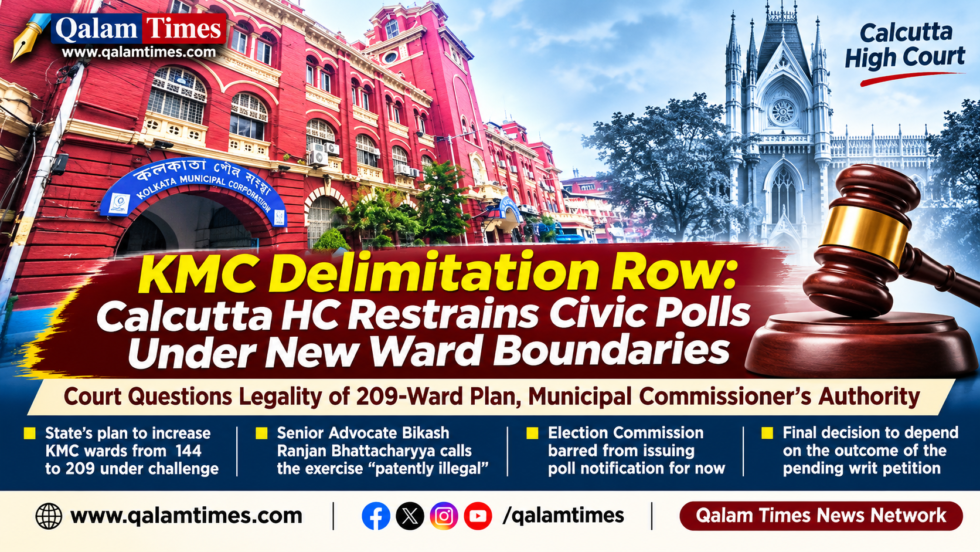
KMC Delimitation faces a major legal challenge as Calcutta High Court restrains civic poll notifications under the proposed 209-ward structure. Bikash Ranjan Bhattacharyya questions the Municipal Commissioner’s authority.
By Qalam Times News Network
Kolkata, November 6, 2026
KMC Delimitation : Bikash Ranjan Bhattacharyya Challenges Authority of Municipal Commissioner; Division Bench Bars Election Notification Until Pending Legal Challenge Is Decided
KMC Delimitation has suffered a significant judicial setback after the Calcutta High Court restrained the West Bengal State Election Commission from issuing an election notification for the Kolkata Municipal Corporation (KMC) polls on the basis of newly redrawn ward boundaries. The Division Bench has directed that no civic election notification based on the amended ward structure can be issued until the pending legal challenge to the delimitation exercise is finally decided.
The ruling has brought the controversial KMC Delimitation process under fresh judicial scrutiny, particularly over the legality of increasing the number of municipal wards from 144 to 209 and the authority under which the boundaries were redrawn. The dispute raises important questions about the powers of an appointed administrator, the role of an elected municipal corporation and the constitutional safeguards governing local-body elections.
A Division Bench comprising Justice Sabyasachi Bhattacharyya and Justice Arjun Ray Mukherjee passed the order on Friday while hearing an appeal filed by Dipu Das, a former Kolkata Municipal Corporation councillor who served between 2005 and 2010 during the Communist Party of India (Marxist) regime.
The Bench partly allowed the appeal and modified an earlier order passed by Justice Hiranmay Bhattacharyya on October 29, which had refused to grant an interim stay on the state government’s delimitation notification.
In its latest order, the Division Bench restrained the West Bengal State Election Commission, identified as respondent number six, from issuing a notification calling elections to the Kolkata Municipal Corporation on the basis of the amended Schedule II of the KMC Act until the disposal of the pending writ petition, WPA 31433 of 2026.
The court clarified that the remaining portions of the single-judge order would continue to operate and that the observations made in the proceedings would remain tentative until the final adjudication of the writ petition.
The order does not finally determine whether the delimitation exercise itself is legal or illegal. That substantive question remains before the single-judge Bench.
KMC Delimitation : From 144 to 209 Wards: Legal Battle Over Kolkata’s Electoral Map
The controversy originated from the West Bengal government’s decision to restructure the Kolkata Municipal Corporation’s electoral boundaries by increasing the number of wards from 144 to 209.
A notification issued by the state government on September 11, 2026, amended Schedule II of the Kolkata Municipal Corporation Act, 1980, providing for the new ward arrangement.
The proposed restructuring represents a major alteration of Kolkata’s municipal electoral map. It involves redrawing existing ward boundaries and determining the geographical composition of the new constituencies ahead of the next civic elections.
The government’s move, however, encountered opposition from several political quarters. Opposition representatives raised objections during an all-party meeting, questioning the process through which the new boundaries had been determined.
The petition filed by Dipu Das challenged the legal foundation of the entire exercise. Among the principal objections were the alleged absence of a valid recommendation from an elected municipal corporation, questions over the authority of the Municipal Commissioner and concerns regarding differences in voter populations across the newly constituted wards.
The dispute subsequently reached the Division Bench after the single judge declined to suspend the delimitation notification on October 29.
Bikash Ranjan Bhattacharyya Calls the Exercise ‘Patently Illegal’
Senior Advocate Bikash Ranjan Bhattacharyya, appearing for Dipu Das, strongly challenged the legality of the delimitation process before the High Court.
He argued that the entire exercise was patently illegal and that the state government had proceeded with the restructuring without following the necessary statutory procedure.
One of the principal arguments concerned the sequence in which the government initiated the delimitation process and introduced legislation to amend the Kolkata Municipal Corporation Act.
According to Bhattacharyya, the Bill seeking amendments to the Kolkata Municipal Act, 1980, was introduced in the West Bengal Legislative Assembly barely two days after the government issued a notification containing the preparatory draft for changing the existing ward boundaries.
He questioned how such a significant restructuring could be undertaken without sufficient deliberation, particularly when the same notification had invited the public to inspect the proposed changes and submit objections.
The petitioner’s counsel argued that the short interval between the publication of the preparatory draft and the introduction of the amendment Bill raised serious concerns about the adequacy of the legislative and consultative process.
Another major issue raised during the hearing concerned the authority of the Municipal Commissioner to recommend changes to ward boundaries in the absence of an elected municipal board.
Can an Appointed Administrator Exercise the Powers of an Elected Corporation?
A central question in the legal dispute is whether a Municipal Commissioner appointed as administrator can exercise powers that the statute ordinarily associates with an elected municipal corporation.
Following the dissolution or supersession of the previous elected municipal board, Municipal Commissioner Smita Pandey was appointed to administer the civic body.
The petitioner’s side argued that the Municipal Commissioner was essentially an executive officer and a subordinate employee of the corporation. According to Bhattacharyya, such an officer could not automatically be treated as equivalent to the elected corporation for exercising powers relating to the restructuring of municipal wards.
During the hearing, Bhattacharyya questioned whether an executive officer could be placed on the same institutional footing as an elected municipal body merely because the state government had assigned administrative responsibilities to that officer.
He argued that the statutory distinction between the Municipal Commissioner and the elected corporation could not be ignored while exercising powers connected with delimitation.
The argument goes to the heart of the dispute: whether administrative authority granted to an appointed administrator can extend to functions that the relevant legislation envisages being exercised through an elected representative institution.
The court will have to examine the relevant statutory provisions and the extent of the powers conferred upon the administrator before deciding the substantive challenge.
Article 243ZG and the State Government’s Defence
The constitutional position surrounding municipal delimitation has emerged as another important aspect of the case.
Justice Hiranmay Bhattacharyya, while refusing interim relief on October 29, had observed that judicial intervention in municipal electoral matters was restricted by Article 243ZG of the Constitution.
This provision places limitations on court interference in matters concerning municipal elections, including challenges relating to the validity of laws governing the delimitation of constituencies.
However, Dipu Das argued that the constitutional protection should not be interpreted as providing unrestricted immunity to every administrative action undertaken under delegated statutory powers.
The petitioner’s argument distinguished between challenging the validity of a law relating to delimitation and questioning the legality of the manner in which administrative authorities exercised powers under that law.
Bhattacharyya maintained that the petition was not simply an attempt to challenge the boundaries themselves. It also questioned whether the authorities responsible for recommending and implementing the changes had acted within their legal powers.
The petition further raised concerns about unequal voter populations in the redrawn wards and whether the exercise had complied with relevant principles governing electoral representation.
On behalf of the Kolkata Municipal Corporation, Advocate General Surojit Nath Mitra opposed the appeal and questioned its maintainability.
Mitra argued that Dipu Das had not personally submitted objections to the notifications issued during the delimitation process. He therefore questioned the petitioner’s right to challenge the exercise at this stage.
The Advocate General also maintained that the petitioner had failed to establish that the Municipal Commissioner’s recommendations were legally unsustainable.
Relying on Article 243ZG, the Advocate General argued that constitutional restrictions prevented courts from interfering with laws relating to municipal ward delimitation.
Thus, the two sides presented fundamentally different interpretations of the constitutional and statutory framework governing the exercise.
Public Expenditure Also Raised as a Concern
During the proceedings, Bhattacharyya also questioned the financial implications of carrying out the proposed restructuring.
He argued that proceeding with the delimitation exercise would place a substantial burden on the public exchequer.
Redrawing 144 existing wards into 209 new constituencies involves administrative preparation, changes to electoral arrangements and the implementation of a revised municipal structure.
The petitioner’s argument was that such expenditure should not be incurred through a process whose legal foundation itself remains under challenge.
The state government and the municipal authorities, however, maintained their opposition to the appeal and defended the legal basis of the exercise.
Civic Elections Face Uncertainty as Administrator’s Tenure Nears End
The High Court’s latest intervention has introduced fresh uncertainty into the timetable for the Kolkata Municipal Corporation elections. The state government had expressed its preference to conduct civic elections in Kolkata and Howrah towards the end of November or in early December 2026. The Municipal Commissioner’s tenure as administrator was scheduled to end on December 7, adding urgency to the question of restoring an elected municipal administration. However, the Division Bench’s latest order means that the State Election Commission cannot issue an election notification for the KMC on the basis of the amended 209-ward structure until the pending writ petition is disposed of. The immediate future of the civic election process will therefore depend on the outcome of the legal proceedings before the single-judge Bench. The central question is no longer limited to whether Kolkata should have 144 or 209 municipal wards. It also concerns the legal authority behind the restructuring, the institutional powers of an appointed administrator and the extent to which constitutional restrictions can shield administrative decisions from judicial examination. The final decision could have implications for the manner in which municipal wards are reorganised when an elected civic body is not in office.
For Kolkata, the controversy has developed into an important test of municipal governance, legislative procedure and democratic accountability. Until the pending legal challenge is resolved, the proposed 209-ward arrangement cannot be used as the basis for announcing the next KMC elections.