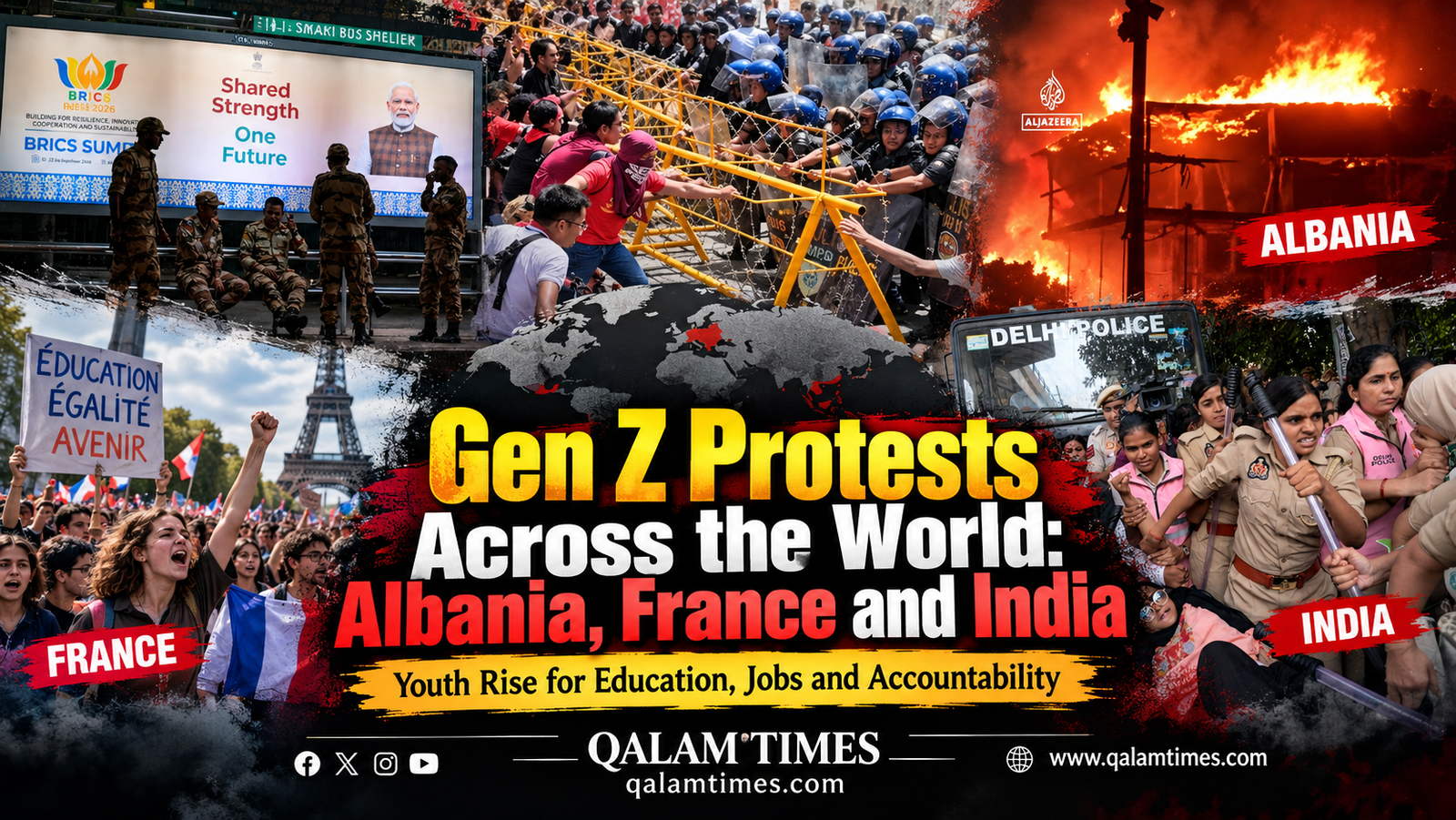




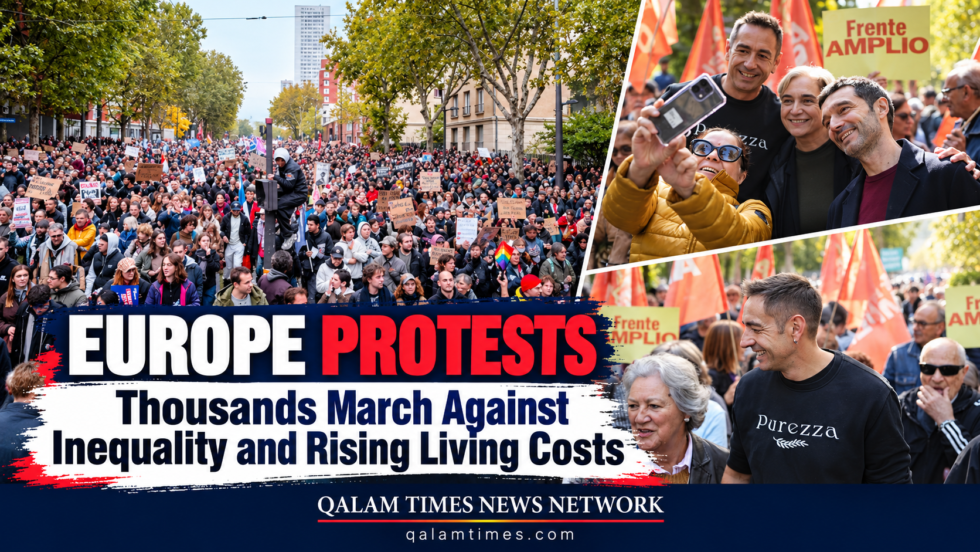
Europe Protests spread across France, Spain, Italy, Portugal, Belgium and Albania as thousands demand economic equality, affordable housing, better education, improved pensions and stronger public services.
Qalam Times News Network
Kolkata, October 26, 2026
Europe Protests Highlight Growing Public Anger Over Economic Hardship
Europe Protests have drawn large crowds onto the streets in several countries, reflecting growing frustration over the rising cost of living, unequal economic opportunities, pressure on public services and concerns about social justice. Demonstrations held on Saturday, October 24, brought together students, workers, pensioners, trade union members and other sections of society, with protesters demanding practical measures to improve their living conditions.
Although the immediate demands differed from one country to another, the demonstrations shared a common message: ordinary people are finding it increasingly difficult to cope with economic pressures while seeking better access to education, housing, healthcare and retirement security. The Europe Protests also highlighted the growing concerns of younger generations, many of whom believe that existing economic and political arrangements are failing to address their needs.
France Sees Major Mobilisation as Students and Workers Join Forces
France witnessed some of the largest demonstrations, with estimates of participation ranging from 410,000 to 800,000 people. The latest mobilisation followed protests that began in September, when students raised concerns about inadequate school funding, teacher shortages and deteriorating educational conditions. Workers subsequently joined the movement, broadening its demands to include economic inequality, living costs and the quality of public services.
According to reports, 289 demonstrations took place across the country, including in Marseille, Nantes, Nice, Lyon, Bordeaux and Orléans. French Interior Minister Laurent Nuñez said that nearly 1,000 people had been arrested, with the total potentially increasing. Two people reportedly sustained serious injuries.
In Paris, authorities changed the originally planned route through the city centre, moving the demonstration to an outer area and restricting marches organised by groups other than trade unions. The decision prompted criticism from demonstrators who argued that administrative restrictions would not resolve the issues driving public anger.
Nurse Soumaya Abed told the Associated Press that the restrictions would not prevent students from continuing to demand better conditions in schools. Her remarks reflected the determination of protesters to keep educational concerns at the centre of the movement.
Jean-Luc Mélenchon, leader of the left-wing France Unbowed party, also commented on the demonstration through social media. He described the gathering at the authorised location as peaceful and criticised the authorities’ handling of the protest, arguing that attempts to disrupt the mobilisation had failed.
The French demonstrations illustrate how concerns initially raised within the education system have developed into a broader challenge over living standards, public spending and the government’s response to citizens’ demands.
Belgium and Spain Focus on Education and Pension Security
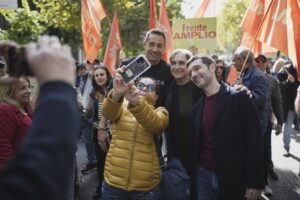
In neighbouring Belgium, hundreds of people marched in Brussels to demand improvements in the education system. The demonstration formed part of a wider movement calling for better educational conditions and stronger support for students and teachers.
Spain witnessed a significantly larger gathering in Madrid, where approximately 25,000 people demonstrated in support of the country’s public pension system. According to Al Jazeera, protesters called for pension payments to keep pace with inflation and demanded action to eliminate the gender gap in retirement income.
Emilio Delgado, deputy spokesperson for the left-wing Más Madrid party, praised the mobilisation on social media. He argued that no pension should fall below the minimum wage, emphasising that people who have spent their lives working deserve a dignified retirement.
The demonstration comes amid heightened political attention ahead of Spain’s forthcoming general election. Prime Minister Pedro Sánchez’s Spanish Socialist Workers’ Party faces a challenge from the conservative Popular Party, led by Alberto Núñez Feijóo.
The Popular Party leader has pledged to adjust pensions in line with inflation if his party wins office. Nevertheless, demonstrators remain concerned about the future of the pension system and whether existing protections will be maintained under a different government.
For pensioners, the debate goes beyond party politics. Rising prices can reduce the real value of fixed incomes, making housing, food, medicines and other essential expenses harder to afford. Their demands reflect a wider concern that retirement should provide financial security rather than expose people to further hardship.
Portugal’s Housing Crisis Brings People Onto the Streets

In Portugal, affordable housing emerged as the principal issue driving demonstrations. Protesters marched in Lisbon as part of a movement that began in Porto on October 10, calling on the government to take stronger action against the country’s housing crisis.
The demonstrations reflected mounting frustration over the difficulty of finding reasonably priced homes, particularly for young people, families and lower-income households. In areas where housing costs have risen sharply, many residents face increasing pressure on their monthly budgets, while some struggle to remain in the communities where they work.
Protesters also criticised proposed policies associated with Prime Minister Luís Montenegro’s government. According to reporting by the Associated Press, the proposals would relax restrictions on annual rent increases and make it easier for landlords to evict tenants who fall behind on payments.
Opponents argue that such changes could leave financially vulnerable households exposed to higher rents and greater insecurity. They want the government to prioritise access to affordable homes and introduce measures that protect tenants from the effects of a tightening housing market.
The demonstrations have placed housing policy at the centre of a broader debate about living standards. For many Portuguese residents, the issue is no longer simply about purchasing property; it is about whether people with ordinary incomes can secure a stable place to live without sacrificing other essential needs.
Italy’s Demonstrations Challenge the Cost of Living and Government Policies
Thousands of people participated in demonstrations across Italy, expressing dissatisfaction with the affordability crisis and the policies of Prime Minister Giorgia Meloni’s right-wing government.
Protests were organised in eight cities, including Milan, Turin and Rome. Milan alone reportedly attracted around 10,000 participants, underlining the scale of public concern.
Demonstrators raised issues connected with household expenses, economic inequality and the direction of government policy. Their demands reflected frustration among people who believe that rising costs are placing an unfair burden on workers and families.
Italy’s demonstrations also formed part of a wider European pattern in which economic grievances have become closely linked with political disagreements. Protesters are increasingly demanding that governments demonstrate how their policies will improve everyday life, particularly for people facing financial insecurity.
While the specific priorities differed between participating groups, the mobilisation showed that concerns about affordability and social protection continue to influence public debate across the country.
Albania’s Protests Combine Anti-Corruption Demands With Environmental Concerns
In Albania, demonstrations in the capital, Tirana, brought together opposition to alleged corruption, concerns about education and anger over a proposed luxury tourism development.
The controversy centres on plans associated with Jared Kushner, son-in-law of US President Donald Trump, to develop a luxury resort near a protected wildlife area. The proposal has become a source of public criticism, with opponents viewing it as a test of government accountability, environmental protection and the influence of wealthy investors.
Students have also demanded stronger action against corruption in the education system, lower tuition fees and increased funding. These concerns have contributed to a wider anti-government mobilisation.
Saturday’s demonstration marked the 12th day of protests during the month, following a summer of public opposition to the proposed luxury hotel development.
Reports indicated that some protesters set fires and threw projectiles, while police responded with tear gas, rubber bullets and water cannons. The confrontations highlighted the increasingly tense atmosphere surrounding the demonstrations.
The protests in Albania demonstrate how environmental issues and allegations of corruption can become intertwined with economic and educational grievances. For demonstrators, the debate concerns not only a single development project but also the transparency of public decision-making and the government’s responsibility to protect the wider public interest.
A Common Demand for Fairness Across Europe
Despite differences in national circumstances, the demonstrations across Europe reveal several common concerns. Students want adequately funded schools and better educational opportunities. Workers are calling for living wages and greater economic security. Pensioners want their retirement income to retain its purchasing power, while families are demanding affordable housing and stronger social protections.
The Europe Protests also expose the difficulties governments face when economic pressures intersect with public dissatisfaction. Measures designed to manage public finances, regulate housing markets or encourage investment can provoke resistance when citizens believe that the costs fall disproportionately on those with the fewest resources.
The participation of young people is particularly significant. Educational inequalities, uncertain employment prospects and high housing costs can make it difficult for younger generations to establish financial independence. Their involvement suggests that dissatisfaction extends beyond immediate economic hardship to questions about future opportunities and social mobility.
At the same time, the demonstrations underline the importance of the right to peaceful assembly and the need for authorities to respond proportionately to public dissent. Where confrontations occur, transparent investigations and accountability are essential to maintaining public confidence.
The long-term impact of these demonstrations will depend on how governments respond to the demands raised by protesters. Public mobilisation can draw attention to neglected issues, but lasting change requires policy decisions, adequate funding and effective implementation.
In France, education spending and school conditions remain important questions. In Spain, the sustainability and purchasing power of pensions are central to the debate. Portugal faces continuing pressure to address housing affordability, while Italy’s demonstrations reflect wider concerns about economic security and government policy. In Belgium, education remains a key priority, and Albania faces demands for greater accountability alongside environmental and educational protections.
The protests do not necessarily indicate agreement on every political question or a single coordinated movement across the continent. Rather, they reveal a shared frustration with problems that have different causes but similar consequences for ordinary people.
For European governments, the challenge is to demonstrate that economic policy can deliver more than headline growth figures. Citizens want to see whether public services are improving, whether housing is becoming more accessible and whether work and retirement can provide a reasonable standard of living.
As the demonstrations continue to shape political debate, their significance will ultimately be measured by whether the demands heard on the streets translate into meaningful improvements in people’s lives.