



Drug Trade in Kolkata’s Muslim Neighbourhoods: Nurullah Javed recounts a disturbing first-hand experience and raises questions about drug sales, social silence, and the future of the younger generation.
Qalam Times News Network
Original Urdu Article By: Nurullah Javed
Kolkata, October 23, 2026
Drug Trade in Kolkata’s Muslim Neighbourhoods: A First-Hand Account Raises Serious Questions About Society’s Silence
The Drug Trade in Kolkata’s Muslim Neighbourhoods is an issue I had been hearing about for several years. However, I had never witnessed the business of selling intoxicating substances taking place so openly and on such a large scale. Earlier, during the holy month of Ramadan, I had witnessed a scene involving the buying and selling of drugs at Park Circus Maidan, where protests against the CAA and NRC were being held. Despite the installation of CCTV cameras, the open nature of this business left me deeply astonished. But what I witnessed with my own eyes last night in a Muslim neighbourhood was not only shocking but also enough to make one hang one’s head in shame.
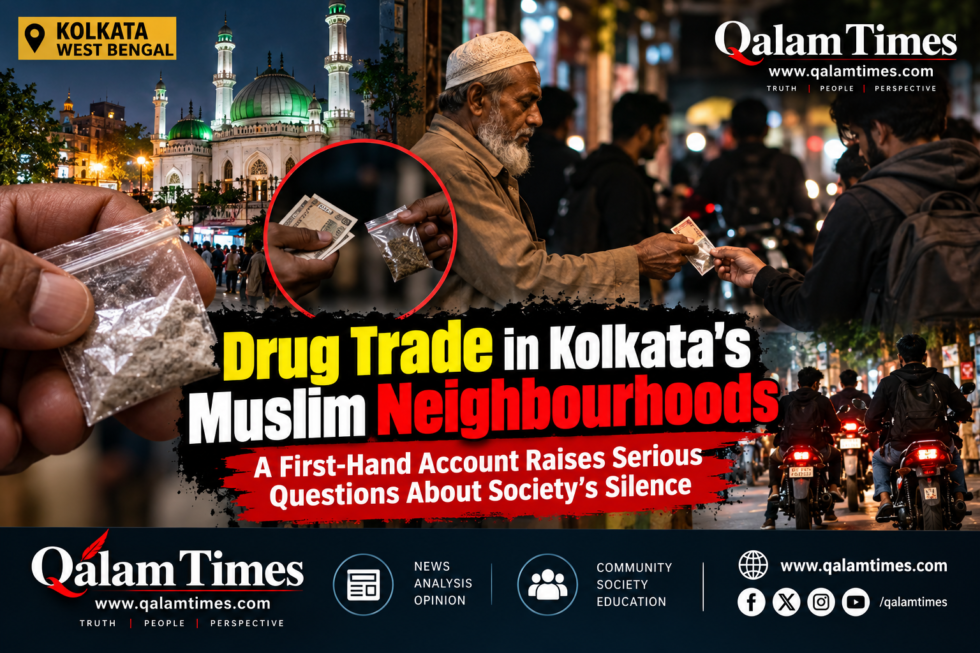
At around 11 p.m., I went to a Muslim neighbourhood to meet someone who has always been kind to me. We were standing and talking just a few steps away from a mosque. Nearby, an elderly man with a light beard was standing outside a shop. I remained there for approximately half an hour. During that time, more than 25 young men arrived, quietly handed the elderly man three or four hundred rupees, and received a small packet from his other hand. For half an hour, I spent more time watching this distressing scene than concentrating on my conversation.
The 25 young men I saw did not appear to be street boys or aimless wanderers. Judging by their appearance and manner, they seemed to be the sons of respectable and well-to-do families. They were arriving on expensive and good-quality motorcycles.
This incident did not take place in some deserted neighbourhood where silence descends at 11 p.m. and shops close for the night. Rather, it was the story of a lively and well-lit neighbourhood where activity continues until midnight and shops remain open. One can imagine from this how fearlessly the business of drugs and intoxicating substances is flourishing in Muslim neighbourhoods. Most of the 25 young men I saw appeared to be under 40 years of age.
The gentleman I was speaking to is a long-time resident of the same neighbourhood, where he spent his childhood. I asked him, “What is all this happening here?” With a bitter smile, he replied, “Herbs are being sold.”
Surprised, I asked, “Is that really true?” He replied, “When you already know everything, why are you asking questions?” He had known the seller for several years. He added, “The poor fellow is merely running his business; the real fault lies with those who buy from him.”
I immediately responded, “The fault lies neither solely with the buyers nor solely with the seller. The real culprit is the society that has become a silent spectator despite witnessing all this. Every person in the neighbourhood knows what destruction is taking place here, yet everyone has chosen to remain silent. The imam of the Jama Masjid, situated just a few steps away, also lives in this neighbourhood, and surely this matter must be within his knowledge as well. Yet he, too, remains silent.”
This alarming situation has raised a major question about the conscience of the entire Muslim community: “Will we continue to watch our own younger generation being destroyed and ruined with our own hands?”
This is not the story of just one neighbourhood. According to sources, this bitter reality is more or less the same in almost every Muslim neighbourhood, and none of this would be possible without some form of political or social patronage.