




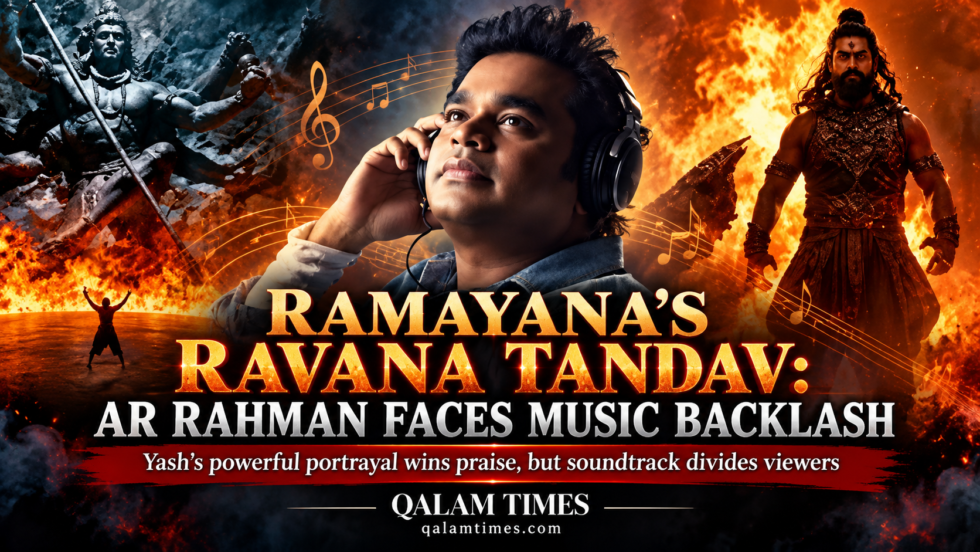
Ravana Tandav from Ramayana sparks mixed reactions as viewers praise Yash’s powerful portrayal of Ravana but question AR Rahman’s music.
By Qalam Times News Network
Kolkata, October 21, 2026
Ravana Tandav, the latest musical release from the much-anticipated film Ramayana, has triggered a lively debate on social media, with viewers divided over AR Rahman’s music. While Kannada superstar Yash has received considerable appreciation for his intense portrayal of Ravana, some viewers have expressed disappointment with the soundtrack, arguing that the music does not fully match the power and grandeur of the visuals.
Released around the occasion of Dussehra, the Ravana Tandav video presents Yash as the formidable king of Lanka, immersed in his devotion to Lord Shiva. The sequence combines dramatic imagery, religious symbolism and an intense performance, but the musical composition has emerged as a major talking point among audiences.
Yash’s Fierce Ravana TandavImpresses Viewers, but the Music Divides Opinion
Directed by Nitesh Tiwari, Ramayana is among the most eagerly anticipated Indian film projects, drawing attention for its ambitious scale, celebrated cast and portrayal of one of the most influential epics in Indian cultural history.
Running for approximately one minute and 55 seconds, the newly released song depicts Ravana’s devotion to Lord Shiva through a series of dramatic scenes. At the beginning, Ravana cuts his palm with a blade and applies a tripundra mark to his forehead. He then performs a ritual before an enormous statue of Lord Shiva before launching into a fierce tandav sequence.
Yash’s commanding screen presence is one of the most widely discussed aspects of the video. His expressions, physical intensity and portrayal of Ravana’s formidable personality have impressed many viewers. The visuals attempt to convey both the demon king’s immense power and his deep spiritual devotion to Shiva.
However, the Ravana Tandav soundtrack has received a more mixed response. Some viewers expected a composition featuring powerful percussion, an overwhelming orchestral arrangement and a distinctive musical build-up to complement Ravana’s fierce movements. Instead, sections of the online audience have described the music as less impactful than anticipated.
Social Media Users Question the Musical Impact

Following the release, several social media users compared the new composition with AR Rahman’s earlier work, expressing the view that the sequence could have benefited from a more energetic and emotionally charged soundtrack.
One recurring sentiment was that Rahman’s music from the 1990s might have brought a different level of magic to the scene. Other comments suggested that, despite the impressive visuals and Yash’s performance, the song did not achieve the musical intensity they had expected.
Some users also proposed composers Ajay–Atul and Amit Trivedi as possible alternatives, arguing that their musical styles might have delivered the forceful, rhythm-driven sound they associated with a sequence centred on Ravana’s tandav.
Nevertheless, criticism on social media does not represent the opinion of every viewer. Other listeners have defended Rahman, pointing to his longstanding contribution to Indian cinema and his ability to experiment with different musical styles. For them, a short promotional sequence may not be enough to judge the complete musical vision of a film on the scale of Ramayana.
A Debate Over Expectations and Musical Storytelling
The reaction highlights the challenge of creating music for a culturally significant character such as Ravana. In popular imagination, the king of Lanka is associated with extraordinary strength, scholarship, ambition and unwavering devotion to Lord Shiva. A musical sequence portraying his tandav therefore carries considerable expectations.
For many viewers, the ideal composition would balance the intensity of Ravana’s movements with the devotional character of the Shiv Tandav Stotram. The music must also work alongside the visuals, helping communicate the character’s rage, spiritual conviction and commanding presence without overwhelming the scene.
The debate surrounding Ravana Tandav also illustrates how audiences increasingly respond to major film releases before the complete production reaches theatres. Short videos, teaser songs and promotional clips can quickly generate strong reactions, particularly when a film draws on a familiar religious or literary tradition.
At the same time, the final impact of a soundtrack may depend on its context within the film. Background scoring, sound design, the complete musical arrangement and the way a sequence connects with the larger narrative can influence how audiences ultimately experience it.
The first instalment of Ramayana is scheduled for release during Diwali, according to the announcement cited in the release coverage. The film continues to attract attention, with audiences closely following updates about its cast, music, visual effects and interpretation of the epic.
For Yash, the portrayal of Ravana offers an opportunity to bring a complex and formidable character to the screen. For Rahman, the online discussion presents a reminder of the high expectations that accompany music for a project of this scale.
Whether the criticism surrounding the song persists or changes after audiences watch the complete film remains to be seen. For now, the response is divided: Yash’s fierce portrayal and the elaborate visuals have attracted praise, while the soundtrack has become the centre of a wider conversation about musical expectations in mythological cinema.