



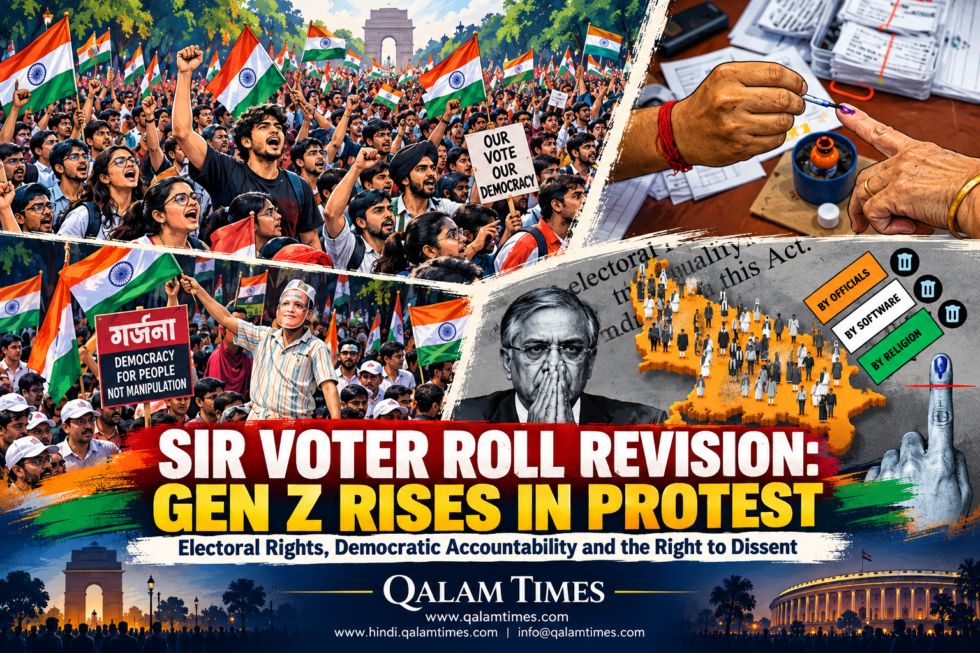
SIR Voter Roll Revision sparks nationwide protests as Gen Z challenges alleged electoral irregularities, mass detentions and threats to democratic freedoms.
The growing Gen Z movement against alleged electoral irregularities and the detention of protesters raise serious questions about democratic freedoms, institutional accountability and the right to dissent.
By Dr. Mohammad Farooque
Qalam Times News Network
Kolkata | October 12, 2026
SIR voter roll revision has become the centre of a nationwide controversy, with mounting protests against the Election Commission’s handling of electoral rolls and the growing demand for accountability from Chief Election Commissioner Gyanesh Kumar. The government’s response to these demonstrations, particularly the detention of protesters in Delhi, has intensified concerns about the space available for peaceful dissent in the world’s largest democracy.
The controversy surrounding the SIR voter roll revision has acquired a new dimension following reports that more than 13 crore entries were excluded from draft electoral rolls across states and Union Territories during the exercise. The Election Commission maintains that the process involves the verification of voter records and that eligible citizens whose names have been wrongly omitted can seek re-enrolment. However, the scale of the deletions and allegations of procedural irregularities have raised legitimate questions about transparency, due process and the protection of voting rights.
A Democratic Right Under Pressure
The protests at Delhi’s Jantar Mantar, a recognised venue for demonstrations, have become a focal point of the growing opposition to the Election Commission’s handling of the revision exercise. Reports of mass detentions, police action against demonstrators and restrictions on protest activity have fuelled criticism of the authorities. When citizens assemble peacefully to question decisions affecting their democratic rights, the state’s response should be guided by constitutional principles rather than an instinct to suppress dissent.
The situation has prompted comparisons with the repressive methods of the colonial era. Although historical circumstances differ, the underlying concern remains relevant: a democratic government must not treat public criticism as a threat to its authority. The right to protest, express disagreement and demand accountability is fundamental to a functioning democracy. Maintaining public order is a legitimate responsibility of the police, but it cannot become a blanket justification for curtailing peaceful political expression.
Allegations Against the Chief Election Commissioner
Questions about the internal functioning of the Election Commission have further intensified the controversy. An investigation published by The Indian Express reported that Election Commissioners Sukhbir Singh Sandhu and Vivek Joshi had raised objections on at least 14 occasions over a period of ten months concerning decisions and procedures linked to electoral-roll management, including changes to Form 6. The Commission, however, subsequently stated that its decisions had been unanimous, describing the recorded objections as part of its decision-making process. These competing positions demand a clear and transparent explanation from the institution entrusted with safeguarding electoral integrity.
The dispute over Form 6, the statutory application used by eligible citizens seeking inclusion in the electoral roll, is particularly significant. Reports have questioned the insertion of additional requirements relating to previous Special Intensive Revision exercises without a corresponding amendment to the relevant rules. During a recent hearing, the Chief Justice of India stated that the Supreme Court had not approved the modifications to Form 6 and indicated that the court would examine the matter further. The legal questions surrounding the form and the responsibility for its modification therefore require careful judicial scrutiny rather than premature conclusions.
These developments have strengthened demands from opposition parties and protest groups for Gyanesh Kumar’s resignation or removal. Such demands must be assessed through constitutional procedures and established legal standards. At the same time, the Election Commission cannot expect public confidence to remain unaffected when questions arise about decision-making, procedural safeguards and the possible exclusion of eligible voters.
Gen Z Emerges as a Force for Democratic Accountability
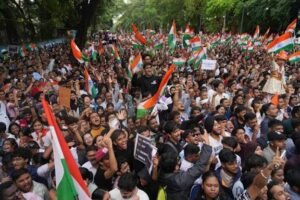
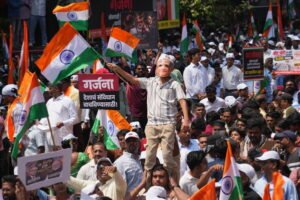
One of the most striking features of the current movement is the participation of young people. Students, first-time voters, activists and members of the emerging Gen Z generation are increasingly visible in protests against alleged electoral irregularities. Their participation suggests that concerns about democracy are no longer confined to established political parties or traditional activist organisations.
The movement has also drawn attention to the role of new platforms such as the Cockroach Janta Party, which has used digital campaigning, online memes, slogans and symbolic forms of protest to mobilise young people. The group’s campaign has helped bring the controversy over voter-list revision into wider public discussion. Its emergence reflects a broader shift in political engagement, in which young citizens increasingly use social media and decentralised networks to challenge institutions and demand answers.
The importance of this participation should not be underestimated. Young people are not merely future voters; they are citizens whose political rights and opportunities are affected by decisions taken today. Any eligible young voter who faces unnecessary procedural barriers to registration has a legitimate reason to seek clarification and redress. Electoral procedures must be accessible, transparent and consistent with the law, particularly for first-time voters.
Beyond Electoral Rolls: The Crisis of Youth
The anger visible on the streets cannot be understood solely through the controversy over the SIR exercise. It is also connected to deeper social and economic anxieties: unemployment, limited access to secure jobs, irregularities in recruitment examinations, paper-leak allegations and the difficulties confronting industry and agriculture. For many young Indians, these problems have created a persistent sense of uncertainty about their future.
Recent protests over alleged examination irregularities demonstrated how quickly such grievances can develop into a wider movement. The present agitation has brought electoral rights into that landscape of dissatisfaction, connecting concerns about employment and education with questions about institutional accountability. When young people believe that both their economic prospects and their democratic voice are being undermined, frustration can spread well beyond the immediate issue that first brought them onto the streets.
The government should recognise this wider context. Instead of relying primarily on police action, it should engage with young protesters, address their grievances and demonstrate that public institutions are willing to listen. A government confident in its democratic mandate should be able to withstand criticism and answer difficult questions without treating every demonstration as a law-and-order crisis.
Accountability, Not Intimidation, Is the Answer
The controversy over the SIR exercise presents an important test for both the government and the Election Commission. Electoral-roll revision is a legitimate administrative responsibility, but its implementation must protect every eligible citizen’s right to vote. Verification procedures should not create arbitrary barriers, and any person whose name has been wrongly omitted must have a fair, accessible and timely opportunity to secure inclusion.
Likewise, allegations of procedural wrongdoing must be examined through independent scrutiny, transparent disclosure and lawful investigation. The Election Commission must explain the basis for disputed decisions, clarify the process through which changes to statutory forms were made and ensure that eligible voters are not disadvantaged by administrative confusion. Public trust cannot be restored through statements alone; it requires demonstrable accountability.
The government, for its part, must respect the right to peaceful assembly and ensure that police action remains proportionate and lawful. The detention of protesters who are exercising their constitutional freedoms can deepen distrust rather than resolve the underlying dispute. A democratic administration should seek to reduce tensions by facilitating lawful protest, communicating clearly and responding to legitimate public concerns.
History repeatedly demonstrates that suppressing dissent rarely eliminates the grievances that fuel it. It often gives those grievances greater visibility and creates new reasons for public anger. The participation of Gen Z in the present movement should therefore be understood as a call for institutional responsiveness, not simply as a challenge to political authority.
India’s democratic strength depends not only on the conduct of elections but also on the confidence citizens have in the institutions that administer them. The right to vote, the independence of the Election Commission and the freedom to protest are interconnected pillars of constitutional democracy. If questions about voter-list revision are met with transparency, due process and accountability, public confidence can be restored. If they are met chiefly with intimidation and repression, the crisis is likely to deepen.
The message for the Modi government is clear: listen to the youth, investigate allegations fairly, protect every eligible voter and respect peaceful dissent. Democracy is strengthened when those in power answer criticism with accountability—not when they attempt to silence it.