



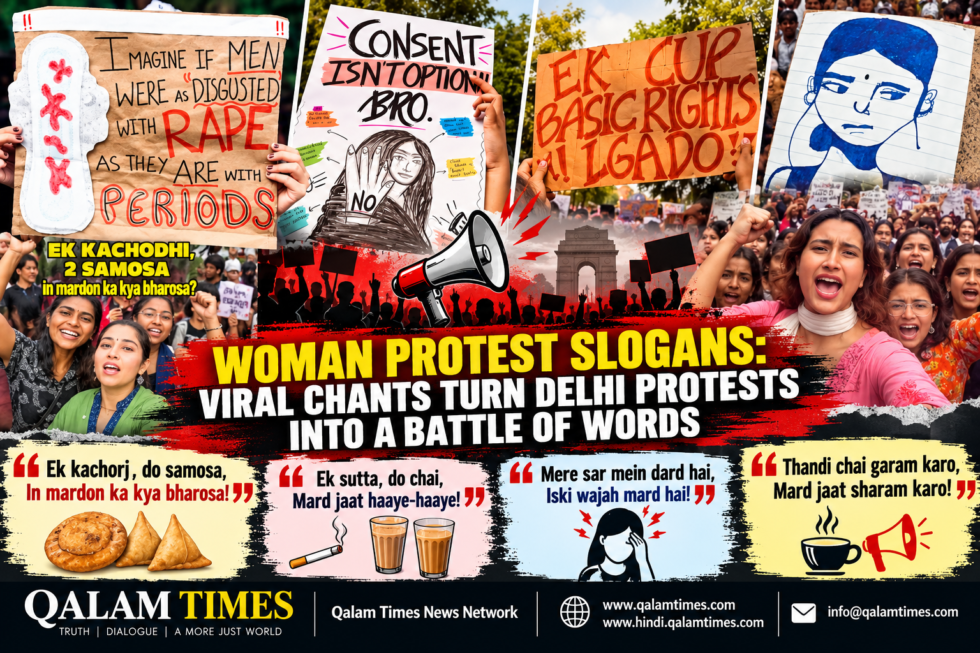
Woman Protest Slogans from Delhi protests go viral as women use humour, satire and catchy rhymes to raise concerns over safety, crime and gender issues.
Qalam Times News Network
Kolkata / New Delhi | October 6, 2026
Woman Protest Slogans have become one of the most talked-about aspects of recent women-led protests in Delhi, where demonstrators have used humour, sarcasm and sharp wordplay to express their anger over crimes and concerns related to women’s safety. Among the chants attracting widespread attention online is the humorous line, “Ek Kachori, Do Samosa, In Mardon Ka Kya Bharosa” — roughly translated as, “One kachori, two samosas, how can you trust these men?”
The Woman Protest Slogans being shared from the demonstrations have added a distinctly unconventional dimension to the protests. While the underlying issue remains serious, several participants have chosen catchy and humorous rhymes to communicate their frustration, leading to a parallel “slogan battle” on social media.
From Safety of Woman to Viral Slogans: Protesters Turn Anger into Wordplay

Women’s safety has remained a major public concern, with incidents involving harassment, violence and crimes against women frequently triggering protests and public discussions across India. Against this backdrop, demonstrations reported in Delhi and elsewhere have brought women onto the streets to voice their concerns and demand greater safety and accountability.
At some of these gatherings, protesters have relied on short, rhythmic slogans that are easy to remember and quickly spread online. The style ranges from humour and satire to direct criticism of what participants describe as a male-dominated social structure.
Among the slogans attracting attention are:
“Ek kachori, do samosa,
In mardon ka kya bharosa!”
Another chant plays with the familiar request for tea:
“Ek sutta, do chai,
Mard jaat haaye-haaye!”
Some slogans take a more personal and humorous approach:
“Mere sar mein dard hai,
Iski wajah mard hai!”
The protesters also used the line:
“Thandi chai garam karo,
Mard jaat sharam karo!”
Another slogan takes a sharper tone:
“Hamari azaadi se jin ko dard hai,
Woh sab naamard hain.”
The protests also featured rhyming food references, including:
“Chaar badam, do kishmish,
Mard samaj ko kar do dismiss!”
And another popular line was:
“Do kebab, ek biryani,
Har mard ki alag kahani.”
The slogans have generated considerable discussion because of their unusual combination of humour, satire and anger. Supporters of the protesters have viewed the chants as a creative way of drawing attention to serious concerns, while some social media users have criticised the generalisation of men in certain slogans.

The contrasting reactions have helped push several of the chants beyond the protest sites and onto social media platforms, where users have begun sharing, remixing and responding to them with slogans of their own.
Although some of the chants are deliberately comic, the broader context behind the demonstrations is not. Women participating in protests have been raising concerns about personal safety, violence against women and the need for stronger social and institutional responses to crimes.
The use of humour in protest is not new. Across different movements, slogans, rhymes, satire and wordplay have often been used to make complex social issues easier to communicate and more difficult to ignore.
In this case, however, the slogans have also sparked a debate about whether protest language should remain focused on specific issues or whether broad references to “men” risk turning a demand for women’s safety into a wider gender confrontation.
For many participants, the slogans are intended as expressions of frustration rather than literal statements about every man. Their rapid circulation online, nevertheless, has ensured that the language used at the protests has become almost as much a topic of discussion as the demonstrations themselves.
The emerging “slogan battle” therefore reflects two parallel conversations: one about women’s safety and the other about how protest movements choose to communicate their anger in the digital age.