



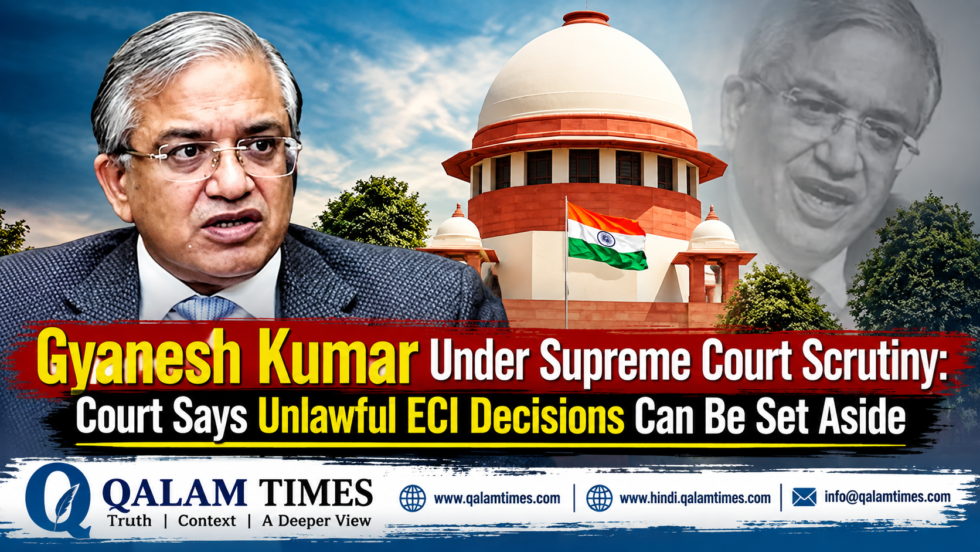
Gyanesh Kumar faces Supreme Court scrutiny as the Court seeks Centre and ECI responses over alleged unilateral SIR decisions and says unlawful decisions may be set aside.
Qalam Times News Network
New Delhi | October 5, 2026
Gyanesh Kumar, Chief Election Commissioner of India, has come under direct judicial scrutiny after the Supreme Court on Monday issued notices to the Union government and the Election Commission of India (ECI) on petitions challenging the manner in which several decisions related to the Special Intensive Revision (SIR) of electoral rolls were allegedly taken.
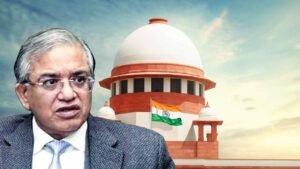
The Gyanesh Kumar case was heard by a three-judge bench headed by Chief Justice of India Surya Kant, along with Justice Joymalya Bagchi and Justice V. Mohana. The Court declined, at this stage, to pass an interim order suspending or restraining the Chief Election Commissioner. Instead, it sought responses from the concerned authorities and made it clear that any decision found to have been taken contrary to law could subsequently be set aside.
Court Seeks Answers Before Taking Further Action on Gyanesh Kumar
The petitions before the Supreme Court question whether the Election Commission’s decisions concerning the SIR exercise were taken in accordance with the constitutional and statutory framework governing the three-member poll panel.
The petitioners have alleged that a number of important decisions were taken without the concurrence of the other two Election Commissioners, Sukhbir Singh Sandhu and Vivek Joshi. Reports cited in the petitions have alleged that as many as 14 important SIR-related decisions were taken in the name of the Commission despite objections recorded by the other commissioners. The allegations remain contested and have not been judicially established.
The Supreme Court, however, indicated that it would not reach conclusions merely on the basis of media reports. During the hearing, the bench observed that a newspaper report could be completely accurate, partly accurate or incorrect, and therefore could not by itself form the basis for a judicial direction. The Court said it would instead seek the responses of the Election Commission and other concerned parties before determining whether any statutory requirement had been breached.
One of the petitions seeks interim action against Gyanesh Kumar until the broader legal challenges concerning the functioning of the Election Commission are decided. The Supreme Court did not grant that interim relief on Monday.
The bench instead directed the concerned authorities to respond to the allegations. The Court indicated that if the material placed before it ultimately establishes that a particular decision was taken contrary to the governing law, it can consider appropriate corrective action, including setting aside such a decision.
The proceedings also involve a demand for an independent investigation into the deletion of voters during the SIR exercise. The petitioners have sought either a judicial inquiry or a Special Investigation Team to examine allegations concerning the removal of a large number of names from electoral rolls. The Centre has been asked to respond to the demand for an investigation.
Why the Election Commission‘s Decision-Making Process Matters
The dispute goes beyond the functioning of an individual office-holder and raises questions about how a multi-member constitutional body should take decisions.
Article 324 of the Constitution establishes the Election Commission and entrusts it with the superintendence, direction and control of elections in India. The constitutional framework provides for a Chief Election Commissioner and other Election Commissioners.
The present statutory framework is contained in the Chief Election Commissioner and Other Election Commissioners (Appointment, Conditions of Service and Term of Office) Act, 2023. Section 18 of the Act states that the Commission should, as far as possible, conduct its business unanimously. Where the Chief Election Commissioner and the other Election Commissioners differ on an issue, the matter is to be decided according to the majority view.
This provision is central to the legal challenge because the petitioners argue that powers vested in the Election Commission as a collective body cannot simply be exercised by one member without following the prescribed decision-making process.
SIR and the Electoral Roll Controversy
The controversy surrounding the Election Commission intensified during the Special Intensive Revision of electoral rolls. The exercise has generated a wider debate over voter verification, deletion of names, documentation requirements and the safeguards available to eligible voters.
The petitioners have challenged several decisions and administrative actions connected with the SIR process, including alleged changes relating to electoral-roll procedures and software. A separate issue concerning Form 6, which is used for voter registration, also came up during the proceedings. The Supreme Court indicated that the modified Form 6 being discussed in the case had not been approved by the Court itself.
The Election Commission, meanwhile, has maintained that its actions are governed by the applicable electoral framework and has disputed allegations that its functioning was unlawful. Reports also indicate that the Commission has sought to distinguish between administrative matters and broader policy decisions in responding to allegations of internal disagreement.
Media Reports and the Court’s Caution
The case gained considerable attention after reports in The Indian Express alleged that the two Election Commissioners had raised objections to several decisions associated with the SIR exercise.
The Supreme Court has nevertheless stressed the need to examine the underlying official record rather than relying solely on press reports. The bench’s approach means that the next stage of the case will depend substantially on the responses and documents submitted by the Election Commission, the Centre and the other respondents.
What Happens Next?
The Centre and the Election Commission have been asked to respond within a week. After receiving those responses, the Supreme Court is expected to examine whether the challenged decisions complied with the Constitution, the 2023 legislation and the applicable electoral rules.
For now, the Court has neither suspended Gyanesh Kumar nor declared the disputed decisions invalid. Instead, it has opened the door for judicial scrutiny of any decision that may ultimately be shown to have violated the law.
The case therefore places the Election Commission’s internal decision-making process, particularly the relationship between the Chief Election Commissioner and the other Election Commissioners, at the centre of the ongoing legal proceedings.