



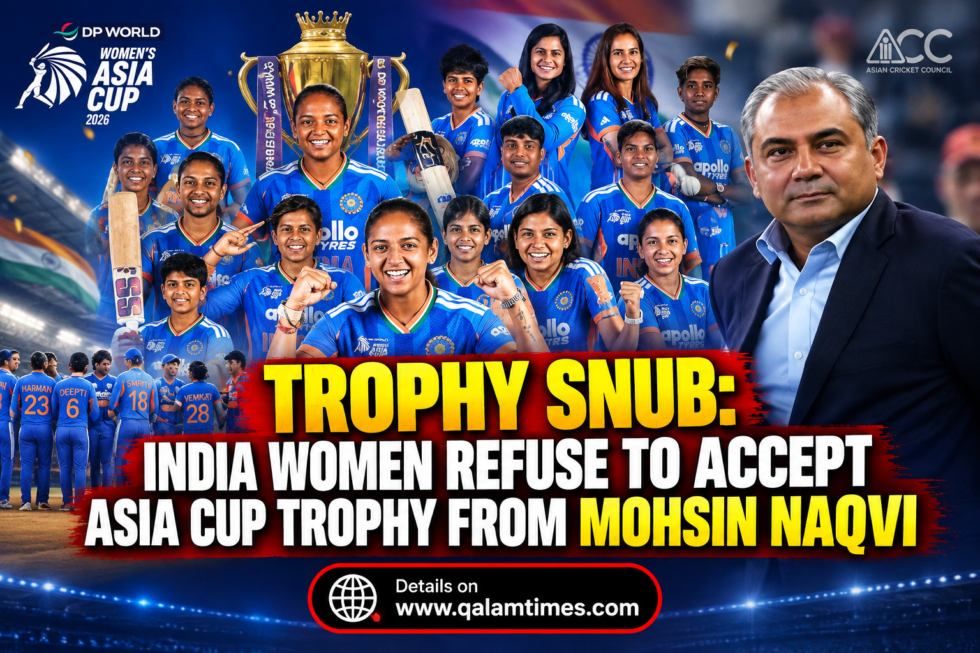
Trophy Snub: India women’s team reportedly refuses to accept the Asia Cup 2026 trophy from ACC president Mohsin Naqvi after defeating Sri Lanka by 72 runs, following the BCCI’s prior decision.
Qalam Times News Network
NEW DELHI | September 14, 2026
Trophy Snub has once again become the talking point in Asian cricket after the Indian women’s team reportedly declined to receive the Asia Cup 2026 trophy from Asian Cricket Council (ACC) president Mohsin Naqvi following their emphatic 72-run victory over Sri Lanka in the final.

The Trophy Snub came a year after the Indian men’s team took a similar position during the men’s Asia Cup final in Dubai. India had defeated Pakistan in that final but declined to accept the trophy from Naqvi, who is not only the ACC president but also the chairman of the Pakistan Cricket Board (PCB) and Pakistan’s interior minister.
BCCI had informed ACC in advance about India’s decision for Trophy
India’s women’s team secured a record eighth Women’s Asia Cup title after defeating Sri Lanka by 72 runs in Sunday’s final. However, the celebrations were overshadowed by the controversy surrounding the post-match presentation. According to India head coach Amol Muzumdar, the decision not to accept the trophy from Naqvi had been taken by the Board of Control for Cricket in India (BCCI). He said the team stood firmly behind the governing body’s decision and remained focused on the achievement of becoming Asian champions. Muzumdar made it clear that the circumstances surrounding the presentation ceremony would not diminish India’s achievement on the field. According to him, the players were simply delighted with the title and regarded the tournament itself as successfully completed. The BCCI had reportedly informed ACC officials before the final that if Naqvi remained present at the presentation ceremony and India won the tournament, the Indian players would not collect the trophy from him. That decision became apparent after Sri Lanka’s final wicket fell. Instead of an immediate presentation, there was a delay of roughly 40 minutes before the ceremony got underway. Match officials were presented with their mementoes first. Sri Lankan captain Chamari Athapaththu, along with her teammates and members of the coaching staff, then received their runners-up medals. Athapaththu also collected the runners-up cheque from Naqvi, who was present in his capacity as ACC president.
After that portion of the ceremony, the broadcast ended without showing Indian players receiving either their winners’ medals or the Asia Cup trophy.
India’s coach says the decision will not overshadow the title

Speaking at the post-match press conference, Muzumdar reiterated that the team supported the BCCI’s position. He said India had already been officially recognised as the 2026 Asia Cup champions on the main display board and that, from the team’s perspective, winning the tournament was what mattered most.When asked when the Indian players would eventually receive the trophy, Muzumdar said he had no information about when or how that would happen. The unresolved presentation has therefore left an unusual situation: India are the champions, but the formal trophy handover remains unclear. The latest Trophy Snub closely resembles what happened after last year’s men’s Asia Cup final in Dubai. India defeated Pakistan by five wickets in that match, with Tilak Varma producing an unbeaten 69 to guide his side to victory. Yet the post-match presentation became the centre of attention after the Indian team refused to accept the Asia Cup trophy from Naqvi. At the time, India and Pakistan were involved in an exceptionally tense political environment following the Pahalgam terror attack and the military confrontation between the two countries in May. The strained relations also affected interactions between the two cricket teams.
Indian players had avoided handshakes with their Pakistani counterparts during all three matches between the sides in that tournament. The same position continued after the final. Reports at the time suggested that India was willing to receive the trophy from another ACC official, including UAE-based cricket administrator Khalid Al Zarooni, but did not want Naqvi to present it. Naqvi, however, remained in his position as ACC president and was reportedly prepared to present the trophy himself. The disagreement contributed to a lengthy delay in the presentation ceremony. During last year’s controversy, individual awards were handed out by other officials. Indian players including Kuldeep Yadav, Abhishek Sharma and Tilak Varma received their individual honours from different presenters.
Pakistan captain Salman Ali Agha collected the runners-up cheque. The ceremony subsequently ended without the Indian team receiving the main trophy or their winners’ medals. The trophy was eventually removed from the presentation area. Despite the absence of a formal trophy handover, India’s players celebrated their victory on the field. Captain Suryakumar Yadav and his teammates even mimicked the act of lifting a trophy with their hands as they celebrated their championship triumph.
The BCCI had indicated that it would raise the matter with the International Cricket Council (ICC). The dispute continued even after the tournament had ended, with Naqvi later saying that India could collect the trophy from him if it wished. Reports in October subsequently indicated that the trophy remained at the ACC headquarters in Dubai.
India’s women’s team completed its part of the tournament in emphatic fashion, defeating Sri Lanka by 72 runs in the final and securing its eighth Women’s Asia Cup title. But the question of the physical trophy remains unanswered. It is currently unclear whether the Indian team will receive the trophy from another ACC official at a later date or whether a separate presentation ceremony will be arranged. Muzumdar said he did not have any information on the matter. For now, the controversy has created an extraordinary contrast. India have been crowned Women’s Asia Cup champions, but the traditional trophy presentation has remained incomplete.
The episode also shows that the political tensions surrounding India-Pakistan cricket continue to influence ceremonial moments involving Naqvi. What began with the men’s team last year has now been repeated by the women’s side, putting the spotlight once again on the relationship between sporting protocol and the wider political environment.