



REVOLT inside CJP as Manish Brahmbhatt launches CJP-D, alleging political influence, leadership bias and the exclusion of grassroots volunteers.
Qalam Times News Network
NEW DELHI | September 4, 2026
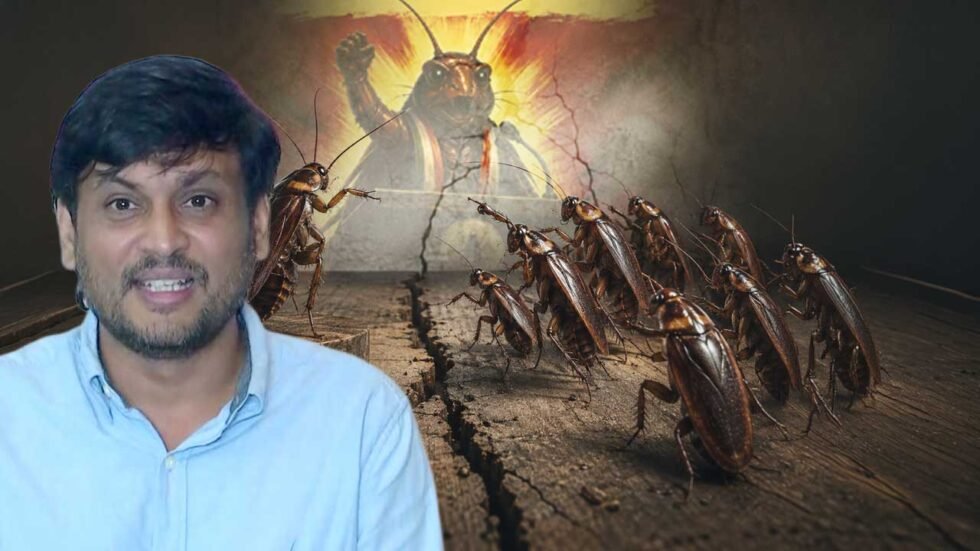
REVOLT has erupted inside the Cockroach Janata Party (CJP), the youth-led movement that began as a satirical online campaign but later evolved into a platform raising its voice on unemployment, examination irregularities and other public issues. Former CJP volunteer Manish Brahmbhatt has now broken away from the organisation and announced the formation of a separate platform, the Cockroach Janata Party-Democratic (CJP-D).
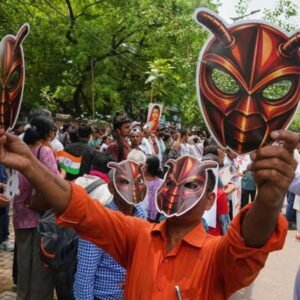
REVOLT Deepens as Brahmbhatt Accuses CJP Leadership of Political Capture
The REVOLT follows serious allegations by Brahmbhatt that CJP founder Abhijit Dipke has gradually pushed aside volunteers who were actively involved in the movement and has transformed what began as a broad-based youth initiative into a group dominated by people allegedly connected with the Aam Aadmi Party (AAP). Brahmbhatt has also alleged that the organisation has become primarily focused on opposing the BJP rather than addressing the concerns of students, young people and citizens from different parts of the country.
From Satirical Movement to Internal Political Battle
Brahmbhatt announced the formation of CJP-D in Delhi on Thursday, arguing that the original movement had moved away from the principles on which it was built. According to him, people who contributed their time and effort to the movement were increasingly being excluded from decision-making, while individuals preferred by the leadership were being given greater influence.
Speaking to ANI, Brahmbhatt alleged that the original CJP had effectively become a platform for people sympathetic to Arvind Kejriwal and the AAP. He claimed that political bargaining and opposition to the BJP had begun to take precedence over issues affecting students and people outside the political mainstream.
However, these are Brahmbhatt’s allegations, and they have not been independently established. As of the information provided, neither Abhijit Dipke nor the CJP has issued a response to the allegations.
The dispute is particularly significant because CJP itself emerged from an unusual beginning. Dipke launched the platform on May 16 as a satirical online response to remarks by Chief Justice of India Surya Kant, after comments referring to certain people as “cockroaches” and “parasites” triggered widespread public anger. What initially appeared to be an internet joke soon attracted young people and developed into a movement dealing with wider social and political concerns.
The organisation subsequently became associated with protests over unemployment, alleged irregularities in medical entrance examinations and other issues affecting students. During the recent agitation surrounding the NEET question-paper controversy, the movement drew attention in Delhi, with Brahmbhatt joining the protest and presenting himself as an active CJP supporter and volunteer.
That makes his present departure particularly noteworthy.
Who Is Manish Brahmbhatt?
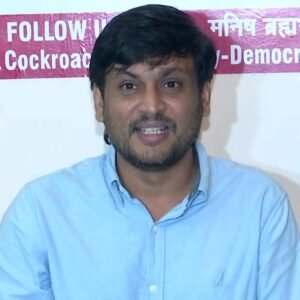
Brahmbhatt is not entirely new to electoral politics. Before emerging as a dissident within CJP, he contested the 2022 Gujarat Assembly election as an independent candidate from the Palanpur constituency.
According to election-affidavit information cited from the Association for Democratic Reforms’ MyNeta platform, Brahmbhatt received 964 votes, accounting for around 0.53 per cent of the total vote, and finished fifth in the constituency. BJP candidate Aniket Girishbhai Thakor won the seat with 95,588 votes.
The affidavit listed Brahmbhatt’s age at the time as 37, placing his current age in the early forties. His professional background was described as that of a management consultant. His educational qualifications included a B.Com degree and study up to the first year of an LLB programme at Hemchandracharya North Gujarat University.
His declared assets were approximately ₹44.42 lakh, with no liabilities reported in the affidavit. The document also disclosed four pending criminal cases against him, including cases registered under various provisions of the Indian Penal Code. The existence of pending cases, however, does not by itself establish guilt.
Brahmbhatt’s break with CJP appears to have been developing for some time. During an August meeting of CJP members at Dipke’s residence, Brahmbhatt was reportedly in Chhatrapati Sambhajinagar in Maharashtra. He and fellow protester Rahul Pandya later demonstrated outside Dipke’s residence, alleging that volunteers who had actively participated in the Jantar Mantar protest were being excluded from internal discussions.
The confrontation reportedly became intense enough for Brahmbhatt and Pandya to require hospitalisation after their health deteriorated during the protest.
At that stage, media reports identified Brahmbhatt as a CJP activist. Now, he has emerged as one of the movement’s most prominent critics.
Brahmbhatt’s principal objection concerns the composition of CJP’s leadership. He claims that eight individuals selected for positions within the organisation have links to the AAP. He has also alleged that volunteers had proposed creating a genuinely national organisational structure that would give representation to activists from different parts of India, but that the proposal was rejected.
These claims remain disputed and have not been independently verified.
The controversy has also been fuelled by the visible presence of AAP leaders during CJP’s Jantar Mantar protest. Arvind Kejriwal and other AAP figures publicly supported Dipke during the agitation. Some CJP members are also reported to have had links with AAP in the past.
But there is an important distinction that should not be lost amid the political noise: the presence of AAP leaders at a protest, or the previous political associations of individual CJP members, does not in itself prove that CJP is being controlled by Kejriwal or the AAP.
Dipke has acknowledged his past association with AAP but has repeatedly maintained that he no longer has any connection with the party.
The creation of CJP-D therefore marks a potentially important moment for a movement that was never expected to become a conventional political organisation in the first place. What began with satire has now entered the familiar territory of leadership disputes, accusations of political influence, questions over representation and competing claims over who genuinely speaks for the movement’s supporters.
The bigger question is whether CJP can retain its original character as a citizen-led platform or whether internal political ambitions will fragment it further.
Brahmbhatt’s REVOLT may or may not develop into a significant political force. At present, however, it exposes a familiar problem that has confronted many grassroots movements: once a loosely organised public campaign begins acquiring structure and influence, disagreements over leadership, representation and political alignment can become as consequential as the original cause itself.
For CJP, the immediate challenge is no longer simply confronting its political opponents. It is convincing its own supporters that the movement remains genuinely independent, internally democratic and accountable to the people whose concerns brought it into existence.