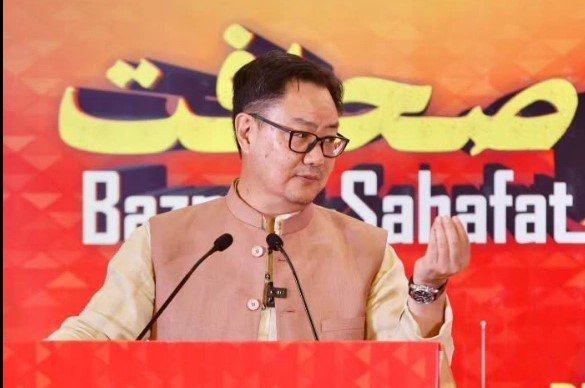





Kshudiram Tudu, West Bengal minister for Tribal Welfare and Minority Affairs, faces expectations to strengthen minority welfare, Urdu education and linguistic diversity.
Qalam Times News Network
Kolkata | August 24, 2026
Kshudiram Tudu, a Bharatiya Janata Party (BJP) legislator from the Ranibandh Assembly constituency, has emerged as an important figure in the new political landscape of West Bengal. A teacher-turned-politician, Tudu has been entrusted with the responsibility of the Tribal Welfare Department as well as the Minority Affairs and Madrasah Education Department in the government led by Chief Minister Suvendu Adhikari.
Kshudiram Tudu represents Ranibandh, a Scheduled Tribe-reserved constituency in Bankura district. His political journey, however, did not begin with an immediate electoral victory. He contested the Assembly election from Ranibandh in 2016 and again in 2021, but could not win on either occasion. His persistence eventually paid off in the 2026 West Bengal Assembly election, when he defeated Trinamool Congress candidate Tanushree Handsa by a margin of more than 52,000 votes. Tudu secured 131,145 votes after counting across 19 rounds.
Born in Bagdubi village in the Ranibandh block of Bankura district, Tudu is the son of Jogendranath Tudu. He completed his Bachelor of Arts degree from Vidyasagar University in 1994 and obtained his Bachelor of Education degree from the University of Burdwan in 2000. Before entering active politics, he worked as a teacher at a government-aided school.
His professional background as an educator gives particular significance to his present responsibilities. Education, social development and access to opportunities are closely connected with the welfare of disadvantaged communities. His experience in the classroom could therefore prove valuable as he takes charge of departments dealing with some of the state’s most socially and economically vulnerable sections.
Kshudiram Tudu : A Significant Oath in Santhali
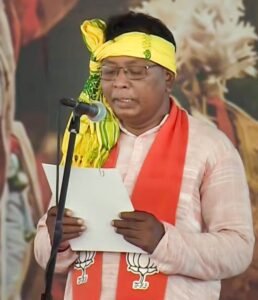
One of the most noteworthy moments of Tudu’s political journey came during the swearing-in ceremony of the new West Bengal government. While other ministers took their oaths in languages such as Bengali or Hindi, Tudu chose to take his oath in Santhali, his mother tongue.
The decision carried significance beyond the ceremony itself. Santhali is an important language of the tribal communities of eastern India and has constitutional recognition as one of the languages included in the Eighth Schedule of the Constitution of India. By choosing to take his oath in Santhali, Tudu publicly demonstrated the importance he attaches to his linguistic and cultural identity.
That experience may also create expectations among speakers of other minority languages in Wet Bengal.
Expectations from the Minority Affairs and Madrasah Education Department
With Tudu now holding responsibility for the Minority Affairs and Madrasah Education Department, there are considerable expectations from minority communities across the state, particularly from Bengali-speaking Muslims.
The department deals with issues that directly affect educational access, institutional development, scholarships, social welfare and opportunities for minority communities. His performance in this portfolio will therefore be closely watched, especially by families and students who depend on government-supported educational and welfare programmes.
There is also a strong expectation that Tudu will approach the responsibilities of the department from the broader perspective of social justice rather than viewing minority welfare only through a political lens. Muslims constitute a significant section of West Bengal’s population, and their educational advancement, economic development and access to government opportunities remain important issues for the state.

Kshudiram Tudu Visits Aliah University: West Bengal Minister Kshudiram Tudu visited Aliah University, Kolkata, where he interacted with university officials and reviewed various academic and administrative matters during his visit.
Among the expectations surrounding Tudu’s new responsibilities, the future of the Urdu language deserves particular attention.
Urdu has a long literary, cultural and educational tradition in West Bengal and continues to be the mother tongue of a substantial number of people in the state. Urdu-medium schools, madrasahs, students, teachers, writers and institutions associated with the language all require sustained attention and institutional support.
Tudu’s own decision to take the oath in Santhali could become an important reason for Urdu-speaking communities to look towards him with hope. A person who has publicly demonstrated respect for his mother tongue and understands the emotional and cultural importance of language may be expected to appreciate the concerns of communities seeking recognition, preservation and development of their own languages.
For Urdu speakers, the expectation is not merely that the language should survive, but that it should receive meaningful opportunities in education, government-supported programmes, cultural activities and literary development. Support for Urdu-medium education, adequate teaching resources, recruitment and training of teachers, scholarships, libraries, publications and cultural institutions could become important areas requiring attention.
Tudu’s ministerial responsibilities place him at an important intersection of tribal and minority affairs. Both portfolios require sensitivity towards communities whose social, cultural and linguistic identities are deeply connected with their access to education and public institutions.
His Santhali oath has already established a symbolic connection between his public office and the principle of linguistic diversity. The challenge now is to translate that symbolism into effective administration.
For the Muslim community and Urdu-speaking population of West Bengal, the hope is that Tudu will carry the same respect for linguistic identity that he demonstrated through his own choice of language. If that approach is reflected in policy and administration, his tenure could contribute to strengthening minority education and protecting the state’s rich multilingual character.
As a teacher who entered politics and eventually reached the state cabinet after several electoral attempts, Kshudiram Tudu has travelled an unusual political path. His success in 2026 has brought him a wider responsibility. The coming years will determine whether he can turn that responsibility into tangible progress for tribal communities, minorities, students and linguistic minorities across West Bengal.