



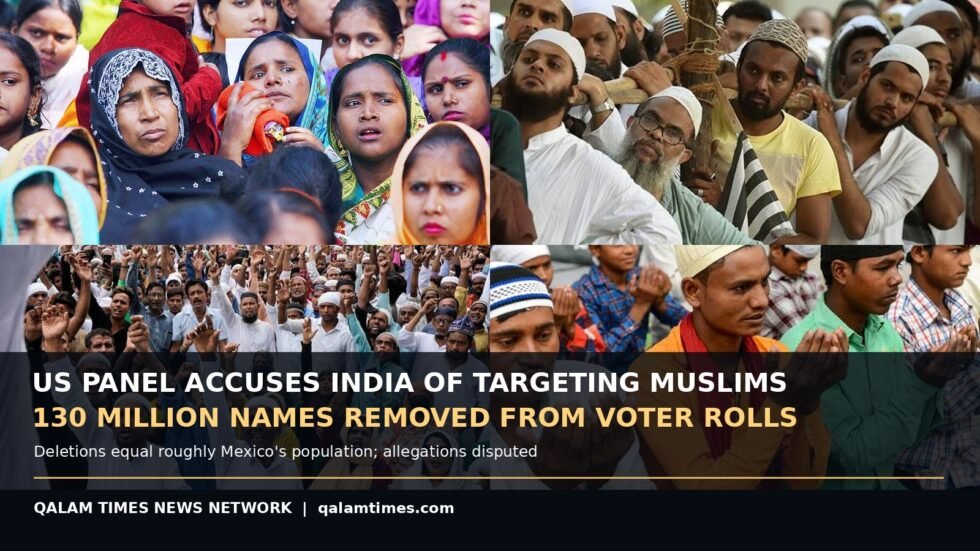
Voter Roll Revision in India faces US religious freedom panel criticism over alleged targeting of Muslims as 130 million names are removed from electoral rolls, nearly Mexico’s population.
Qalam Times News Network
New Delhi, November 20, 2026
India’s massive voter roll revision has triggered international concern after the United States Commission on International Religious Freedom (USCIRF) accused the Indian government of targeting Muslim citizens through the removal of millions of names from electoral registers. The controversy has intensified following reports that approximately 130 million names have been deleted from India’s electoral rolls, a figure comparable to the entire population of Mexico.
The scale of the deletions has raised serious questions about electoral inclusion, citizenship rights and the protection of religious minorities in the world’s largest democracy. The US religious freedom watchdog has expressed concern that the exercise may disproportionately affect Muslims, India’s largest religious minority, potentially leaving eligible citizens unable to exercise their constitutional right to vote. Asif Mahmood, chair of the USCIRF, criticised the Indian government’s approach in a statement issued on Thursday, alleging that Muslim citizens were being removed from voter lists, labelled as foreigners and subjected to deportation. “The Indian gov’t is targeting Muslim citizens by removing them from voter rolls, calling them ‘foreigners,’ and now illegally deporting them,” Mahmood said. The commission’s intervention has brought renewed international attention to the relationship between electoral verification, citizenship procedures and the treatment of religious minorities in India.
Voter Roll Revision: US Religious Freedom Commission Calls for Stronger Action Against India
Gene Mills, another commissioner of USCIRF, also criticised the developments, describing the alleged expulsion of Indian citizens on the basis of their Muslim identity as a serious escalation in the treatment of religious minorities. Mills urged the US Department of State to designate India as a “Country of Particular Concern” (CPC), a classification used by Washington in cases involving particularly serious violations of religious freedom. The USCIRF is a bipartisan federal government commission in the United States that monitors religious freedom conditions across the world and makes policy recommendations to the American administration. Although its recommendations can influence foreign policy discussions, they are not legally binding on the US government. Washington has not acted on the commission’s recent recommendations concerning India.
Voter Roll Revision: Election Commission Defends Removal of Names
India’s Election Commission has defended the voter list revision, maintaining that the exercise is intended to improve the accuracy and reliability of electoral records. According to the commission, names have been removed to eliminate duplicate entries, deceased voters, individuals who have permanently shifted their residences and people considered otherwise ineligible under electoral rules. The Election Commission has also maintained that individuals whose names have been excluded mistakenly can approach the authorities through the prescribed appeal procedures and seek restoration of their names. However, critics argue that the scale of the deletions and their reported impact on minority communities require greater transparency and independent scrutiny. An important distinction in the controversy is that removal from an electoral roll does not, by itself, establish that an individual is a foreign national or lacks Indian citizenship.
Voter Roll Revision: Voter Verification and Deportation Concerns Intensify
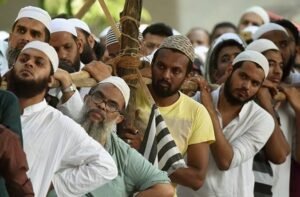
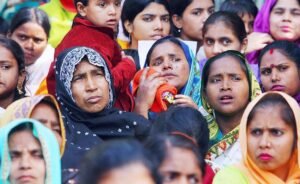
The controversy has become more complicated because the electoral revision is taking place alongside a separate government drive to identify and remove suspected illegal immigrants. Rights advocates have expressed concern that the two processes could create uncertainty for vulnerable communities, particularly Muslims who may face difficulties establishing their citizenship or residential status.
The USCIRF has alleged that these developments represent a broader pattern of measures affecting religious minorities. Critics fear that the combination of electoral exclusions and immigration-related enforcement could create additional difficulties for people whose documentation or residential records are incomplete. The distinction between electoral eligibility, citizenship verification and deportation procedures remains central to the ongoing debate.
Voter Roll Revision: Opposition Parties and Student Groups Raise Objections
The voter roll revision has also triggered protests in different parts of India. Opposition parties and student organisations have questioned the timing, implementation and possible political consequences of the exercise. Some demonstrators have alleged that the deletions could disproportionately affect communities and voters less likely to support the ruling Bharatiya Janata Party (BJP).
Civil rights advocates have called for safeguards to ensure that eligible voters are not excluded through administrative errors, inadequate verification procedures or difficulties in accessing the appeals process. Human rights experts have also criticised the authorities’ response to demonstrations opposing the revision.
Voter Roll Revision: Wider Concerns Over Religious Freedom in India
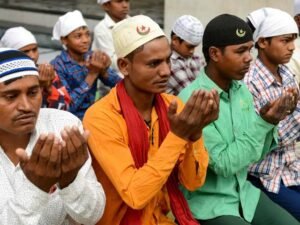
The latest controversy comes amid continuing international debate over religious freedom and minority rights in India under Prime Minister Narendra Modi’s government, which has been in power since 2014. UN experts and international human rights organisations have previously raised concerns about several developments affecting religious minorities.
Among the issues cited are:
- The spread of anti-Muslim hate speech and communal rhetoric.
- The Citizenship Amendment Act and its religion-based eligibility provisions.
- The demolition of properties belonging to Muslims.
- Changes to the constitutional status of Muslim-majority Jammu and Kashmir.
- Anti-conversion legislation and concerns surrounding freedom of belief.
The United Nations has previously described India’s religion-based citizenship legislation as fundamentally discriminatory. Rights organisations argue that these developments have contributed to an increasingly difficult environment for religious minorities. The Indian government, however, rejects allegations of systematic discrimination and maintains that its policies and welfare programmes are intended to benefit citizens across religious and social communities. India has consistently questioned the credibility and impartiality of the US Commission on International Religious Freedom. The Ministry of External Affairs has previously described the commission as biased and accused it of making politically motivated assessments of India’s internal affairs. New Delhi has also rejected international criticism concerning its domestic policies, arguing that matters relating to citizenship, elections and national administration fall within India’s sovereign jurisdiction. The Indian Embassy in Washington did not respond to a request for comment on the latest allegations, according to the report. Meanwhile, US Secretary of State Marco Rubio had described the issue as a domestic political matter during earlier remarks, indicating that Washington would not comment on the controversy.
Questions Over Electoral Rights and Minority Protection
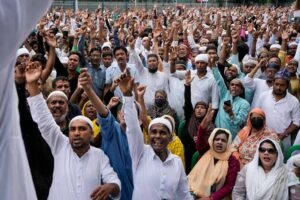
The removal of approximately 130 million names from India’s electoral rolls has brought the country’s voter verification process under unprecedented scrutiny. The central questions remain whether eligible citizens have been unfairly excluded, whether the appeals process provides effective protection and whether electoral verification is being conducted transparently and without discrimination. While the Election Commission maintains that the exercise is necessary to clean electoral records, the allegations raised by USCIRF have intensified calls for accountability and greater protection of minority voting rights. The controversy has now moved beyond a domestic electoral dispute, drawing attention from international religious freedom institutions and placing India’s record on minority rights under renewed scrutiny.