



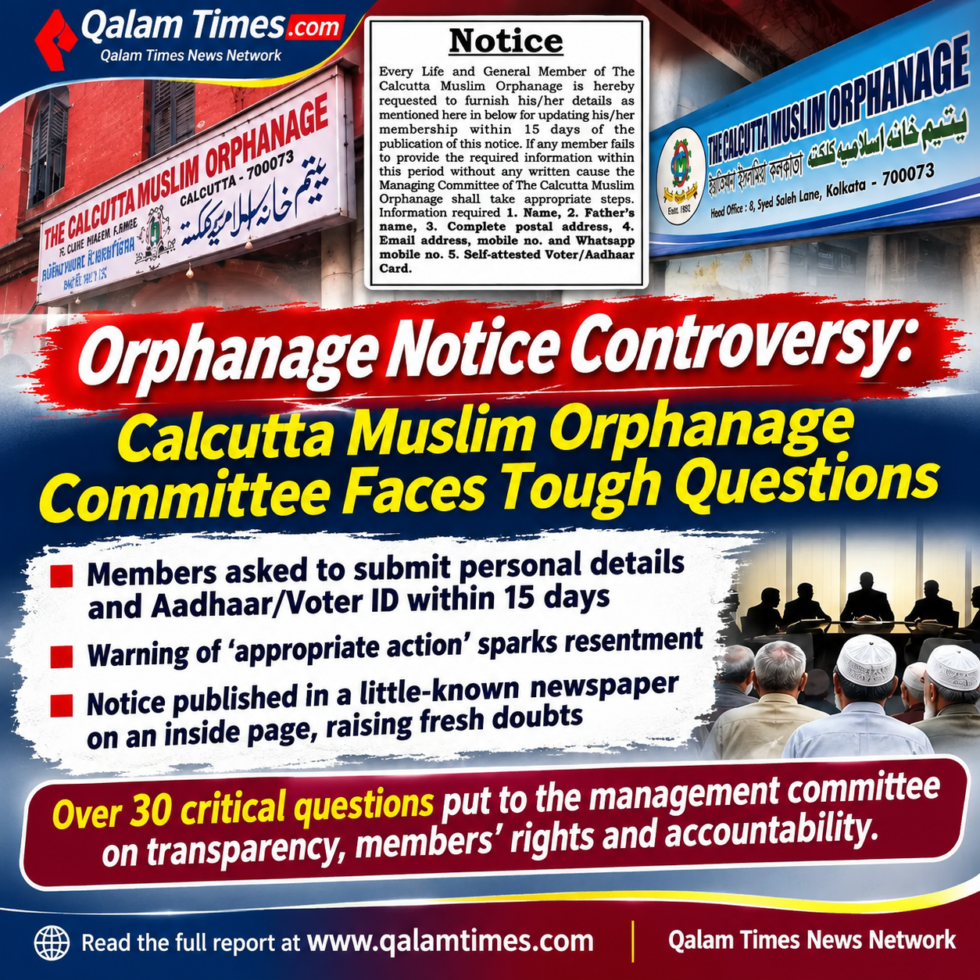
Orphanage Notice Controversy at The Calcutta Muslim Orphanage intensifies after the management committee asks life and general members to submit personal details and Aadhaar or voter ID copies within 15 days, raising serious questions over transparency, members’ rights, privacy and administrative accountability.
Orphanage Notice Controversy: A Welfare Institution or an Authoritarian Administration? Members Question the 15-Day Deadline, Threat of Action and Publication of the Notice in an Obscure Newspaper
Qalam Times News Network
Kolkata, November 28, 2026
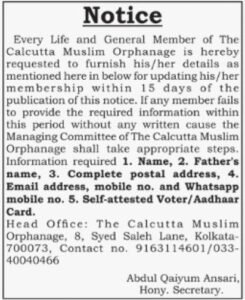
The Orphanage Notice Controversy surrounding The Calcutta Muslim Orphanage has raised serious questions about the management committee’s approach towards the institution’s life members and general members. A recent notice issued in the name of Honorary Secretary Abdul Qaiyum Ansari has asked every member to submit personal and contact details, along with a self-attested copy of either an Aadhaar card or voter ID, within 15 days of publication.

The Orphanage Notice Controversy has become particularly contentious because the notice not only imposes a short deadline but also warns that the management committee may take appropriate action against members who fail to provide the required information without submitting a written explanation. Critics are questioning whether such an intimidating approach is appropriate for an institution established to serve orphaned and underprivileged children through voluntary public participation.
The issue has also drawn attention to the manner in which the notice was published. According to information available to concerned members, the announcement appeared towards the bottom of an inside page of a relatively little-known Urdu newspaper, rather than being prominently displayed in a widely circulated publication. This has raised questions about whether the committee genuinely intended to ensure that every member received the information or merely wanted to complete a formal publication requirement.
The controversy is no longer limited to updating membership records. It has developed into a broader debate about institutional democracy, members’ dignity, administrative transparency, privacy and the accountability of those entrusted with managing a historic charitable organisation.
Orphanage Notice Controversy: Fifteen Days to Submit Personal Information
The notice addressed to all Life Members and General Members of The Calcutta Muslim Orphanage requests the following information:
- Full name of the member.
- Father’s name.
- Complete postal address.
- Email address, mobile number and WhatsApp number.
- Self-attested copy of either a voter ID card or Aadhaar card.
Members have been asked to submit these details within 15 days from the publication of the notice.
The announcement further states that if a member fails to provide the required information within the prescribed period without a written explanation, the management committee may take appropriate steps.
However, the notice does not specify what those steps might involve. It does not clearly explain whether the committee is contemplating suspension of membership, removal from the membership register, restrictions on voting rights or some other administrative measure.
This lack of clarity has become a major source of concern.
Why should members be subjected to a warning of possible action without being clearly informed about the nature of the proposed action and the constitutional provisions under which it might be taken?
An institution that expects cooperation from its members must also demonstrate fairness, clarity and respect towards them.
Why Was the Notice Published in an Obscure Newspaper and Hidden on an Inside Page?
One of the most troubling aspects of the controversy concerns the manner of publication.
When an organisation seeks sensitive personal information from every life and general member, the obvious expectation is that the announcement should receive maximum publicity.
A notice of such importance should ordinarily be published prominently in a newspaper with substantial circulation among the institution’s membership. Individual letters, registered post, emails and direct communication could also have been used to ensure that no member remained uninformed.
Instead, according to the information provided by concerned members, the notice appeared near the bottom of an inside page of a relatively little-known Urdu daily.
This raises several uncomfortable questions:
- Why was a newspaper with wider circulation not selected?
- Why was the announcement not published prominently with a clear and descriptive headline?
- Did the committee establish whether most members actually read the newspaper in which the notice appeared?
- Were individual letters or electronic notifications sent to members?
- Was the publication method approved through a formal committee decision?
- Was the intention genuinely to inform every member, or simply to fulfil a publication formality?
The use of only the generic heading ‘Notice’ has also attracted criticism.
Why was such an important membership-related announcement not given a clear heading explaining that it concerned the submission of personal information by life and general members?
If the purpose was transparency, why was the announcement not made as visible as possible?
The management committee must explain the newspaper selection, placement and publicity arrangements. These are legitimate questions concerning the fairness and effectiveness of the notification process.
Is a Charitable Institution Treating Its Members Like Subordinate Employees?
The Calcutta Muslim Orphanage is a charitable and social welfare institution, not a private commercial establishment or a government department.
Its members are associated with an organisation whose fundamental mission is the welfare, education and care of orphaned and disadvantaged children. Their involvement represents a commitment to public service, not an employment relationship.
Many members contribute through their time, experience, resources, professional expertise and social connections.
Against this background, the language and approach adopted in the notice have prompted criticism.
Are members being treated as partners in the institution’s mission or merely as individuals expected to obey administrative instructions?
Does the management committee consider itself a representative body responsible for serving the institution and its membership, or an authority entitled to issue unilateral orders?
A management committee is entrusted with responsibilities under an institution’s constitution and applicable rules. Its position should not be confused with ownership of the institution.
The people responsible for administration must remember that institutional authority carries obligations of accountability, not unlimited personal power.
Aadhaar and Voter ID Copies: Who Will Protect Members’ Personal Information?
Another important concern relates to the demand for copies of government-issued identity documents.
The notice asks members to provide either an Aadhaar card or voter ID copy but does not explain in detail why these documents are necessary or how the information will be protected.
The committee needs to answer several questions.
Is collecting photocopies of identity documents essential for updating the membership register?
Could identity verification be completed through inspection of original documents or another less intrusive method?
Who will have access to the submitted documents?
Where will these records be stored?
For how long will the documents be retained?
Will they be accessible only to authorised office-bearers?
What safeguards will prevent unauthorised access, disclosure or misuse?
Members are entitled to understand the purpose for which their personal information is being collected and the arrangements for protecting it.
The demand for personal documents should be accompanied by a clear explanation of necessity, data handling and security arrangements. Merely asking members to submit sensitive information without explaining these matters is not an adequate approach to institutional administration.
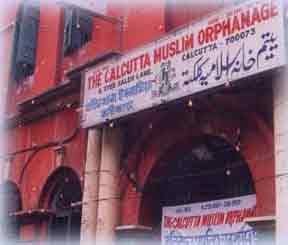
Orphanage Notice : Thirty Questions the Management Committee Must Answer
The controversy has raised questions that deserve clear, written and publicly accessible answers.
- Questions about the notice and its publication
- Why was such an important notice published in a relatively little-known newspaper instead of a widely circulated publication?
- Why was it placed towards the bottom of an inside page rather than given prominent visibility?
- Did the committee ensure that all life and general members would actually see the announcement?
- Were individual letters, registered postal communications, emails or WhatsApp messages sent to members?
- Why was the announcement given only the generic heading ‘Notice’ instead of a clear and descriptive title?
- Will the committee accept responsibility if members remain unaware of the notice because of its limited publicity?
- Questions about members’ rights and dignity
- Are members of the institution subordinate employees of the management committee?
- Does the committee regard itself as the representative and caretaker of the members or as an authority above them?
- Under what democratic and constitutional principles was this decision taken without prior consultation?
- Do life members have meaningful rights to participate in the institution’s administration and decision-making?
- Will members be given an opportunity to explain their circumstances or raise objections before any action is considered?
- Questions about the threat of administrative action
- What exactly does the expression ‘appropriate steps’ in the notice mean?
- Can action be taken against a member without first providing individual notice and an opportunity to explain?
- Under which provision of the institution’s constitution can the committee suspend or cancel a life membership?
- Why does the notice not identify the relevant constitutional clauses or rules?
- Can a member submit a reasonable written explanation if they are unable or unwilling to provide a particular document?
- Questions about personal information and identity documents
- Why are Aadhaar or voter ID copies necessary when names, addresses and contact details are already being requested?
- What specific purpose will these identity documents serve?
- Why has the committee not explained whether a less intrusive alternative can be used for identity verification?
- What security arrangements exist to protect members’ personal documents?
- Which office-bearers or employees will have access to the submitted information?
- Who will accept responsibility if a member’s personal information is leaked, misused or accessed without authorisation?
- Questions about institutional transparency and accountability
- Have elections, Annual General Meetings and the presentation of audit reports been conducted regularly and transparently?
- Are members provided with a proper account of donations, institutional income, property-related revenue and expenditure?
- Has the committee informed members how much is spent on the education, accommodation, food, healthcare and overall welfare of orphaned children?
- Are children’s welfare, educational development and financial transparency receiving the attention they deserve?
- Do members have the freedom to question the committee’s performance and suggest improvements without being treated as troublemakers?
- What concrete improvement in the institution’s administration is expected from this membership verification exercise?
- Was approval obtained from the General Body before introducing this process? If not, what constitutional authority was relied upon?
- Does the committee have the willingness to answer all these questions in writing and adopt a more consultative and respectful administrative approach?
These are not unreasonable demands. They concern the basic relationship between an institution, its members and the people entrusted with its administration.
Membership Verification May Be Necessary, But Administrative High-Handedness Is Not
It would be unfair to suggest that updating membership records is inherently wrong. Every properly functioning organisation needs accurate records, reliable contact information and appropriate identity verification.
However, the legitimacy of an administrative objective does not automatically justify every method adopted to achieve it.
If the committee genuinely wants to update its records, it should communicate directly with each member, explain why the information is required, provide sufficient time and establish a transparent system for protecting personal documents.
It should also clarify whether the exercise has been approved under the institution’s constitution and whether the General Body has been consulted wherever necessary.
Most importantly, members should not be made to feel that their long-standing association with the institution is under threat simply because they have not responded to a newspaper announcement within 15 days.
An elderly life member living outside Kolkata, for example, may not even come across the newspaper in which the notice appeared. Treating such a person as non-compliant without individual communication would raise obvious questions of fairness.
Financial Transparency and Children’s Welfare Must Remain the Priority
The debate also brings attention to a much larger issue: the institution’s overall accountability.
If the committee expects members to provide personal information and identity documents, it should also be prepared to share meaningful information about its own functioning.
Members should be able to understand the institution’s financial position, sources of income, donations, property-related revenue, expenditure, audit findings and welfare activities.
How much is being spent on the education of orphaned children?
What facilities are available for their accommodation, nutrition and healthcare?
Are the annual financial statements and audit reports regularly presented to the General Body?
Are institutional decisions taken in accordance with the constitution and approved procedures?
These are essential questions for any charitable organisation.
The purpose of a membership verification exercise should be institutional improvement, not the creation of an atmosphere in which members hesitate to question the management.
The Committee Is a Custodian, Not the Owner of the Institution
There is a fundamental principle that must not be forgotten: a management committee is entrusted with the administration of an institution; it does not own the institution.
The committee’s authority must operate within the framework of the organisation’s constitution, applicable law and the rights of its members.
Life members and general members are not outsiders who can be treated as unwanted participants. They are part of the institution’s wider social and administrative structure.
Their contributions, commitment and willingness to serve are important assets.
An organisation becomes stronger when its members are heard, when decisions are explained and when disagreements are addressed through dialogue.
It becomes weaker when questions are treated as disobedience, criticism as hostility and administrative authority as an instrument of intimidation.
The management committee should therefore reconsider the disputed notice, clarify the purpose of collecting identity documents, explain the legal and constitutional basis of its decision and provide members with a reasonable opportunity to respond.
Now the Management Committee Must Speak
The controversy surrounding The Calcutta Muslim Orphanage deserves a clear response from those responsible for its administration.
The committee should publicly explain:
- Why was the notice published in a relatively little-known newspaper and placed towards the bottom of an inside page?
- Why were members not individually informed?
- Why was a deadline of only 15 days prescribed?
- What does the warning of ‘appropriate action’ actually mean?
- Under which constitutional provisions can such action be taken?
- Why are Aadhaar or voter ID copies required?
- What arrangements exist to protect members’ personal information?
- Was the General Body consulted before this process was initiated?
The committee’s response would help establish whether the process is a legitimate administrative exercise or whether the concerns raised by members have a reasonable basis.
Asking questions is not indiscipline. Demanding transparency is not hostility. And being a life member does not mean surrendering one’s dignity and rights.
The identity of The Calcutta Muslim Orphanage should be defined by its commitment to orphaned children, public welfare, institutional integrity and mutual respect among its members.
It should never become an organisation where administrative positions are mistaken for personal ownership.
The institution belongs to its charitable mission, not to the personal authority of any committee. Its members deserve respect, its administration owes accountability, and the welfare of orphaned children must remain its highest priority.
The management committee must now decide whether it will respond to these legitimate questions or allow the controversy to deepen through silence.