



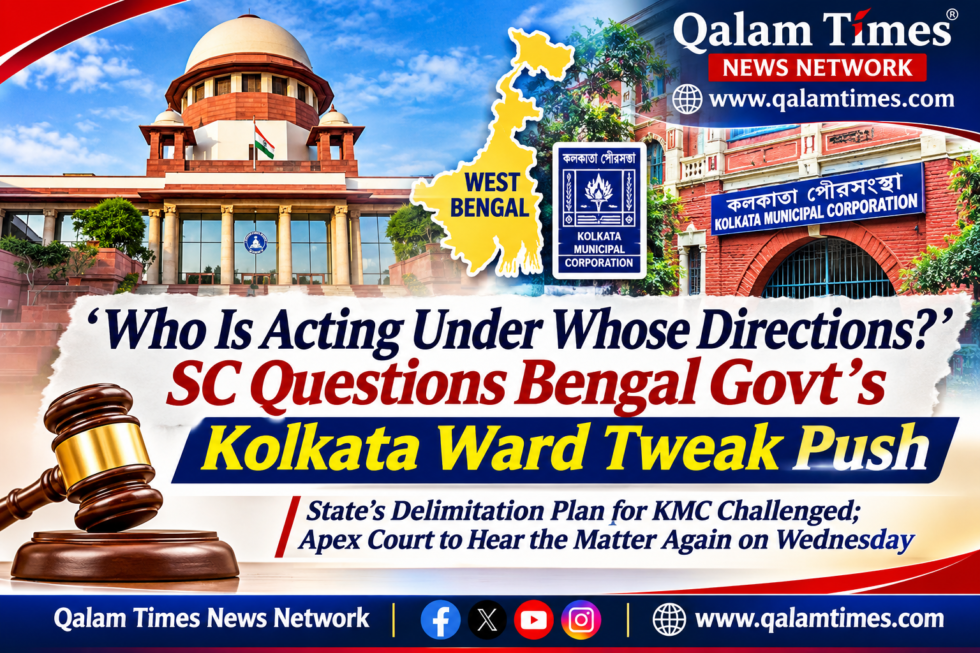
Kolkata Ward Delimitation faces fresh Supreme Court scrutiny as Justice Joymalya Bagchi questions the Bengal government’s reliance on a recommendation from a dissolved municipal corporation. The case concerns the proposed increase in Kolkata’s wards from 144 to 209.
Qalam Times News Network
Kolkata, November 23, 2026
Supreme Court Examines Authority Behind the Proposed Kolkata Ward Reorganisation
Kolkata Ward Delimitation has come under renewed judicial scrutiny after the Supreme Court questioned the West Bengal government’s procedure for reorganising the wards of the Kolkata Municipal Corporation (KMC). During Monday’s hearing, Justice Joymalya Bagchi raised questions about the authority behind the recommendation used to justify the exercise, particularly because the elected municipal corporation had ceased to exist.
The observations came as the state government challenged a Calcutta High Court order that put the Kolkata civic election process on hold until a pending legal challenge to the Kolkata Ward Delimitation exercise is decided. The proposed reorganisation would increase the number of municipal wards from the existing 144 to 209.
The Supreme Court bench comprised Chief Justice of India Surya Kant, Justice J.V. Mohana and Justice Joymalya Bagchi. Justice Bagchi questioned how the state could rely on a recommendation from a corporation that was no longer functioning as an elected civic body.
“If you are getting a recommendation from a corporation which does not exist, how will you exercise power?” he asked during the proceedings.
Court Seeks Clarity on Who Initiated the Delimitation Exercise
Representing the state government, Tushar Mehta told the bench that the delimitation exercise had effectively been carried out by the state administration and not independently by the municipal corporation. However, Justice Bagchi sought a clearer explanation of the relationship between the state government’s directions and the recommendation formally attributed to the corporation.
Referring to the issue, the judge remarked: “Who is acting under whose directions?”
He observed that the notification referred to a recommendation from the corporation, while the administrator heading the civic body could not be treated as the corporation itself. The court indicated that this distinction was central to the dispute considered by the Calcutta High Court’s division bench. Justice Bagchi also referred to the principle that public authorities must act through the proper statutory process, questioning the sequence of directions and recommendations that led to the final notification.
State Government Defends the Process
The state’s counsel argued that the Urban Development and Municipal Affairs Department had followed a procedure for inviting objections and suggestions regarding the proposed increase in wards.
According to the government’s submissions, ten officers had been appointed to conduct hearings and examine objections relating to the proposed reorganisation. Mehta also pointed out that the original petitioner had not submitted objections during the relevant process. He referred to Section 17 of the applicable legislation, arguing that during the period when the corporation stood dissolved, the commissioner was required to act in accordance with the directions of the state government. The state’s position was that the Municipal Commissioner had submitted the final recommendations and revised Schedule II on the instructions of the Additional Chief Secretary. Mehta further argued that government-appointed officers had conducted hearings, considered objections and submitted their findings before the state government took the final decision. He maintained that the challenge before the High Court concerned the demarcation of ward boundaries rather than the state’s decision to increase the total number of wards.
Justice Bagchi Distinguishes Between Increasing Wards and Redrawing Boundaries
During the hearing, Justice Bagchi observed that the state government was not necessarily prevented from increasing the number of municipal wards. However, he pointed out that changing the total number of wards would naturally require corresponding changes to the boundaries of the existing constituencies. The judge also referred to a communication dated July 3, observing that its concluding lines appeared to reflect a possible misunderstanding by the state in seeking a recommendation from an already dissolved corporation.
He indicated that even if an error had occurred in that communication, the question of the state’s statutory authority would have to be considered separately. The court’s observations therefore focused not simply on the proposed increase from 144 to 209 wards, but also on the legal procedure followed to determine the revised boundaries.
Calcutta High Court Order Holds Up Civic Election Process
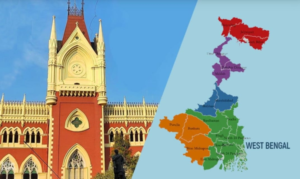
The West Bengal government approached the Supreme Court after a division bench of the Calcutta High Court directed that the civic election notification should not be issued until a single-judge bench decides the pending challenge to the delimitation exercise.
The High Court’s intervention has delayed the process of moving ahead with the Kolkata Municipal Corporation elections.
The ward reorganisation has been challenged on questions concerning the authority and procedure followed in preparing the revised boundaries. The state government, however, has defended the exercise and sought permission to proceed with the civic election process.
The legal dispute has consequently become a significant factor in determining the timeline for the next Kolkata municipal elections.
Political and Administrative Uncertainty Ahead of Civic Polls
The Kolkata Municipal Corporation’s elected board was dissolved after Mayor Firhad Hakim resigned following the Trinamool Congress’s defeat in the West Bengal Assembly elections. Municipal Commissioner Smita Pandey was appointed as the administrator, and her tenure is due to end on December 7.
The state government has been seeking to conduct elections to the Kolkata Municipal Corporation and Howrah Municipal Corporation by December.
Chief Minister Suvendu Adhikari had also indicated that, if the civic elections could not be held within the expected timeframe, the government would appoint coordinators from the BJP to ensure the continued delivery of civic services in Kolkata.
The next hearing in the Supreme Court is scheduled for Wednesday. The proceedings are expected to bring further clarity to the legal questions surrounding the delimitation process and the future schedule of Kolkata’s civic elections.
For now, the Supreme Court has raised questions about the procedure and the authority behind the ward reorganisation. No final decision on the legality of the exercise or the civic election schedule has yet been announced.