




Muslim Displacement in Assam has left 132 Bengali Muslim families homeless again after authorities demolished their houses and a mosque in Lakhimpur, reviving painful memories of the 1983 anti-Muslim violence.
Qalam Times News Network Special Report
Lakhimpur, (Assam) November 18, 2026
Four Decades After the 1983 Violence, Bengali Muslim Families Face Another Eviction as Questions of Selective Demolition Emerge
MUSLIM DISPLACEMENT has once again become a painful reality for 132 Bengali Muslim families in Assam, where a demolition operation carried out on November 13 in Boginadi, Lakhimpur district, reportedly destroyed their homes and a mosque. More than four decades after their families were displaced by the anti-Muslim violence of 1983, these residents now find themselves facing another devastating experience of homelessness. The operation, conducted under the BJP-led Assam government, has triggered serious questions about the treatment of displaced communities, the protection of religious places and the alleged selective enforcement of land regulations.
For the affected families, the latest demolition is not simply a dispute over land. It represents the destruction of homes they say they rebuilt after escaping communal violence more than 40 years ago. Residents allege that Muslim households were specifically targeted while Hindu families living in the same settlement were left untouched. The Muslim Displacement controversy has consequently raised concerns about equality before the law, the rights of vulnerable communities and the responsibility of the state towards people who have already experienced historical displacement.
FROM THE TRAUMA OF 1983 TO THE DESTRUCTION OF THEIR HOMES IN 2026
The history of the affected families is closely connected with one of the darkest periods in Assam’s modern history. In 1983, widespread violence took place across Assam amid an intense anti-immigration movement. Bengali-speaking Muslims were among the communities affected by the violence, with thousands of people losing their lives and many others being forced to abandon their homes. The Nellie massacre remains one of the most devastating episodes associated with that period. The killings left deep scars on the region’s social and communal fabric and continue to represent a painful chapter in Assam’s history. According to accounts provided by the affected residents, the 132 families involved in the latest demolition were among those displaced during the violence. After losing their original homes, they reportedly settled in Boginadi and gradually rebuilt their lives. Over the following decades, generations grew up in the settlement, families established households and residents developed a sense of belonging to the area. For many, the settlement had become the only home they had known. However, the demolition operation on November 13 has once again left them without permanent shelter. The destruction of their homes has revived painful memories of the displacement their families experienced in 1983.
GOVERNMENT CITES ENCROACHMENT ON GRAZING RESERVE LAND

The district administration reportedly justified the demolition by stating that the houses had been constructed on land designated as a Professional Grazing Reserve (PGR). Such land is officially reserved for grazing purposes and is subject to restrictions on unauthorised occupation. From the administration’s perspective, the operation was an action against alleged encroachment on protected land. However, the affected families challenge the circumstances and fairness of the action. They maintain that their settlement dates back decades and that their presence in the area followed the displacement caused by the 1983 violence. They also question why the administration did not provide an adequate rehabilitation arrangement before demolishing their homes. The central issue therefore extends beyond the classification of the land. It concerns the circumstances in which the families settled there, the legal status of their occupation, the notices and procedures followed before demolition, and whether alternative accommodation was considered. These questions require transparent answers from the district administration.
ALLEGATIONS OF SELECTIVE TARGETING: WHY WERE MUSLIM HOMES DEMOLISHED?
One of the most serious allegations emerging from Boginadi concerns the alleged selective nature of the demolition. Affected residents claim that Muslim households were removed while Hindu families living in the same settlement were allowed to remain. One resident questioned the administration’s approach, asking: “Why were only Muslim families’ homes demolished?”
The allegation has intensified concerns about whether land regulations were applied equally to all residents. According to the residents, people belonging to different communities, including Muslims, Hindus, Nepalis, Misings, Bodos and Assamese, had lived alongside one another in the settlement for generations. If households belonging to different communities occupied comparable land under similar circumstances, the administration must explain the criteria used to identify properties for demolition. Were all alleged encroachments examined under the same standards?
Were notices issued consistently?
Were residents given equal opportunities to establish their claims?
And if Hindu households were indeed spared while Muslim households were demolished, what was the legal basis for treating them differently?
These are serious allegations that require an independent and transparent examination.
The administration should publish the relevant land records, demolition orders and details of the properties identified for eviction.
FAMILIES TAKE SHELTER BESIDE A RIVER, BUT FEAR ANOTHER EVICTION
The immediate humanitarian consequences of the demolition are particularly distressing.
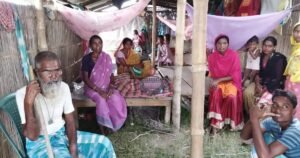
With their homes destroyed, several affected families have reportedly sought temporary shelter along a nearby riverbank.
For households that have already lost their homes, this is an extremely precarious situation. Families with children, elderly residents and women are now facing uncertainty about where they will sleep and how they will meet their basic needs.
Residents have further alleged that police personnel are pressuring them to leave the riverbank, leaving them with no clear alternative.
One displaced resident described the situation: “We have nowhere to go. Muslim houses were targeted. We are now on the bank of the river, and the police are chasing us away from this area.”
The statement reflects the immediate desperation of people who say they have lost everything.
If the allegations are accurate, the authorities must explain where these families are expected to go and what arrangements have been made for their temporary accommodation.
Eviction operations cannot be viewed solely through the lens of land administration when they leave large numbers of people without shelter.
The government has a responsibility to ensure that affected residents are treated humanely and that their basic needs are addressed.
“ARE WE FROM BANGLADESH?” RESIDENTS QUESTION THEIR IDENTITY AND BELONGING
Another disturbing aspect of the incident concerns the recurring questions surrounding the identity of Bengali-speaking Muslims in Assam. For decades, the citizenship and belonging of Bengali-speaking communities have remained sensitive political issues in the state.
Residents affected by the demolition expressed frustration over what they see as a contradiction between political promises and administrative action. One resident reportedly questioned the authorities:
“They came asking for votes during the elections, and now they have demolished our homes. Are we from Bangladesh?”
The statement captures the sense of insecurity experienced by families who insist that they have lived in the region for generations.
For these residents, the issue is not merely the destruction of houses. It is also about whether their history, residence and claims to belonging are being recognised. Questions of citizenship and land ownership must be determined through lawful procedures and documentary evidence, not assumptions based on language, religion or community identity.
Bengali-speaking Muslims should not face collective suspicion simply because of their linguistic or religious background.
ASSAM’S EVICTION CAMPAIGNS AND THE VULNERABILITY OF BENGALI MUSLIM COMMUNITIES
The latest incident in Lakhimpur has brought renewed attention to the wider pattern of eviction drives in Assam.
The BJP-led state government has carried out several operations against alleged encroachments on government and protected land. Such actions have frequently affected Bengali-speaking Muslim communities and generated debates about land rights, citizenship, rehabilitation and equal treatment.
The government has generally defended these operations on the grounds of removing illegal occupation and protecting public land.
However, human rights concerns emerge when large numbers of families are displaced without adequate rehabilitation or when allegations of discriminatory enforcement remain unanswered.
The Boginadi incident deserves particular scrutiny because the affected families claim that their settlement originated in the aftermath of the 1983 violence.
If their account is supported by historical and administrative records, their displacement raises additional questions about the state’s responsibility towards people who were previously uprooted by communal violence.
A government cannot ignore the humanitarian consequences of an eviction simply by describing it as an anti-encroachment operation.
At the same time, the legality of individual land claims must be examined through proper records and established legal procedures.
THE MOSQUE DEMOLITION RAISES ADDITIONAL QUESTIONS ABOUT RELIGIOUS RIGHTS
The reported demolition of a mosque alongside residential properties has added another dimension to the controversy.
A mosque is not simply a physical structure. For the people who use it, it is a place of worship and an important part of their religious and social life.
The administration must clarify the legal status of the mosque, the grounds on which it was included in the demolition operation and whether the relevant procedures were followed.
Was the mosque included in the official demolition notice?
Were its ownership or land-use records examined?
Were religious representatives given an opportunity to present relevant documents?
These questions should be answered openly.
The protection of public land and the constitutional freedom of religion must both be respected. Any action affecting a place of worship must follow the applicable law and procedural safeguards.
QUESTIONS THE ASSAM GOVERNMENT AND DISTRICT ADMINISTRATION MUST ANSWER
The demolition in Boginadi has created a series of questions that cannot be ignored.
- Why were 132 Bengali Muslim families rendered homeless in the November 13 operation?
- What documentary evidence establishes the legal status of the land occupied by these families?
- Were the families originally settled in Boginadi following the 1983 communal violence?
- Were proper notices and opportunities for legal representation provided before demolition?
- Why do residents allege that Muslim homes were demolished while Hindu households in the same settlement were spared?
- What criteria were used to identify the properties selected for demolition?
- Why was a mosque demolished, and what legal process governed that action?
- Has the administration arranged temporary accommodation, food, drinking water and medical assistance for displaced residents?
- Why are police allegedly preventing homeless families from remaining at the nearby riverbank?
- Will the government conduct an independent inquiry into the allegations of selective targeting?
- Will affected families receive rehabilitation or compensation if their claims are found legally justified?
- Will the administration publish the relevant land records and demolition orders to establish transparency?
These questions are not merely political. They concern human dignity, due process, equality and the basic right to live with security.
The destruction of 132 homes in Boginadi has once again brought the plight of vulnerable Bengali Muslim families in Assam into public discussion.
For families whose history is connected with the violence of 1983, the latest demolition represents another period of fear, uncertainty and displacement.
The government’s responsibility does not end with identifying alleged encroachment. It must also ensure that every action follows the law, that similar cases are treated equally and that people are not left without shelter.
The administration should urgently clarify the legal circumstances of the operation, investigate the allegations of selective demolition and ensure that displaced families receive necessary humanitarian assistance.
If the residents’ allegations are substantiated, accountability must follow.
No family should have to experience homelessness twice because the state fails to address the consequences of earlier displacement.
The people of Boginadi deserve transparent answers, lawful treatment and the opportunity to rebuild their lives with dignity.
For the 132 families who have lost their homes, the immediate question is simple: Where will they go, and who will take responsibility for their future?