



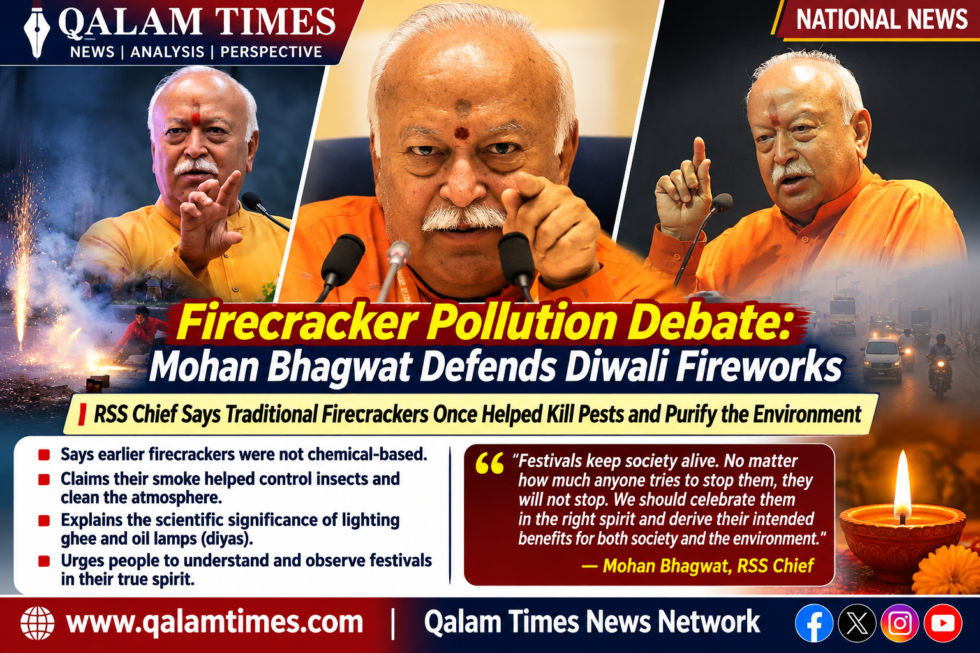
Firecracker Pollution Debate intensifies as RSS chief Mohan Bhagwat defends traditional fireworks and explains their historical significance during Diwali.
Qalam Times News Network
Nagpur, November 12, 2026
Firecracker Pollution Debate Intensifies as Mohan Bhagwat Explains Traditional Significance of Diwali Fireworks and Oil Lamps
The Firecracker Pollution Debate has gained fresh attention following remarks by Rashtriya Swayamsevak Sangh (RSS) chief Mohan Bhagwat, who has defended the traditional use of firecrackers during festivals, arguing that earlier forms of fireworks served purposes beyond entertainment. Speaking at a Deepawali Milan programme in Nagpur on Tuesday, November 10, Bhagwat claimed that traditional firecrackers were manufactured differently from modern products and did not contain the same chemical substances. According to him, their smoke helped eliminate insects and pests, particularly around the agricultural harvest season, and contributed to what he described as the purification of the surrounding atmosphere.
His comments come at a time when several Indian cities, including Delhi and Mumbai, are experiencing serious air-quality concerns following Diwali celebrations. The Firecracker Pollution Debate has consequently brought two important issues into focus: the cultural significance of traditional festivals and the environmental consequences of modern fireworks. While Bhagwat emphasised the historical and cultural reasoning behind certain festive practices, concerns over smoke emissions, fine particulate matter and public health continue to attract considerable attention.
Bhagwat Explains the Traditional Purpose of Firecrackers
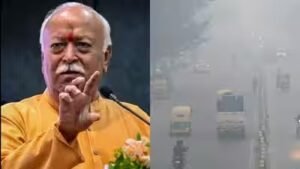
Addressing the gathering in Nagpur, Bhagwat spoke about the historical practices associated with Indian festivals and argued that many customs developed through practical observations and traditional knowledge. He suggested that people in earlier generations used firecrackers in a different manner and that their composition was not comparable to the chemically manufactured fireworks commonly available today. Explaining his perspective, Bhagwat said that traditional firecrackers produced smoke which, according to him, helped destroy insects and agricultural pests, especially during the harvest period. He argued that such practices had a practical purpose in addition to their festive significance. Bhagwat also suggested that modern society should make an effort to understand the historical background of traditional customs instead of viewing them exclusively through the lens of contemporary celebrations. However, his statements represent his explanation of traditional practices and should not be confused with established scientific evidence that firecracker smoke purifies the air. Modern firework emissions are known to release particulate matter and other pollutants.
Scientific Significance of Lighting Oil and Ghee Lamps
Apart from firecrackers, Bhagwat also discussed the traditional practice of lighting lamps using ghee and oil during Diwali. He argued that these customs were not merely symbolic and that there were practical and scientific explanations behind them. According to him, burning traditional lamps creates particular environmental conditions, and earlier generations incorporated such practices into their celebrations based on their understanding of nature and everyday life. The RSS chief encouraged people to explore the reasoning behind these customs and observe festivals with an understanding of their cultural and traditional significance. Lighting diyas remains one of the most recognisable features of Diwali celebrations, symbolising the victory of light over darkness, hope over despair and knowledge over ignorance. The practice also carries deep religious, cultural and social significance across different parts of India.
Air Pollution Concerns Following Diwali Celebrations
Bhagwat’s remarks have come amid growing concern over the impact of firecrackers on air quality in major Indian cities. Following Diwali celebrations, several urban areas experienced deteriorating air conditions, with smoke and particulate pollution adding to existing environmental pressures. Delhi, which regularly faces severe winter pollution, has been particularly vulnerable to the combined effects of fireworks, vehicle emissions, industrial activities, construction dust and agricultural residue burning. Mumbai has also witnessed concerns about worsening air quality following the festive period. The immediate impact of fireworks can be particularly significant because they release fine particles and various chemical compounds into the atmosphere. PM2.5 and PM10 particles are among the major pollutants associated with firework emissions. Fine particles can enter the respiratory system and aggravate breathing difficulties, particularly among children, older people and individuals suffering from existing respiratory or cardiovascular conditions. Environmental experts have repeatedly highlighted the importance of controlling emissions and adopting safer festive practices to reduce the public-health impact of air pollution.
Bhagwat Says Festivals Are Essential to Society
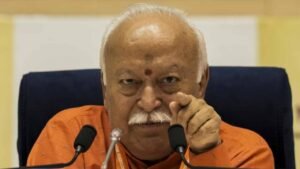
During his address, Bhagwat also spoke about the broader social importance of festivals and their role in maintaining cultural continuity. He argued that celebrations such as Diwali are deeply embedded in Indian society and cannot be separated from the country’s cultural identity. According to him, festivals bring people together, strengthen social relationships and help preserve traditions across generations. He maintained that celebrations would continue despite opposition, emphasising that the important consideration should be the manner in which people observe them. Bhagwat urged people to celebrate festivals in their proper spirit and understand the values they represent. His remarks suggested that traditional celebrations should not be viewed simply as occasions for entertainment but as opportunities to strengthen social harmony, cultural awareness and collective identity.
Diwali Represents the Victory of Light Over Darkness
Explaining the wider meaning of Diwali, Bhagwat described the festival as a celebration of light overcoming darkness. He said the significance of the occasion extended beyond lighting lamps and celebrating with family members. According to him, Diwali also represents the spread of knowledge, the removal of ignorance and the creation of a harmonious society. The festival carries different historical and religious associations across India. In many traditions, it is connected with the return of Lord Rama to Ayodhya, while other communities associate it with prosperity, spiritual renewal and the worship of Goddess Lakshmi. Despite these different interpretations, the central themes of light, hope, renewal and the triumph of good over evil remain widely recognised. Bhagwat encouraged people to appreciate these values and ensure that celebrations contribute positively to society.
Tradition and Environmental Responsibility: The Debate Continues
The remarks have once again brought attention to the challenge of balancing cultural traditions with environmental responsibility. Diwali remains one of India’s most important festivals, celebrated by millions of people through prayers, family gatherings, decorations and the lighting of lamps. At the same time, the environmental consequences of modern fireworks cannot be overlooked. The chemical composition of contemporary firecrackers, their emissions and the timing of their use can contribute to short-term deterioration in air quality. Understanding the historical significance of festive practices and addressing their present-day environmental impact are therefore two separate but equally important considerations. The discussion also highlights the need for greater public awareness, responsible celebrations and effective measures to reduce pollution without disregarding the cultural importance of festivals.