



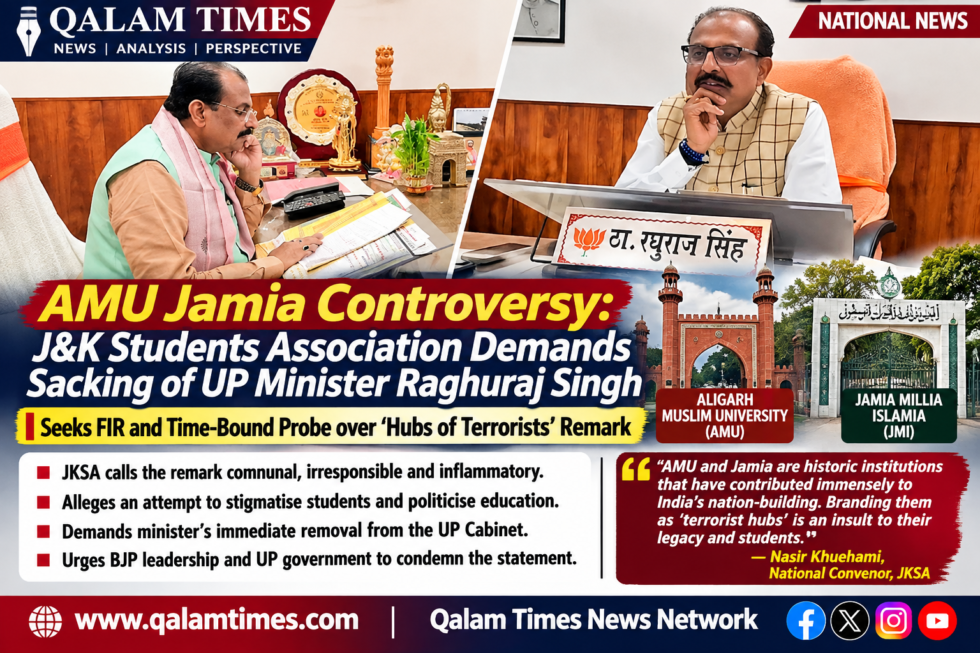
AMU Jamia Controversy: J&K Students Association demands UP Minister Raghuraj Singh’s dismissal, FIR and probe over remarks targeting AMU and Jamia.
Qalam Times News Network
New Delhi / Lucknow, November 12, 2026
AMU Jamia Controversy Intensifies as Students’ Body Seeks FIR, Time-Bound Investigation and Minister’s Removal
The AMU Jamia Controversy has intensified after the Jammu and Kashmir Students Association (JKSA) demanded the immediate removal of Uttar Pradesh Minister Thakur Raghuraj Singh from the state Cabinet over his controversial description of Aligarh Muslim University (AMU) and Jamia Millia Islamia (JMI) as alleged “hubs of terrorists”. The association has also called for the registration of a First Information Report (FIR) against the minister and a time-bound investigation into his remarks, arguing that such statements are unacceptable from a public representative holding constitutional office.
The controversy erupted after Singh reportedly made remarks targeting the two prominent universities and threatened that they should be shut down. The AMU Jamia Controversy has subsequently raised wider concerns about the treatment of educational institutions, freedom of academic expression and the responsibility of elected representatives to maintain communal harmony. The JKSA has described the minister’s comments as inflammatory and an attempt to associate entire student communities with terrorism on the basis of the identities of their educational institutions.
JKSA Calls Remarks Communal, Demands Immediate Accountability
In a strongly worded response, the Jammu and Kashmir Students Association condemned Singh’s statements, describing them as irresponsible, divisive and damaging to the academic environment. Nasir Khuehami, National Convenor of the association, said that targeting established universities through communal rhetoric was a dangerous development that could undermine the country’s educational institutions and create unnecessary divisions among students. He argued that public representatives should concentrate on improving India’s education system rather than making statements that stigmatise universities and their students. Khuehami questioned the logic of portraying students of prestigious educational institutions as potential threats to national security without substantiated evidence. According to him, such comments risk creating an atmosphere of suspicion, insecurity and hostility on university campuses. The association maintained that educational institutions should be assessed on the basis of their academic achievements, research activities, institutional governance and contribution to society rather than assumptions linked to their names or perceived religious identities.
Association Demands Minister’s Removal and Registration of FIR
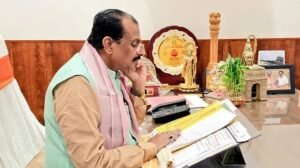
The JKSA has placed three principal demands before the political leadership and law enforcement authorities. First, it has demanded that Thakur Raghuraj Singh be removed immediately from the Uttar Pradesh Council of Ministers. Second, it has called for the registration of an FIR under appropriate legal provisions concerning his alleged inflammatory statements. Third, it has demanded a time-bound investigation to establish the circumstances surrounding the remarks and determine whether they attract legal action. The association has also appealed to the BJP’s national leadership and the Uttar Pradesh Chief Minister to publicly distance themselves from the minister’s statements and take appropriate action. Khuehami argued that holding ministerial office carries a responsibility to protect constitutional values and promote social harmony. He maintained that public officials should not be permitted to use their positions to malign educational institutions or create fear among students. The association further stressed that threats against universities should not be treated as ordinary political commentary when they risk encouraging prejudice against particular communities.
AMU and Jamia: Institutions With a Significant Place in India’s History
The association also defended the historical and educational contributions of Aligarh Muslim University and Jamia Millia Islamia, describing both as important parts of India’s intellectual and national heritage.
Aligarh Muslim University, located in Aligarh, Uttar Pradesh, traces its origins to the Muhammadan Anglo-Oriental College established by Sir Syed Ahmad Khan in 1875. It subsequently developed into a university in 1920 and became an important centre of modern education, academic scholarship and intellectual discussion.
Over the decades, AMU has produced distinguished personalities in politics, administration, literature, science, sports and public service.
Jamia Millia Islamia, established in 1920, also has a significant place in India’s educational and freedom movement history. Its foundation was closely connected with the nationalist educational movement and the efforts of Indian intellectuals and political leaders to develop institutions rooted in national aspirations. The university later developed into a major centre of higher education and research in New Delhi. The JKSA argued that reducing the contributions of these institutions to religious identities or allegations of terrorism was historically unfair and deeply insulting to generations of teachers, researchers and students. Khuehami said that the achievements of AMU and Jamia should be recognised through their academic and social contributions rather than subjected to political attacks. He emphasised that both institutions belong to the country and that their students are an integral part of India’s future.
Universities Must Remain Centres of Learning, Not Political Targets
The association expressed concern that educational institutions were increasingly being drawn into political controversies. It argued that universities should provide an environment where students can pursue education, conduct research, exchange ideas and engage in intellectual discussions without fear of being collectively labelled or targeted. According to the JKSA, the responsibility of political leadership should be to strengthen the country’s educational infrastructure, expand research opportunities and improve access to quality higher education. The association criticised what it described as an approach in which established universities were threatened with closure instead of receiving greater institutional support. Khuehami maintained that the identity of a university cannot be used as a justification for questioning the patriotism of its students. He also warned that such rhetoric could deepen feelings of exclusion among young people who should feel equally respected and represented in the country’s democratic framework.
Appeal to BJP Leadership and Uttar Pradesh Government
The JKSA has called upon the BJP’s central leadership and the Uttar Pradesh Chief Minister to respond clearly to the controversy. The association wants the party leadership to publicly condemn the remarks and demonstrate that inflammatory statements against educational institutions will not be tolerated. It has reiterated that Singh’s position as a minister makes the matter particularly serious because statements from individuals holding government office carry considerable public influence. Khuehami argued that a minister who publicly describes prominent universities as centres of terrorism and threatens their existence should be held accountable. The association also maintained that an investigation would help establish whether the remarks violate applicable legal provisions. At the time of the statement described in the report, the association was demanding an FIR and an investigation; its demand should not be confused with confirmation that a case had already been registered.
A Wider Debate Over Education, Constitutional Values and Communal Harmony
The controversy has once again brought the relationship between politics and educational institutions into the national conversation. India’s universities accommodate students from different religious, linguistic, regional and social backgrounds. Their academic environments are expected to encourage diversity, debate and intellectual independence. The JKSA’s objections reflect concerns that political statements targeting particular institutions could affect students beyond the immediate controversy. The debate also raises questions about the responsibilities of public representatives, the protection of institutional reputation and the importance of maintaining social harmony in a diverse democracy. For AMU and Jamia, the association argues, their academic contributions and historical significance should remain the basis of public discussion.
The central question is whether political disagreements should be allowed to turn universities and their students into targets of communal rhetoric, or whether educational institutions should be protected as spaces of learning, equality and national development.
The JKSA has made its position clear: it wants the Uttar Pradesh government and BJP leadership to take action against the minister and ensure accountability through the appropriate legal process.