



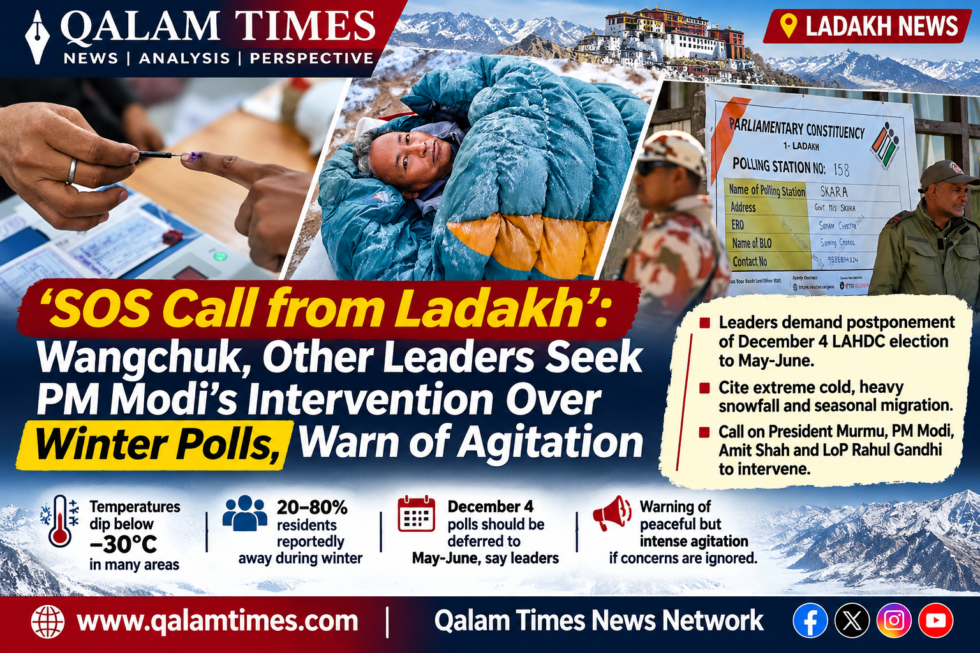
Ladakh Winter Elections face opposition as Sonam Wangchuk seeks PM Modi’s intervention to postpone December 4 polls until May–June 2027.
Qalam Times News Network
Leh, Ladakh, November 11, 2026
Ladakh Winter Elections Row Intensifies as Leaders Demand May–June Polls, Warn of Peaceful Agitation Over Severe Cold and Voter Exclusion

Ladakh Winter Elections have triggered a fresh political confrontation in the Union Territory, with climate activist Sonam Wangchuk and prominent representatives from Leh and Kargil jointly urging the country’s top constitutional and political leadership to intervene against the proposed December 4 polling schedule. Concerned about extreme weather conditions, seasonal migration and the possibility of thousands of eligible residents being unable to participate, the leaders have demanded that the Ladakh Autonomous Hill Development Council (LAHDC) elections be postponed until May–June 2027.
Describing their appeal as an “SOS call from Ladakh”, Wangchuk warned that the regional leadership might be compelled to launch peaceful but intense public demonstrations if their concerns were ignored. The controversy surrounding the Ladakh Winter Elections has raised wider questions about democratic participation, the practical difficulties of conducting elections in geographically challenging areas and the need to consider local climatic conditions while determining polling schedules.
Wangchuk Appeals to President, Prime Minister and Opposition Leadership
At a press conference held in Sham, climate activist Sonam Wangchuk appeared alongside political representatives from Leh and Kargil to present their concerns over the proposed election schedule.
The delegation appealed to President Droupadi Murmu, Prime Minister Narendra Modi, Union Home Minister Amit Shah and Leader of Opposition Rahul Gandhi to intervene before the situation developed into another phase of public agitation.
Wangchuk said the leadership of both Leh and Kargil, including the Ladakh Member of Parliament, had come together to convey the seriousness of the situation to the national leadership.
He warned that the people of Ladakh were deeply concerned about the timing of the elections and wanted their difficulties to be recognised before the administration proceeded further.
Calling the appeal an “SOS call from Ladakh”, he emphasised that the objective was to ensure that the electoral process remained inclusive and that people across the region could exercise their democratic rights.
The press conference was attended by Ladakh MP Mohammad Haneefa Jan, Kargil Democratic Alliance (KDA) co-chairman Asgar Ali Karbalai and Leh Apex Body (LAB) co-chairman Chering Dorjey.
Their joint appearance reflected the growing convergence of concerns among representatives from different parts of Ladakh regarding the proposed winter polling schedule.
Extreme Winter Conditions Raise Concerns Over Voter Participation
One of the principal arguments put forward by the leaders concerns the exceptionally harsh winter experienced across Ladakh.
December and January are generally among the coldest and snowiest months in the region. In several areas, temperatures can fall below minus 30 degrees Celsius, making ordinary movement and public activities extremely difficult.
Wangchuk argued that a substantial proportion of Ladakh’s population leaves the region during winter for education, holidays, religious pilgrimages and other personal reasons.
He estimated that nearly half of the population migrates temporarily during this period.
According to him, holding elections when a significant number of registered voters are outside their home constituencies could affect the overall participation and representativeness of the electoral process.
The leaders also expressed concern that snowfall, freezing temperatures and disruptions to transport facilities could prevent residents from reaching polling stations.
They maintained that the election schedule should take local geographical and climatic realities into account rather than following a calendar that might make participation difficult for ordinary citizens.
Haneefa Jan Questions the Timing of the Election Notification
Ladakh MP Mohammad Haneefa Jan said he had already approached the Lieutenant Governor and requested that the election process be postponed, preferably until May 2027.
Reacting to the announcement of the December 4 polling date, he expressed concern that the notification had been issued without sufficient consultation with regional stakeholders.
Jan argued that the fundamental purpose of elections in a democracy was to provide every eligible citizen with a meaningful opportunity to participate.
However, he said the prevailing circumstances in Ladakh could prevent thousands of people from exercising that right.
He estimated that approximately 20–25 per cent of the population had already migrated from the region.
The MP also questioned the administrative preparedness for conducting elections during a period when harsh weather and seasonal movement could create logistical difficulties.
He maintained that postponing the polls until favourable weather conditions returned would help ensure wider participation and strengthen public confidence in the electoral process.
Leh Apex Body Warns Against Elections Amid Mass Migration
Leh Apex Body co-chairman Chering Dorjey also opposed the December polling schedule, arguing that a significant section of the population had already left Ladakh.
According to his estimate, nearly one-third of the region’s residents had migrated to other parts of the country.
He questioned the democratic value of holding elections when many residents were unable to remain in their constituencies because of winter conditions and seasonal requirements.
Dorjey urged the administration to reconsider its decision and withdraw the existing notification in favour of elections during May.
He stressed that elections should be organised in circumstances that allow the maximum possible participation of the electorate.
His remarks reflected the concerns of regional organisations that believe the winter schedule could create difficulties for voters, particularly senior citizens, students and people living in remote settlements.
Asgar Ali Karbalai Warns of Snowfall and Communication Disruptions
Kargil Democratic Alliance co-chairman Asgar Ali Karbalai raised additional concerns about the impact of extreme weather on transport and communication infrastructure.
He claimed that nearly 80 per cent of the population, including the student community, was currently away from the region.
He warned that temperatures could fall to approximately minus 25 degrees Celsius as December approached and that even limited snowfall could disrupt road connectivity and communication networks in several areas.
Such conditions, he argued, could make it difficult for election officials, voters and other personnel to carry out their responsibilities.
Karbalai clarified that the regional leaders were not opposed to elections themselves.
Instead, their demand was to conduct the electoral exercise at a time when weather conditions and public availability were more favourable.
He said democratic institutions should function at every level, from grassroots organisations to higher administrative bodies, but the timing of elections must reflect the practical circumstances of the region.
Leaders Also Question Delay in Judicial Inquiry Report
Apart from the election controversy, Wangchuk raised questions about the status of the Judicial Inquiry Commission’s report concerning the September 24, 2025 incidents in Leh.
He questioned why the findings had not been made public despite more than a year having passed since the events.
The September 2025 violence had resulted in deaths and injuries during protests in Leh, making the inquiry an important issue for the people of Ladakh.
Wangchuk’s reference to the pending report indicated that the latest appeal was connected not only with election scheduling but also with broader concerns about transparency, accountability and the relationship between regional representatives and the administration.
The demand for the publication of the inquiry findings has remained part of the wider political discussion surrounding Ladakh’s governance and future.
Administration Maintains December 4 Election Schedule
The Ladakh administration has announced December 4, 2026, as the polling date for elections to the eight Ladakh Autonomous Hill Development Councils.
According to the published schedule, the nomination process is set to conclude on November 17, scrutiny is scheduled for November 18, and November 20 is the final date for withdrawal of candidature. Polling is scheduled between 8 am and 5 pm, with the entire election process expected to conclude by December 8.
The administration has defended the electoral exercise, describing it as an important step towards strengthening democratic institutions and elected grassroots governance in the Union Territory.
Chief Secretary Ashish Kundra has also said that arrangements would be made to facilitate voting during the winter, including heaters at polling stations and separate queues for senior citizens.
The administration’s position highlights the difference between its emphasis on completing the electoral process within the announced schedule and the regional leaders’ demand for postponement to ensure wider participation.
A Larger Debate Over Democracy and Ladakh’s Political Future
The disagreement over the December 4 election date has emerged against the backdrop of wider political demands in Ladakh.
Since becoming a Union Territory in 2019, Ladakh has witnessed continuing discussions and protests concerning constitutional safeguards, statehood, local representation and the protection of the region’s distinctive cultural and environmental identity.
The Leh Apex Body and Kargil Democratic Alliance have been among the organisations engaged in discussions with the Union government over these demands.
The latest controversy has added another layer to the ongoing political debate, with questions surrounding the electoral process now becoming a major concern.
For the leaders opposing the winter schedule, the issue is not simply about changing an election date. They argue that the democratic process must be organised in a manner that allows people living in remote and difficult geographical conditions to participate without facing unnecessary barriers.
The administration, meanwhile, has emphasised the importance of holding the elections on schedule and providing necessary facilities to voters despite the cold.
Will the Centre Respond to Ladakh’s SOS Appeal?
With the December 4 polling date approaching, attention has now shifted towards the response of the Union government and the country’s senior political leadership.
Wangchuk and other regional representatives have made it clear that they want the elections rescheduled to May–June 2027.
Their warning of peaceful but intense agitation suggests that the issue could develop into a larger public mobilisation if their demand is not addressed.
The coming days will therefore be important in determining whether the administration considers the concerns raised by Leh and Kargil or proceeds with the existing electoral timetable.
At the heart of the controversy lies a fundamental democratic question: should elections be conducted simply according to an administrative calendar, or should their timing also reflect the geographical, climatic and social realities of the people expected to participate?
For the people of Ladakh, the answer could have significant implications for voter participation, regional representation and the future of democratic governance in the Union Territory.