



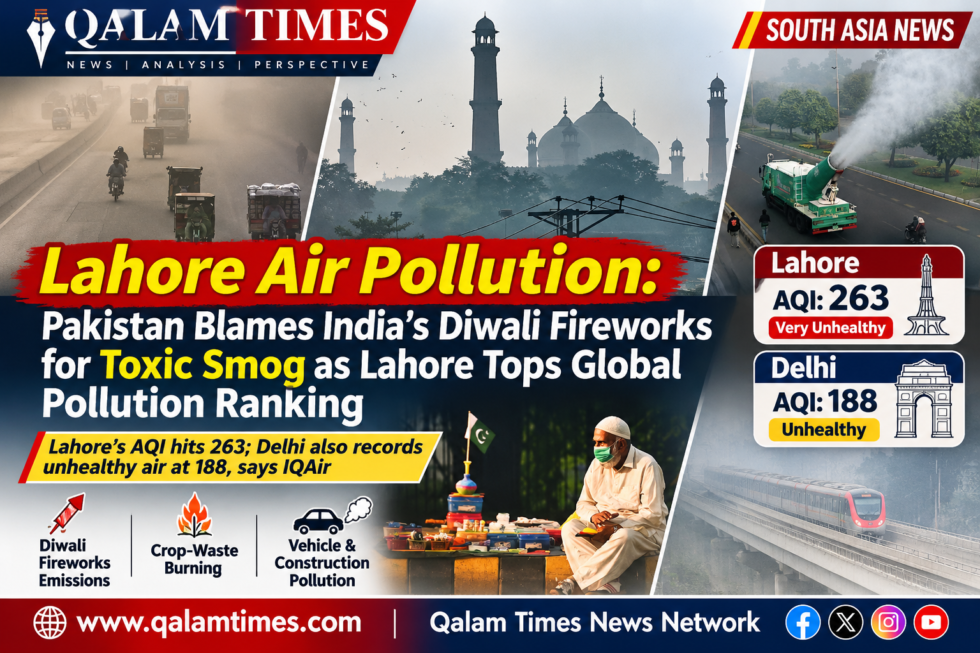
Lahore Air Pollution reaches alarming levels as Pakistan blames India’s Diwali fireworks for toxic smog, while Delhi also records unhealthy air quality.
Qalam Times News Network
Lahore, November 10, 2026
Lahore Air Pollution Crisis Deepens: Pakistan Points Finger at India After Diwali, While Delhi Also Battles Dangerous Air Quality
Lahore Air Pollution has once again become a major environmental concern in South Asia, with Pakistani authorities attributing the worsening air quality in the country’s second-largest city to pollution allegedly drifting across the border from India following Diwali celebrations. Lahore ranked as the world’s most polluted major city for the second consecutive day on Tuesday, according to the Swiss air quality monitoring organisation IQAir. The city recorded an Air Quality Index (AQI) of 263, placing it in the “very unhealthy” category and raising fresh concerns about the health risks faced by millions of residents.
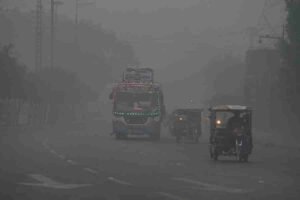
The latest pollution episode has renewed tensions between India and Pakistan over the sources of deteriorating air quality across the Punjab region. Pakistani officials have argued that smoke from firecrackers used during Diwali celebrations in India travelled across the international border, contributing to the thick layer of toxic smog over Lahore. However, the Lahore Air Pollution crisis is part of a much broader environmental problem involving several sources, including vehicle emissions, industrial activities, construction dust and the seasonal burning of agricultural waste.
Lahore Records One of the World’s Worst Air Quality Levels
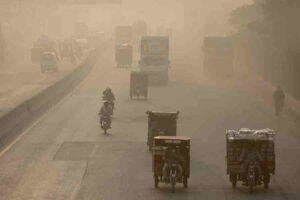
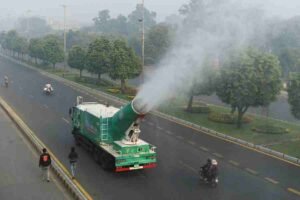
According to IQAir’s latest rankings cited in the report, Lahore recorded an AQI of 263 on Tuesday, making it the world’s most polluted major city for the second day in succession.
The figures highlight the severity of the pollution affecting the Pakistani city as winter approaches and atmospheric conditions increasingly favour the accumulation of harmful airborne particles.
One of the most concerning indicators was the concentration of PM2.5, which IQAir reported at approximately 37.2 times higher than the World Health Organization’s annual guideline.
PM2.5 refers to extremely fine particulate matter measuring 2.5 micrometres or less in diameter. These particles are particularly dangerous because they can travel deep into the respiratory system and enter the bloodstream, potentially increasing the risk of respiratory illnesses, cardiovascular complications and other serious health conditions.
The prolonged exposure to such polluted air is especially concerning for children, older people and individuals with existing respiratory or heart conditions.
For Lahore’s residents, the latest readings represent another difficult episode in a recurring winter pollution crisis that has affected daily life, public health and the city’s overall environmental conditions.
Pakistan Attributes Pollution to India’s Diwali Celebrations
Pakistan’s Punjab Environment Protection Minister Marriyum Aurangzeb blamed the deteriorating air quality partly on pollution allegedly transported from neighbouring India.
According to her explanation, relatively light winds and cross-border atmospheric movement carried pollutants into Pakistani Punjab following the Diwali festivities over the weekend.
The celebrations in northern India involved the use of firecrackers, which release smoke and particulate matter into the atmosphere. These emissions can significantly worsen local air quality, particularly when weather conditions prevent pollutants from dispersing.
Aurangzeb expressed the expectation that the situation would gradually improve from the early afternoon as weather conditions changed and wind direction shifted.
Her remarks placed the spotlight on the transboundary nature of air pollution and the environmental challenges shared by communities living on both sides of the India-Pakistan border.
India’s Ministry of External Affairs had not immediately responded to a request for comment at the time of the reported developments.
Delhi Also Faces Severe Pollution After Diwali
While Lahore occupied the top position in IQAir’s global pollution ranking, India’s national capital, New Delhi, was also struggling with unhealthy air conditions. According to the same IQAir ranking, Delhi recorded an AQI of 188 on Tuesday, placing it among the world’s most polluted major cities. Indian government monitoring data reportedly indicated that firecracker emissions accounted for nearly 55 per cent of the PM2.5 concentration recorded in the capital a day earlier. The figures underline the immediate environmental impact that large-scale fireworks can have during festive celebrations, particularly in cities already affected by high levels of background pollution.
However, the contribution of firecrackers is only one part of Delhi’s wider pollution problem.
Vehicle exhaust, construction activities, industrial emissions, road dust and agricultural residue burning also contribute to the city’s deteriorating air quality, particularly during the colder months.
The combination of these sources, together with unfavourable weather conditions, frequently results in a dense layer of smog over northern India.
Crop-Waste Burning Remains a Major Environmental Challenge
Agricultural residue burning has long been identified as one of the important seasonal contributors to air pollution across northern India and Pakistan.
After harvesting paddy crops, some farmers burn the remaining stubble to clear their fields quickly before the next agricultural cycle.
Although this practice is often associated with economic and operational pressures faced by farmers, the resulting smoke releases particulate matter and other pollutants into the atmosphere.
During the winter season, these emissions can combine with urban pollution and become trapped close to the ground because of atmospheric conditions.
The issue has repeatedly generated disagreements between Indian and Pakistani authorities over the movement of smoke and the responsibility for deteriorating air quality.
In 2024, Pakistani officials similarly attributed their pollution problems partly to agricultural fires in India’s Punjab region.
However, India’s meteorological authorities reportedly challenged that explanation, arguing that the prevailing wind direction at the time suggested that air was moving from Pakistan towards India.
The disagreement demonstrated how difficult it can be to establish the precise origin and movement of pollutants without detailed atmospheric monitoring and scientific evidence.
Political Disagreement Over Farm Fires in Indian Punjab
The latest pollution episode has also become a subject of political debate within India.
The Bharatiya Janata Party (BJP) has blamed agricultural residue burning in Punjab for contributing to Delhi’s poor air quality.
Punjab is governed by the Aam Aadmi Party (AAP), a regional political rival of the BJP, making the issue politically sensitive.
Local media reports cited in the original account indicated a significant increase in farm-fire incidents in Punjab on Sunday, the day Diwali was celebrated.
Some reports suggested that the number of agricultural fires had increased sevenfold.
However, the Punjab government has maintained that incidents of stubble burning have declined compared with previous years.
The contrasting claims highlight the importance of independently verified agricultural fire data rather than relying solely on political statements.
A comprehensive assessment would require satellite-based fire monitoring, meteorological information and measurements of pollution levels across different locations.
Cross-Border Air Pollution Requires Scientific Cooperation
The latest situation in Lahore and Delhi illustrates that air pollution does not recognise political boundaries.
Pollutants released in one region can travel considerable distances depending on wind direction, atmospheric pressure, temperature and other weather conditions.
This makes cooperation between neighbouring countries particularly important when dealing with environmental challenges affecting shared geographical regions.
India and Pakistan both face recurring winter pollution problems, and their respective Punjab regions experience several similar environmental pressures.
Instead of limiting the debate to accusations over the origin of pollution, environmental experts and policymakers need to focus on reliable monitoring systems, agricultural alternatives to stubble burning, cleaner transport, industrial emission controls and stronger public awareness.
Coordinated scientific studies could also help determine how much pollution originates locally and how much is transported across national borders.
The worsening air quality in Lahore and Delhi raises serious concerns about the health of people living across northern South Asia.
High concentrations of fine particulate matter can aggravate asthma, cause respiratory irritation and increase the risk of heart and lung diseases.
During periods of severe pollution, vulnerable groups may experience breathing difficulties and other health complications.
Residents are generally advised to reduce prolonged outdoor activities when air quality reaches dangerous levels, follow official health advisories and use appropriate respiratory protection when necessary.
Authorities also need to strengthen air-quality monitoring and communicate pollution-related health risks more effectively.
The latest episode serves as another reminder that the region’s pollution problem cannot be addressed through temporary measures alone.
The latest Lahore Air Pollution crisis has once again exposed the environmental challenges confronting both India and Pakistan.
Although Pakistani officials have blamed pollution drifting from India after Diwali celebrations, the broader picture involves multiple contributing factors, including fireworks, agricultural residue burning, vehicle emissions, construction dust and industrial pollution.
With Lahore recording an AQI of 263 and Delhi registering 188 in the reported IQAir rankings, the situation highlights the seriousness of the region’s deteriorating air quality.
Ultimately, the challenge extends beyond political disagreements. Cleaner air requires scientific assessment, effective environmental policies and sustained cooperation.
For millions of people living across the Indo-Pak Punjab region, access to clean and breathable air is not a political issue but a fundamental public health necessity.