




Raiganj Police Encounter: A rape-murder accused was shot dead in North Bengal, triggering political criticism as Suvendu Adhikari defends police action.
Qalam Times News Network
Raiganj, (Uttar Dinajpur) ,November 10, 2026
Raiganj Police Encounter Sparks Political Storm as Suvendu Adhikari Defends Police Action and Opposition Questions Rule of Law
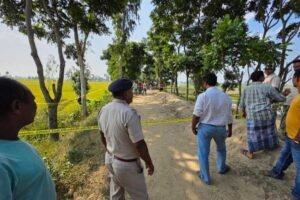
The Raiganj Police Encounter has triggered a fresh political controversy in West Bengal after a man accused of raping and murdering a minor girl was shot dead during a police operation near the West Bengal-Bihar border on Monday morning. The deceased, identified as 46-year-old Dilip Roy, was allegedly attempting to escape when a police team intercepted him near the Kulik river in the Pararpukur area of Raiganj. According to the police, Roy opened fire at the officers, forcing them to retaliate in self-defence. He was subsequently taken to Raiganj Government Medical College and Hospital, where doctors declared him dead.
The incident marks the fourth reported police encounter death in West Bengal since the Bharatiya Janata Party (BJP) government assumed office in May 2026. The Raiganj Police Encounter has intensified the debate over policing methods, public safety, criminal justice and the limits of police action. While Chief Minister Suvendu Adhikari has defended the officers, opposition leaders have questioned the repeated deaths of suspects in police firing and raised concerns about due process and the rule of law.
A Minor Girl’s Disappearance Leads to a Murder Investigation
The case began on November 3, when a minor girl from a village under the Kamalabari-I gram panchayat in Raiganj block left home on her bicycle but did not return.
Her family members became increasingly worried as efforts to locate her proved unsuccessful. On November 5, police recovered her body from a forested area near Abdulghata, close to the Kulik river.
The discovery shocked the locality and prompted an investigation into the circumstances surrounding her disappearance and death. Investigators reportedly focused on Dilip Roy after learning that the girl had last been seen with him on the evening of November 3.
Police subsequently began searching for Roy, who had reportedly gone missing after the incident. His mobile phone had been switched off, making it difficult for investigators to establish his immediate whereabouts.
According to police sources, officers began monitoring the telephone numbers of people close to the suspect and activated local intelligence networks to trace his movements.
Reports also indicated that investigators examined CCTV footage and other leads while attempting to reconstruct the girl’s final movements.
According to police sources, investigators received information on Sunday that Roy might attempt to cross into Bihar.
The suspected escape route reportedly passed through the Kulik river near the Shampur and Pararpukur areas, from where a person could reach villages in Bihar and travel towards Barsoi railway station.
A special police team led by Sandip Chakraborty, the inspector-in-charge of Raiganj police station, reportedly began surveillance along the riverbanks in the Gouri gram panchayat area.
At approximately 3.30–4 am on Monday, police personnel spotted a man approaching through the morning fog near Pararpukur.
The officers allegedly instructed him to stop. Police claimed that the man opened fire instead of surrendering.
According to their account, bullets struck the tyre and front portion of the SUV being used by the police team. The officers then returned fire, injuring the suspect.
Roy was reportedly hit by four bullets. He was immediately taken to Raiganj Government Medical College and Hospital, where doctors declared him dead.
Police also claimed to have recovered a 9mm pistol from the location. The weapon’s origin and the circumstances in which it came into Roy’s possession are reportedly being investigated.
The body was subsequently sent for post-mortem examination.
Chief Minister Suvendu Adhikari Defends Police Action
Chief Minister Suvendu Adhikari defended the police operation while speaking to reporters in Digha.
Responding to questions about the shooting, he maintained that police personnel had acted in self-defence after allegedly coming under fire.
He made his position clear with a pointed remark, questioning whether officers should offer sweets to someone attacking them instead of defending themselves.
Adhikari said his government followed a zero-tolerance policy towards serious crimes, particularly rape and murder.
He further stated that the police had been given freedom to act firmly in cases involving such offences.
The Chief Minister’s remarks have reinforced the government’s position that officers must be able to protect themselves when confronted with armed attacks. However, the incident has also raised questions about the circumstances in which police firing is used and the need for independent examination of such cases.
Fourth Encounter Death Since BJP Formed Government
The Raiganj incident is the fourth reported encounter killing in West Bengal since the BJP government took office in May 2026.
Three earlier incidents had been reported from Baruipur, Gaighata and Samserganj.
In those cases, police had claimed that the accused, who were already in custody, attempted to snatch officers’ weapons and attacked personnel during crime-scene reconstruction exercises. Police subsequently opened fire, resulting in the deaths of the suspects.
The repeated incidents have attracted considerable political attention and raised questions about the use of firearms during police operations.
The latest shooting has brought renewed focus on the government’s approach to law enforcement and the accountability mechanisms applicable when suspects die in police custody or during encounters.
Opposition Accuses Government of Following the Uttar Pradesh Model
Opposition leaders have criticised the repeated police shootings, arguing that criminal allegations must be established through the judicial process rather than through encounters.
Senior Trinamool Congress leader and Dum Dum MP Saugata Roy condemned what he described as extra-judicial killings.
He argued that a person accused of a crime should face investigation, trial and punishment in accordance with the law.
Roy alleged that the state was moving towards a system of summary justice and accused the Suvendu Adhikari government of imitating the policing approach associated with Uttar Pradesh under Chief Minister Yogi Adityanath.
His criticism reflected wider opposition concerns about whether the repeated encounters could weaken public confidence in established legal procedures.
The opposition has maintained that even individuals accused of particularly serious crimes are entitled to due process and that allegations of police firing must be independently examined.
Abhishek Banerjee Questions the Government’s Law-and-Order Record
Trinamool Congress national general secretary and MP Abhishek Banerjee also criticised the state government’s handling of law and order.
In a post on X, Banerjee referred to reported figures concerning rape cases, murders and other serious offences in recent months.
He argued that these figures represented real victims, affected families and communities facing insecurity.
Banerjee also questioned the political accountability of Chief Minister Suvendu Adhikari, recalling his earlier criticism of the previous government over the RG Kar Medical College and Hospital incident.
He asked the Chief Minister to explain his government’s record on women’s safety and public security.
The remarks added another dimension to the political debate, with the opposition seeking to turn attention from individual police operations towards the government’s broader responsibility for maintaining law and order.
Victim’s Family Expresses Satisfaction, Suspect’s Mother Refuses to Accept Body
The incident also produced contrasting reactions from the families connected with the case.
The victim’s father reportedly expressed satisfaction after learning that the man accused in the case had been killed.
He said the family had demanded exemplary punishment and felt that their prayers had been answered.
Dilip Roy’s mother, Chaniya Roy, also made a striking statement. She reportedly said she would not mourn his death or accept his body.
She claimed that similar allegations had previously been made against her son and that she had been forced to sell land to pay compensation in an earlier matter.
Her remarks added another disturbing aspect to the case and raised questions about the previous allegations she referred to.
Questions of Justice, Police Accountability and Due Process
The death of Dilip Roy has brought two important issues into sharp focus: the demand for justice for victims of violent crimes and the legal accountability of police forces when suspects are killed during operations.
The seriousness of the allegations against Roy and the suffering of the victim’s family have generated strong public reactions. At the same time, a police encounter cannot by itself replace the judicial process or establish every aspect of a criminal case.
The circumstances of the shooting, the alleged exchange of fire, the recovered weapon and the medical findings will be important in determining what happened during the operation.
An independent and transparent examination of the incident would help establish the sequence of events and address questions surrounding the use of lethal force.
For West Bengal, the latest incident is therefore more than another police operation. It has become part of a wider debate over women’s safety, crime prevention, police powers and the protection of constitutional and legal rights.
As political parties continue to exchange accusations, the central questions remain: How can victims receive justice, how can serious crimes be prevented, and how can law enforcement remain accountable under the law?
The answers will be important in shaping public confidence in the state’s criminal justice system.