



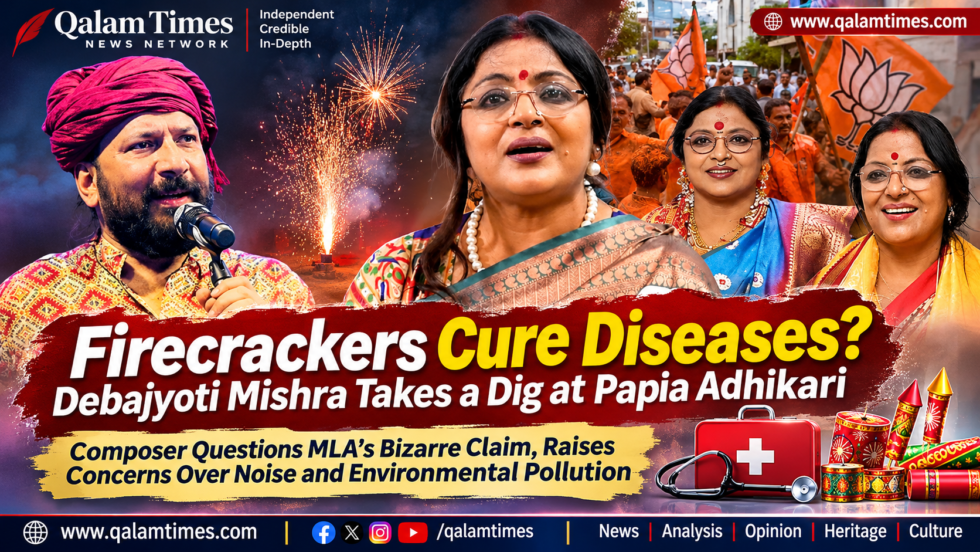
Firecrackers Cure Diseases? Debajyoti Mishra takes a dig at MLA Papia Adhikari over her reported remarks, sparking debate on noise pollution, public health and animal welfare in West Bengal.
By Qalam Times News Network
Kolkata, November 9, 2026
The debate over firecracker use in West Bengal has taken a fresh turn after MLA Papia Adhikari reportedly claimed that bursting firecrackers could help eliminate illnesses. Her remarks have drawn a sarcastic response from renowned music composer and director Debajyoti Mishra, who questioned the logic behind such claims through a pointed social media post.
The controversy comes after Kali Puja celebrations, when several neighbourhoods reportedly witnessed excessive noise from firecrackers. Despite judicial guidelines and restrictions intended to control noise pollution, residents raised concerns over widespread violations. The incident has once again brought the issues of public health, environmental protection and administrative accountability into the spotlight.
Debajyoti Mishra’s Sarcastic Questions

Taking to social media, Mishra highlighted the fear and distress experienced by animals during noisy celebrations. Referring to a neighbourhood dog hiding underneath a bed because of the loud explosions, he wrote sarcastically that he had tried to reassure the frightened animal by telling it that the noise was part of its treatment. However, the dog failed to understand, he added, suggesting that it was a matter of insufficient education.
Mishra then directly addressed Adhikari’s reported claim that firecrackers could help cure illnesses. In a series of sarcastic questions, he asked which firecracker was suitable for which disease, whether it should be used before or after meals, and whether half a chocolate bomb would be sufficient for elderly people. He also questioned whether the treatment could be administered from a distance in the case of someone with a weak heart.
Through this sharp response, Mishra drew attention to the dangers of treating firecrackers as harmless objects, particularly when excessive noise can cause distress to vulnerable people and animals.
The composer also referred to BJP leader Agnimitra Paul’s assurances regarding the prevention of water pollution. Questioning whether public statements alone could solve environmental problems, Mishra stressed that cleaning water bodies requires concrete action rather than announcements.
He pointed out that proper waste removal, sanitation arrangements, payment of workers and regular water-quality testing are essential for tackling water pollution.
In another pointed observation, Mishra highlighted the helplessness of animals and birds, which cannot publicly express their grievances. Fish cannot organise press conferences when water becomes polluted, birds cannot demand protection through public statements, and stray dogs cannot submit petitions during election campaigns.
His remarks underlined the need to include environmental protection and animal welfare in discussions about public responsibility.
Mishra also emphasised that public figures must understand the influence their words can have on society. According to him, statements made by popular personalities carry considerable weight because people may trust them, draw encouragement from them or even use them to justify irresponsible behaviour.
He suggested that anyone speaking from a public platform must recognise the responsibility that accompanies public influence.
Firecrackers : Questions Over Noise Pollution and Administrative Action
The controversy has also revived wider concerns about the enforcement of noise pollution regulations during Kali Puja. Several citizens and environmental observers have questioned how such widespread firecracker use could take place despite existing restrictions and judicial directions.
The issue goes beyond a political exchange or a social media disagreement. Excessive noise can cause serious distress to elderly people, children, patients and animals. It also raises broader concerns about environmental quality and the protection of public health.
The latest debate has once again highlighted the gap between regulations and their implementation. Effective monitoring, public awareness and consistent enforcement remain essential if noise pollution is to be controlled.
As the discussion continues, the central question remains: can public celebrations take place without compromising the health, peace and safety of others?