



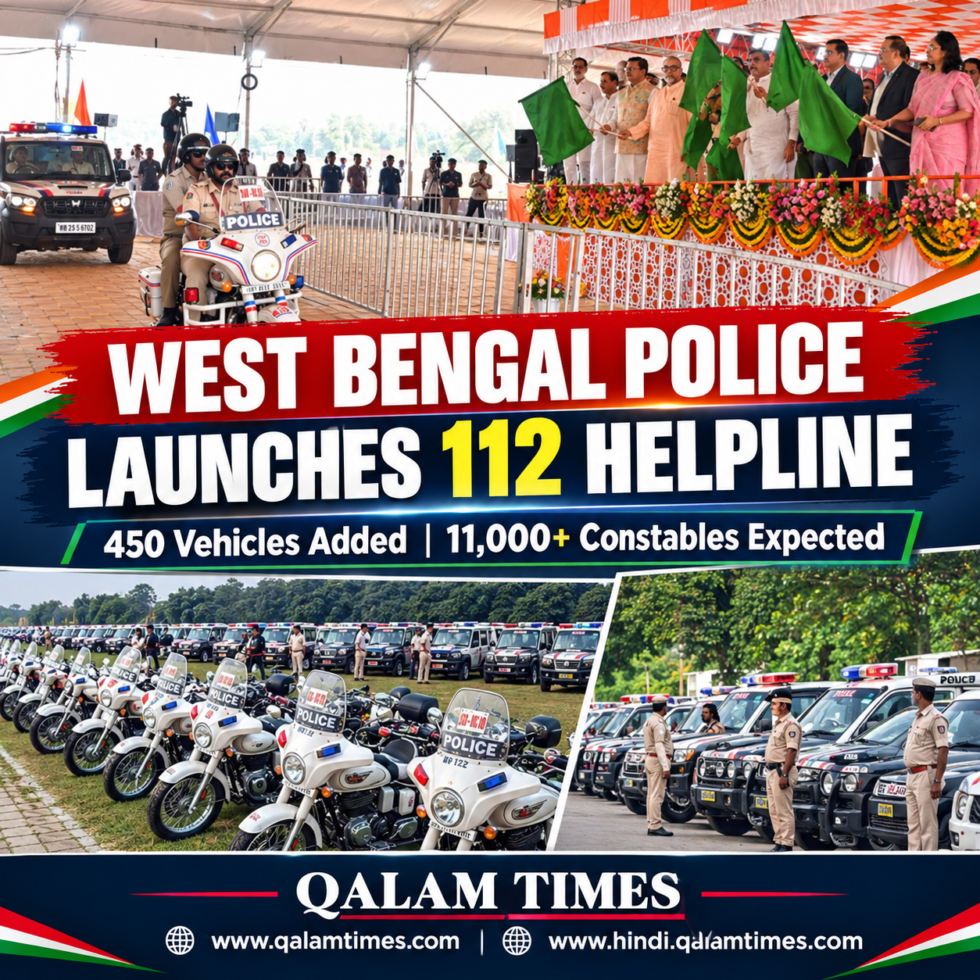
West Bengal Police launches the 112 emergency helpline on Mahalaya as Suvendu Adhikari announces new vehicles, recruitment plans and a warning against attacks on police.
Qalam Times News Network
Kolkata | October 10, 2026
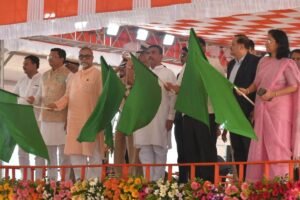
KOLKATA: The West Bengal Police has launched the 112 emergency response service on Mahalaya, introducing a new channel for residents to seek police assistance during emergencies. The initiative is accompanied by the addition of hundreds of vehicles and motorcycles to the police fleet, as Chief Minister and Police Minister Suvendu Adhikari announced measures to improve emergency response, strengthen police infrastructure and accelerate recruitment.
The West Bengal Police modernisation programme includes the deployment of new vehicles, the appointment of drivers and plans to increase personnel strength. Adhikari said the administration was working to change the functioning of the police system within months, while issuing a stern warning that attacks on police personnel would invite serious consequences. He also revisited the Park Street incident to underline his position on protecting law enforcement officers.
112 Helpline Introduced Alongside New Police Vehicles
The launch of the 112 emergency response service is intended to give residents a single number to contact authorities when urgent assistance is required. The service is designed to operate round the clock, enabling the administration to respond to emergencies involving public safety and law and order.
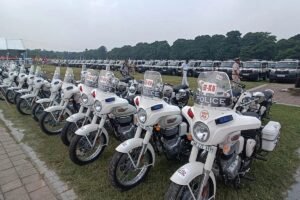
As part of the rollout, approximately 450 vehicles and 450 motorcycles have been added to the police fleet, according to reports on the government’s announcement. The vehicles are intended to improve mobility and help officers reach emergency locations more quickly. Police stations across the state are also being equipped with transport facilities, while 1,500 drivers have reportedly been recruited to support operations.
The initiative follows earlier concerns raised by Adhikari about delays in police response. He said the government wanted to reduce the time taken to reach people in distress, particularly in rural areas, where emergency response can take considerably longer than in urban centres.
The new system will need effective coordination between police stations, control rooms, personnel and transport facilities to deliver the intended improvements.
Suvendu Adhikari Criticises Previous Police Administration
Speaking about the changes, Adhikari criticised the functioning of the police system under the previous government. He said that, before he assumed responsibility for the police department, calls to the 100 emergency number often failed to receive an adequate response.
He described how he had spent the preceding five months examining police operations across West Bengal, visiting the Barrackpore Police Commissionerate and inspecting control rooms. He also referred to efforts to introduce a live traffic monitoring system across the state.
Adhikari highlighted the recognition given to personnel involved in saving lives during rescue operations in Taratala. He said officers who had demonstrated courage in life-threatening situations had received the ‘Jeevan Rakshak Samman’ in recognition of their service.
He also mentioned the distribution of raincoats to police personnel, arranged with assistance from relevant agencies, as part of measures to improve working conditions.
According to the Police Minister, the administration’s objective is to strengthen operational capacity while improving the resources available to officers working in the field.
Police Strength and Recruitment Plans
Adhikari also raised concerns about the number of police personnel available in relation to the state’s population. He cited a figure of approximately 155 police personnel per lakh of population in West Bengal, compared with around 200 in Uttar Pradesh. He claimed that the corresponding figure under the previous state government had been approximately 105 per lakh.
These figures were presented by Adhikari as part of his argument that inadequate manpower had affected policing. Independent verification of the figures and the methodology used to calculate them would be necessary for a full comparison.
Recruitment has emerged as another major element of the administration’s plans. Adhikari said legal complications relating to Other Backward Classes (OBC) reservation had delayed recruitment and that legislative amendments had been undertaken to address the issue.
He announced that more than 11,000 newly selected constables were expected to receive appointment letters around the Durga Puja period. The government had also indicated that recruitment formalities would be completed for eligible candidates after the necessary verification and medical procedures.
The recruitment drive is intended to increase the force’s capacity and address vacancies that have affected police operations. The precise number of appointments completed will depend on the final selection lists and the completion of the required formalities.
Park Street Incident Recalled as Minister Warns Against Attacks on Police
In one of the most forceful portions of his remarks, Adhikari recalled the Park Street incident while warning against attacks on police personnel.
He referred to an earlier confrontation in which police and Central Reserve Police Force (CRPF) personnel were allegedly targeted with stones. He said he had publicly warned at the time that anyone assaulting a police officer would face serious consequences.
Adhikari also cited an incident in Asansol in which a police outpost was reportedly vandalised, saying that action had subsequently been taken to recover money.
His remarks were intended to convey that the government would support police personnel facing violence while performing their duties. The warning comes as the administration seeks to reinforce discipline and strengthen the operational authority of the force.
Birbhum Police Praised for Action Against Alleged Mining Mafia
Adhikari also praised the Birbhum district police for action against an individual he described as a prominent stone-mining operator.
According to the minister, the police had recovered assets, including vehicles and property, worth approximately Rs 220 crore in the operation. He said the action demonstrated that the state police could investigate major cases without always requiring the intervention of central investigative agencies such as the Enforcement Directorate (ED), Central Bureau of Investigation (CBI) or National Investigation Agency (NIA).
The claim regarding the value of the recovered assets was made by Adhikari and would require confirmation through official case records to establish the details of the seizure and its legal status.
His remarks were part of a broader argument that the state police should be given the resources and institutional support necessary to investigate serious offences independently.
Government Promises Action Against Serious Crimes
Adhikari also referred to high-profile cases, including the RG Kar incident and a case in Baruipur, while stating that the government would work to prevent similar occurrences in the future.
He further warned that the administration would not tolerate the illegal trade in prohibited cough syrups. The statement signals an intention to intensify enforcement against the unauthorised distribution and sale of restricted pharmaceutical products.
The effectiveness of these commitments will depend on investigation quality, enforcement consistency, accountability and the ability of police units to act promptly on complaints.
A Broader Push to Reshape Policing in West Bengal
The introduction of the 112 emergency service, expansion of the police vehicle fleet and proposed recruitment drive form part of the administration’s wider effort to reorganise law enforcement in West Bengal.
For residents, the principal test will be whether the new system makes it easier to report emergencies and brings assistance to the scene more quickly. Additional vehicles and personnel may help improve response times, but their impact will depend on staffing, maintenance, control-room coordination and the availability of trained officers.
The launch on Mahalaya marks a new phase in the state’s emergency response arrangements. As the government pursues further changes, public attention is likely to focus on how effectively the 112 service operates, whether recruitment targets are fulfilled and whether the promised improvements translate into more accessible and accountable policing.