



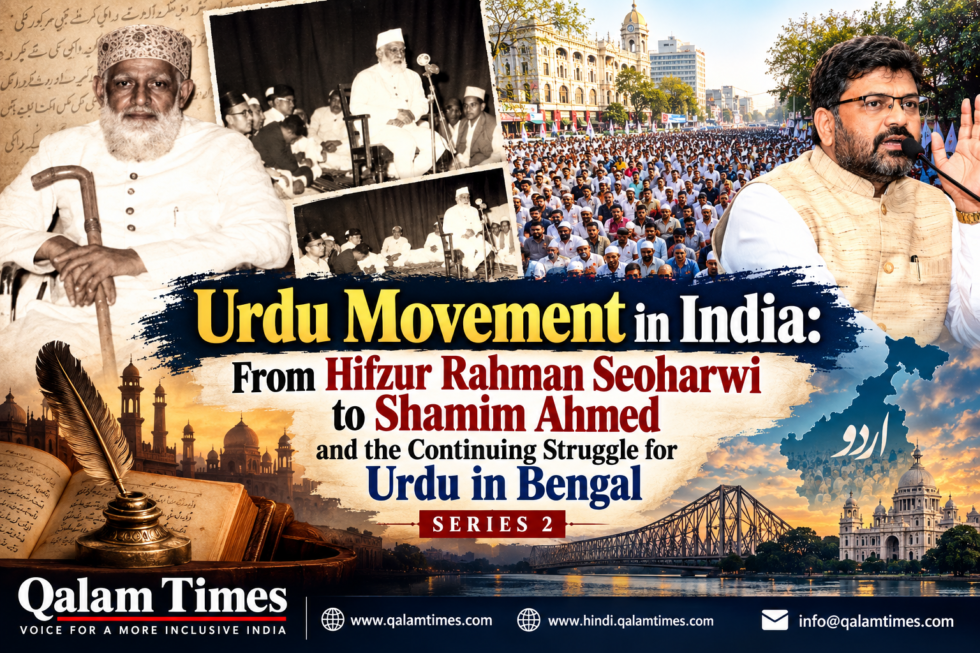
Urdu Movement Series 2 traces Maulana Hifzur Rahman Seoharwi’s struggle for Urdu rights and connects his legacy with Shamim Ahmed and the continuing Bengal Urdu Movement.
By Qalam Times News Network
Kolkata | September 27, 2026
The Urdu Movement in India has never been confined to a single region, generation or political platform. From the constitutional debates of independent India to the continuing efforts to preserve Urdu’s educational, cultural and linguistic space in Bengal, the movement has passed through several phases and produced different kinds of campaigners. In this second instalment of the Qalam Times series, the story moves from the parliamentary and national intervention of Maulana Hifzur Rahman Seoharwi to the contemporary Bengal context, where figures such as Shamim Ahmed have drawn attention to the continuing need to document, preserve and advance Urdu’s place in the region.
The Urdu Movement was shaped in the years after independence by a combination of political debates, educational campaigns, literary initiatives and efforts to secure linguistic rights. Maulana Hifzur Rahman Seoharwi emerged as one of the prominent political voices in this struggle. A graduate of Darul Uloom Deoband and a disciple of the distinguished scholar Muhammad Anwar Shah Kashmiri, he moved far beyond the traditional boundaries of religious scholarship. He became a freedom fighter, political leader, member of the Constituent Assembly and later a Member of Parliament, while continuing to campaign for the educational, cultural and linguistic rights of Urdu speakers.
From Seoharwi’s Parliament to Bengal’s Continuing Urdu Movement
The connection between Seoharwi’s generation and the Urdu Movement in Bengal does not mean that the circumstances of the two periods were identical. Rather, the connection lies in a continuing question: how can Urdu retain and strengthen its linguistic, educational and cultural presence in different parts of India as political and social circumstances change?
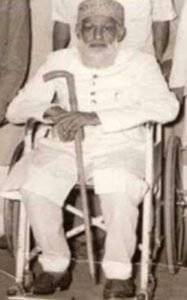
Seoharwi carried this question into the Constituent Assembly and Parliament. Decades later, the Bengal chapter of the story provides another regional perspective on the continuing effort to preserve Urdu’s history, strengthen its institutional presence and keep the language connected with younger generations.
It is in this wider historical continuum that the work associated with Shamim Ahmed and the Bengal Urdu Movement becomes relevant to the present Qalam Times series. His efforts to bring attention to the history and struggle of Urdu in West Bengal represent a contemporary attempt to ensure that Bengal’s contribution is not overlooked when the broader history of Urdu in India is written.
A Scholar Who Refused to Remain Within the Seminary
Maulana Hifzur Rahman Seoharwi was born into a scholarly tradition and received his education at Darul Uloom Deoband. His association with Muhammad Anwar Shah Kashmiri placed him among an important generation of scholars. Yet his public life eventually extended far beyond teaching and religious scholarship.
He participated actively in the freedom struggle and became involved in national politics. After independence, when Delhi and other parts of the country were experiencing the consequences of Partition and communal violence, he also worked among affected communities. His political and social activities eventually brought him into the Constituent Assembly and then Parliament.
He represented Amroha for three terms and, according to the source material, repeatedly raised questions concerning the political, educational and religious rights of Muslims. His commitment to Urdu formed an important part of this wider public engagement.
The Language Debate After Independence
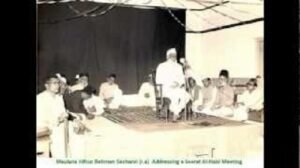
The language question became one of the most difficult issues confronting India’s political leadership after independence.
Before Partition, the Indian National Congress and Mahatma Gandhi had supported the idea of Hindustani as a broadly understood Indian language, with both Devanagari and Urdu scripts associated with it. Following independence and Partition, however, the political atmosphere surrounding language changed dramatically.
When the Constituent Assembly considered the language question in December 1949, the earlier concept of Hindustani faced increasing political resistance. Support for Hindi in the Devanagari script became dominant.
Seoharwi was among those who continued to defend the broader Hindustani concept associated with Gandhi. The source also identifies Rafi Ahmad Kidwai and Khursheed Lal as supporters of Hindustani.
Seoharwi argued that Congress had publicly supported Hindustani for decades and that abandoning that position represented a departure from an earlier national commitment.
His disappointment did not lead him to abandon the language question. Instead, he continued to challenge arguments that sought to marginalise Urdu.
Challenging the Idea That Urdu Was Foreign
One of the arguments advanced by opponents of Urdu was that the language contained foreign elements and therefore could not properly be regarded as an Indian language.
Seoharwi challenged this argument through examples from Indian culture and literature. In responding to Seth Govind Das, he referred to poetry containing references to Kashi, Mathura and the Ganga—places deeply embedded in India’s cultural and religious geography.
His point was straightforward: the cultural vocabulary of Urdu literature reflected the Indian environment in which the language had developed.
He also rejected the notion that a country could possess only one culture because it had one dominant language. Switzerland was cited as an example of a country in which several languages could coexist within one political system.
The Demand for Regional Recognition
The Urdu question returned to Parliament during the debate on the recommendations of the States Reorganisation Commission in December 1955.
Seoharwi argued that Urdu should be recognised as a regional language in areas including Delhi, Uttar Pradesh and Bihar where substantial Urdu-speaking populations existed.
His argument was based on the principle that linguistic communities should receive appropriate recognition where demographic and social conditions justified it. He compared the situation of Urdu with languages such as Bengali, Gujarati, Marathi, Tamil and Malayalam, which had received regional recognition.
For Seoharwi, official recognition was important because it could support the development of a language through education, administration and public institutions.
Urdu and the Politics of Partition
The most contentious part of the debate was the attempt to associate Urdu directly with Pakistan and the Muslim League.
Opponents of Urdu argued that its continued recognition could encourage separatism. Seoharwi rejected this interpretation and maintained that Urdu belonged to all Indians who spoke or used it, irrespective of religion.
According to the source, he described the Urdu campaign in Uttar Pradesh as a movement involving Hindus, Muslims, Sikhs and Christians who had a relationship with the language.
He also rejected the argument that giving Urdu educational or administrative facilities would threaten India’s unity.
His intervention is important because it placed the language question within the broader principle of India’s linguistic plurality rather than treating Urdu exclusively as a religious issue.
Opposition to Urdu also extended to its script. Critics argued that because Urdu used a script historically connected with Arabic and Persian traditions, it could not be considered genuinely Indian. Seoharwi responded by explaining that languages regularly borrow and adapt scripts. He distinguished between the Arabic Naskh script and the Nastaliq script used for Urdu, arguing that Urdu’s adoption and development of its script did not make the language foreign. His response reflected a broader understanding of linguistic development: languages evolve through contact, adaptation and cultural interaction.
Beyond Parliament: Taking the Urdu Campaign to the Ground
Seoharwi’s contribution to the Urdu Movement was not restricted to parliamentary speeches.
The source records his participation in the Delhi branch of Anjuman Taraqqi-e-Urdu from 1950 onward. He remained associated with its executive body for around twelve years and continued attending meetings despite periods of poor health. He was present at the final executive meeting held on November 25, 1961, despite suffering from fever and severe coughing. His work extended across different parts of India. On May 22, 1951, he joined a delegation that met Uttar Pradesh Education Minister Sampurnanand to raise concerns about discrimination against Urdu. Dr Zakir Hussain and writer Qazi Abdul Ghaffar were also part of the delegation.
An All-India Urdu Conference was subsequently held in Lucknow in December 1951 under the presidency of Dr Zakir Hussain. The conference decided to launch a campaign to collect two million signatures in support of Urdu’s legal rights. The source credits Seoharwi with playing a major role in advancing the campaign. The campaign eventually became part of a wider effort to present Urdu’s case before India’s constitutional authorities. In February 1954, an Anjuman Taraqqi-e-Urdu delegation led by Dr Zakir Hussain met President Dr Rajendra Prasad and submitted the record of the two-million-signature campaign seeking regional recognition for Urdu in Uttar Pradesh. Seoharwi was among those associated with the delegation. He also travelled to Rajasthan in August 1956 and met senior education officials to raise concerns about Urdu’s treatment in schools.
The 1958 Delhi Urdu Conference
Another major episode came in February 1958, when an All-India Urdu Conference was held in Delhi under the presidency of Dr Tara Chand. Jawaharlal Nehru inaugurated the conference, while Maulana Abul Kalam Azad delivered what the source describes as his final speech. Seoharwi served as organiser and chairman of the reception committee and carried a substantial share of the organisational and financial responsibilities. The event demonstrated the continuing political and intellectual importance of Urdu in the years immediately following independence.
Education Was Central to His Vision
Seoharwi understood that political speeches alone could not secure the future of a language. For him, Urdu needed educational institutions, teachers and students. The source therefore highlights his involvement in efforts to establish Urdu-medium schools. One example was a government higher secondary school for girls in Ballimaran, Delhi. Fatima Sardar Ahmad, who had served as its principal, recorded Seoharwi’s role in establishing the Urdu-medium institution at a difficult time for Muslim education in Delhi following Partition. This aspect of his work is particularly significant. It shows that his language activism was not confined to political rhetoric. He was also concerned with creating practical educational opportunities through which Urdu could be transmitted to future generations.
The Scholar as a Lover of Literature
Seoharwi’s relationship with Urdu extended beyond politics and education. The source portrays him as a keen reader of Urdu poetry and classical literature. He studied poets such as Mir and Ghalib and was known for explaining difficult classical verses to audiences. He also took an active interest in mushairas and literary gatherings in Delhi and surrounding areas. According to the source, he sometimes acted as a mediator when disputes arose between poets or organisers. His ability to use persuasion and personal influence enabled him to resolve disagreements and keep literary gatherings functioning. His own writing further strengthened his connection with Urdu. He authored books and essays in Urdu, producing prose characterised in the source as clear, direct and grounded in historical and social realities.
What His Contemporaries Said
Several contemporaries recognised Seoharwi’s contribution to the Urdu cause. The literary critic Ale Ahmad Suroor described him as someone who worked for the Urdu organisation not merely as a political leader but as a field worker who went wherever his services were required, settled disagreements and helped overcome organisational difficulties. Former Allahabad High Court judge S. P. Sinha also highlighted Seoharwi’s role in confronting those who attempted to portray Urdu exclusively as the language of Jinnah or the Muslim League. Sinha particularly referred to Seoharwi’s parliamentary intervention of March 29, 1962. Khan Bahadur Altaf Ahmad Khairi, associated with Anjuman Taraqqi-e-Urdu Rajasthan, emphasised that Seoharwi did not campaign against Hindi. Rather, he consistently sought what he regarded as legitimate recognition and opportunities for Urdu.
Sajjad Zaheer’s recollections, also cited in the source, present Seoharwi as a respected scholar and fellow participant in the anti-colonial struggle, despite political differences between the two men.
The Missing Chapter in Urdu’s History
Despite the scale of his activities, the source argues that Seoharwi’s contribution to the Urdu movement has not received sufficient scholarly attention.
His political and social activities have been discussed in various publications, but his specific contribution to Urdu’s post-independence struggle has often remained in the background. The source points out that even some publications devoted to prominent personalities of Delhi have given little or no detailed attention to his linguistic work.
The available material includes the special issue of Al-Jamiat and Abu Salman Shahjahanpuri’s study Mujahid-e-Millat Maulana Hifzur Rahman Seoharwi: Ek Siyasi Mutala’a. Yet the source argues that a comprehensive biography bringing together his political, scholarly, literary and linguistic contributions is still needed.
Seoharwi died in 1962 after suffering from cancer. But the end of his life did not end the questions he had raised about Urdu’s position in India.
From Seoharwi to Bengal: The Story Continues
The history of the Urdu Movement cannot be understood solely through Delhi, Uttar Pradesh, Bihar or the traditional centres of North Indian Urdu culture. West Bengal provides another important regional chapter.
Urdu has had a longstanding presence in Bengal’s social, literary and cultural landscape. Yet the history of that presence and the efforts made to preserve and strengthen it have not always received the same attention as the better-known Urdu movements of North India.This is where the contemporary Bengal dimension becomes important for the Qalam Times series.
Shamim Ahmed’s engagement with the Bengal Urdu Movement represents an effort to bring this regional history into wider public discussion. His work draws attention to the fact that the history of Urdu in Bengal should not be treated as an isolated footnote to the national story. It deserves to be examined as part of India’s broader history of linguistic plurality, cultural interaction and language rights.
The comparison with Seoharwi is therefore not about suggesting that the two historical contexts were the same. It is about recognising a continuing thread.
Seoharwi worked through Parliament, political organisations, conferences, educational campaigns and public mobilisation. In Bengal, later efforts associated with Shamim Ahmed similarly emphasise documentation, public awareness and the preservation of Urdu’s regional history.
The methods and circumstances may differ, but both belong to a much larger story: the continuing attempt to ensure that Urdu’s Indian history is recorded rather than forgotten.
Why Bengal Matters to the National Urdu Story
The Bengal dimension also challenges a narrow understanding of Urdu’s history.
Urdu’s development in India was never confined to one geographical zone. Its literary and cultural networks extended across regions, cities and communities. Bengal’s experience therefore adds another layer to the national narrative.
The history of the Urdu Movement in West Bengal needs to be examined through its own institutions, writers, educators, activists, cultural organisations and political circumstances. Such research can help explain how Urdu survived, adapted and continued to function within a region whose dominant linguistic environment is Bengali.
For Qalam Times, documenting this history is part of a larger editorial effort to bring lesser-known chapters of India’s Urdu story into public view.
The inclusion of Shamim Ahmed and the Bengal Urdu Movement in this series therefore serves as a bridge between historical memory and contemporary documentation.
A Legacy That Still Demands Research
The story of Hifzur Rahman Seoharwi demonstrates that the post-independence Urdu Movement was not merely a literary campaign. It involved constitutional debates, parliamentary interventions, educational institutions, public conferences, signature campaigns, political negotiations and grassroots mobilisation.
It also demonstrates that the defence of Urdu was not necessarily framed as opposition to Hindi. The source material repeatedly shows Seoharwi presenting the issue in terms of linguistic rights and India’s multilingual character.
His career also shows the importance of individuals who were able to operate across different worlds—religious scholarship, politics, education, literature and public activism.
The Bengal dimension represented in this Qalam Times series adds another important question: how much of this wider history remains undocumented?
The story of Urdu in West Bengal, including the work associated with Shamim Ahmed, deserves systematic documentation so that future generations can understand how Urdu developed and survived beyond the traditional centres of the language.
The Urdu Movement Continues
More than six decades after Seoharwi’s death, the historical questions surrounding Urdu have acquired new forms.
The struggle is no longer limited to the constitutional debates of the early republic. It also involves preserving educational institutions, documenting regional histories, encouraging Urdu learning, protecting literary traditions and ensuring that younger generations remain connected with the language.
From Seoharwi’s parliamentary interventions to the continuing work surrounding the Bengal Urdu Movement, the story reveals an important continuity.
The people, institutions and circumstances may change. The methods may change. The political environment may change.
But the need to record Urdu’s history and understand its place in India’s multilingual society remains.
For that reason, the story of Maulana Hifzur Rahman Seoharwi is not simply a chapter from the past. It is one of the foundations from which later regional stories—including Bengal’s Urdu story—can be understood.
And this is where the Qalam Times series moves next: from the national parliamentary struggle for Urdu rights to the regional history of Urdu in Bengal and the contemporary efforts to ensure that this important chapter is neither forgotten nor reduced to a footnote.
The Urdu Movement changed its form from generation to generation—but its history continues to be written.