




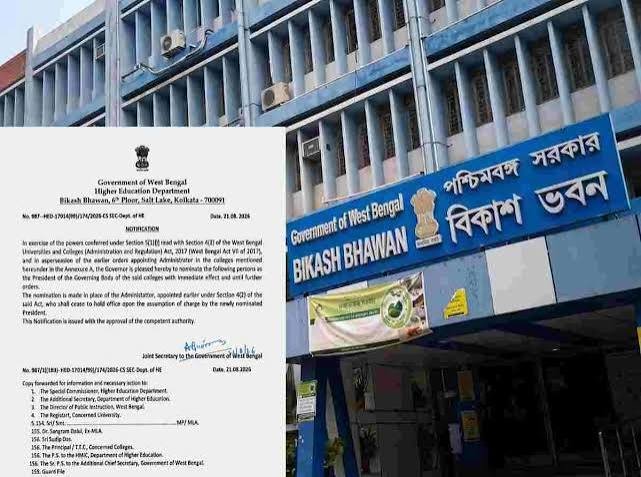
College governance in West Bengal faces controversy as BJP MLAs, MPs and ministers are appointed to governing bodies of 247 colleges, despite the government’s promise to reduce political influence.
Nearly 99% of the newly announced governing-body presidents of College are BJP MLAs or MPs, raising questions over the government’s promise to keep educational institutions free from political influence.
Qalam Times News Network
Kolkata, August 23, 2026
KOLKATA: College governance has come under fresh political scrutiny in West Bengal after the Higher Education Department announced the appointment of presidents to the governing bodies of 247 colleges across the state. According to the notification issued by Bikash Bhavan, nearly 99 per cent of these colleges have been placed under the leadership of local BJP MLAs or MPs.
The appointments have triggered a debate over college governance and the BJP government’s stated commitment to keeping educational institutions free from political influence. The controversy is particularly significant because Chief Minister Shuvendu Adhikari had, shortly after assuming office, publicly declared that his government would remove political interference from schools, colleges and universities.
Shuvendu Adhikari took oath as the first BJP Chief Minister of West Bengal on May 9. Just nine days later, on May 18, he announced at a public programme that his administration would work towards freeing educational institutions from political influence.
The Chief Minister had said that political nominations in various schools, colleges and universities had been cancelled with the objective of removing political influence from educational institutions. He had also stressed that making campuses free from political interference and ensuring greater autonomy for universities would remain among the government’s priorities.
However, the latest notification from Bikash Bhavan appears to have raised questions about how that promise will translate into practice. The list covering 247 colleges shows that local BJP-elected representatives have been appointed as presidents of governing bodies in the overwhelming majority of institutions.
Several ministers have also been given responsibility for college governing bodies. Shardwat Mukhopadhyay, the state Health Minister, has reportedly been appointed president of the governing body of East Kolkata Girls’ College. Fire Services Minister of State Kaushik Chowdhury has been placed at the head of Raiganj B.Ed College’s governing body.
The controversy has revived an old debate over political influence in West Bengal’s education sector.
During the Left Front era, opposition parties frequently accused the government of what they described as the “Anilisation” of education, alleging that the then CPI(M) state secretary Anil Biswas exercised considerable influence over educational institutions, from the secondary education system to colleges and universities.
During the Trinamool Congress government, critics similarly alleged that educational institutions continued to face political interference. The phrase “Mamataisation” was subsequently used by opponents to describe what they viewed as the continuation of political control over education after the Left’s long rule had ended.
Against this backdrop, Shuvendu Adhikari’s promise to free educational institutions from political influence had generated expectations among sections of the public and the education community.
The latest appointments, however, have prompted opposition parties to question whether the new administration is following a different approach or merely replacing one form of political influence with another.
Leader of the Opposition Rituraj Bandyopadhyay criticised the government over the appointments, arguing that there appears to be a gap between its stated policy and its actions.
TMC leader and Belgachia MLA Kunal Ghosh also attacked the BJP government, alleging that its public statements and administrative decisions were contradictory. He compared the situation to a political party having “two sets of teeth”—one for public display and another for actual use—and claimed that the Bikash Bhavan notification had exposed the latter.
CPI(M) leader Sujan Chakraborty also questioned the decision to appoint ministers and elected representatives to college governing bodies. Referring to the BJP government’s earlier criticism of political control over education, he argued that the latest appointments appeared to follow a familiar pattern.
The state government, however, has rejected the suggestion that the appointments amount to an attempt to politicise colleges.
Higher Education Minister Jagannath Chattopadhyay said that the Higher Education Department conducts a screening process before deciding who should head college governing bodies.
According to the minister, the first list covers 247 colleges, where BJP MLAs and MPs elected on the party’s symbol have been appointed as governing-body presidents. He added that appointments for another 200 colleges are yet to be announced.
Chattopadhyay said that the remaining institutions would include academics and social workers among those selected to head their governing bodies.
The minister also reiterated his position that colleges would not be allowed to become political arenas. At the same time, he argued that this did not mean elected representatives from local areas should have no role whatsoever in the administration and development of colleges.
The government’s explanation has shifted attention towards the second phase of appointments.
With governing-body appointments for around 200 more colleges still pending, the composition of the next list could determine whether the government’s stated policy of reducing political influence is reflected more broadly.
If academics, educationists and social workers are given a substantial role in the remaining appointments, the government may argue that the first list represents only one component of a larger policy. Opposition parties, however, are likely to continue questioning why BJP legislators and MPs dominate the first batch.
The debate therefore goes beyond individual appointments. At its core is the question of whether elected political representatives should occupy leadership positions in college governing bodies and, if so, how such appointments can be reconciled with the government’s promise to make educational institutions politically independent.
For West Bengal’s education sector, the forthcoming list of 200 colleges is therefore likely to receive considerable attention. It may offer a clearer indication of whether the government intends to establish a new model of college governance or whether political representatives will continue to play a central role in running higher educational institutions.



Madrasa Service Commission Set To Merge With School Service Commission; Aliah University May Come Under Higher Education Department - Qalam Times