



Batwara 1947 review: Rajkumar Santoshi, Sunny Deol and Shabana Azmi bring a humanistic perspective to Partition, communal trauma and shared grief.
Qalam Times News Network
Kolkata, August 14, 2026
Batwara 1947 emerges as a deeply human Partition drama that attempts to move beyond the familiar language of communal division. Directed by Rajkumar Santoshi and adapted from Asghar Wajahat’s acclaimed play Jis Lahore Nai Vekhya O Janmeya Nai, the film places ordinary people and their emotional wounds at the centre of a story shaped by one of the darkest chapters in the subcontinent’s history.
Batwara 1947 : A Partition story that turns communal hatred into a question of human conscience
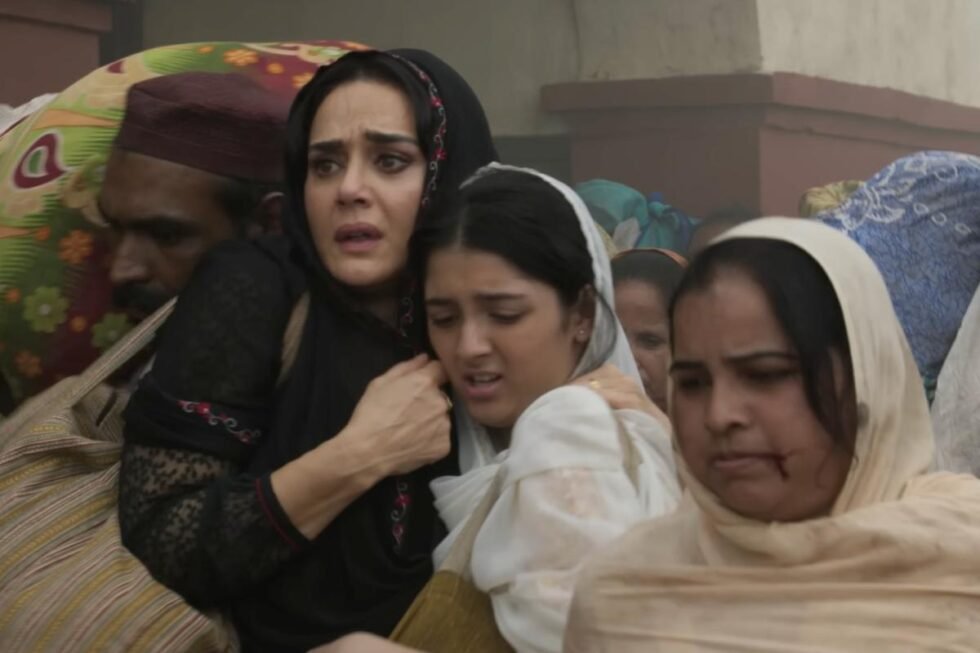
Batwara 1947 begins with a Muslim refugee family from Meerut arriving in Lahore after losing almost everything during the Partition violence. Sikandar Mirza and his family are given possession of a large haveli that has been abandoned by its Hindu occupants. What initially appears to be a new beginning soon becomes complicated when they discover that an elderly Hindu woman, Durga Devi — affectionately known as Mai — is still living inside the house.
For Sikandar, the haveli represents more than shelter. It is compensation for the home, security and dignity his family was forced to leave behind in India. His first reaction towards Mai is therefore influenced by the bitterness and fear created by communal violence. She is not immediately seen as an individual woman who has suffered her own loss; instead, she becomes associated with the community Sikandar believes responsible for his family’s tragedy.
That perception gradually begins to change.
Shabana Azmi gives Mai a quiet but powerful presence. Rather than presenting her merely as a symbol of Hindu-Muslim harmony, the film allows her to remain a wounded, ageing woman carrying memories of her own devastation. Her vulnerability slowly breaks through Sikandar’s anger, making him recognise that suffering cannot be divided neatly along religious lines.
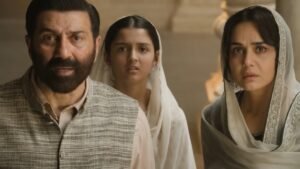

Sunny Deol’s portrayal of Sikandar is particularly important to the film’s approach. The actor, widely associated with physically forceful and confrontational characters, is used here to create a different kind of transformation. His anger remains visible, but it is eventually challenged by compassion. The film uses the contrast between his familiar screen image and the character’s emotional journey to suggest that strength can also mean overcoming hatred.
At the heart of the story is a simple but powerful idea: personal grief does not belong to one religion. Both Mai and Sikandar have experienced loss, displacement and violence. Their backgrounds are different, but their pain is remarkably similar.
The film becomes more effective when it avoids turning this message into a conventional political lecture. Instead, Santoshi allows everyday interactions inside the haveli to gradually undermine the rigid boundaries created by Partition. A grandmother preparing tea, offering traditional remedies and recalling her family becomes far more powerful than any political speech because she forces Sikandar to confront the human being behind the identity he had learned to hate.
One of the film’s strongest thematic moments comes when Sikandar argues that a mother itself can be regarded as a religion. The sentiment shifts the discussion of patriotism and identity away from borders, political slogans and religious labels towards the values of compassion, memory and moral responsibility.
The Deepawali sequence adds another emotional dimension. Mai sings a Ram bhajan written by Javed Akhtar and composed by A.R. Rahman. The song is not presented simply as a religious performance; within the context of the story, it becomes an expression of memory, faith and shared humanity. Its emotional impact comes from the way Mai’s remembrance of her own son begins to intersect with Sikandar’s relationship with her.

The film also refuses to completely sanitise the violence of Partition. Audiences have encountered countless depictions of killings, displacement and communal brutality, and the danger for any new Partition film is that such images can become repetitive or emotionally numb. Santoshi, however, attempts to use violence primarily to establish psychological trauma rather than merely to create spectacle.
This approach gives the film an unusual structural character. At one point, it resembles an intimate theatrical drama centred on a handful of characters; at another, it moves towards the larger-than-life emotional and physical intensity associated with Sunny Deol’s cinema. Cinematographer Santosh Sivan helps connect these contrasting moods by giving the film both an atmospheric visual quality and a sense of historical unease.
The influence of Wajahat’s original stage play remains visible throughout. The characters retain some of the clear moral outlines of theatre, where personalities and ideological positions often need to be established quickly. Santoshi adapts those elements for a cinematic audience while preserving much of the play’s stylised quality.
The film is not without limitations. Its messaging can sometimes become overt, and certain dramatic turns feel designed to underline the central argument rather than emerge naturally from the characters. The presence of radicalised voices and opportunistic neighbours also occasionally pushes the narrative towards familiar stereotypes. As a result, the film’s humanistic argument does not always achieve the subtlety it appears to seek.
In an era when historical events are frequently retold through rigid categories of victim and enemy, Batwara 1947 attempts to ask a more difficult question: what happens when the person we have been taught to hate becomes someone we know personally?
That question gives the film its emotional foundation. Its most compelling moments do not come from grand declarations about nationalism or communal harmony, but from the gradual recognition that grief, motherhood, displacement and loneliness do not recognise religious boundaries.
Ultimately, Batwara 1947 works best as a reminder that Partition was not merely a political event that created a border. It was also a human catastrophe that fractured families, destroyed homes and left memories of violence across generations. By bringing two traumatised individuals together under one roof, Rajkumar Santoshi turns that historical wound into an intimate moral conflict.
The result is an uneven but sincere film whose strongest achievement is its insistence that humanity must remain larger than the identities imposed upon people by history.