



Census 2027 in West Bengal raises questions over deploying teachers for census duties. The Calcutta High Court seeks a balance between enumeration and education.
Qalam Times News Network
Kolkata, August 23, 2026
Protecting Schools While Completing a National Census 2027 Responsibility
Census 2027 is not merely a statistical exercise; it is one of the most important administrative processes undertaken by the country. The information collected through the census influences public policy, welfare planning, infrastructure development and the allocation of resources. Yet Census 2027 also raises an important question in West Bengal: should the education system be asked to sacrifice regular teaching time in order to meet the manpower requirements of another government exercise?
The Calcutta High Court’s recent questioning of the deployment of teachers for census duties deserves serious consideration. Justice Krishna Rao reportedly questioned why teachers should be assigned census work during school hours and whether the Centre had adequately consulted the West Bengal government before deciding to involve them. The concern goes beyond the immediate inconvenience faced by teachers. It touches upon a fundamental administrative principle: a government cannot strengthen one public service by unnecessarily weakening another.
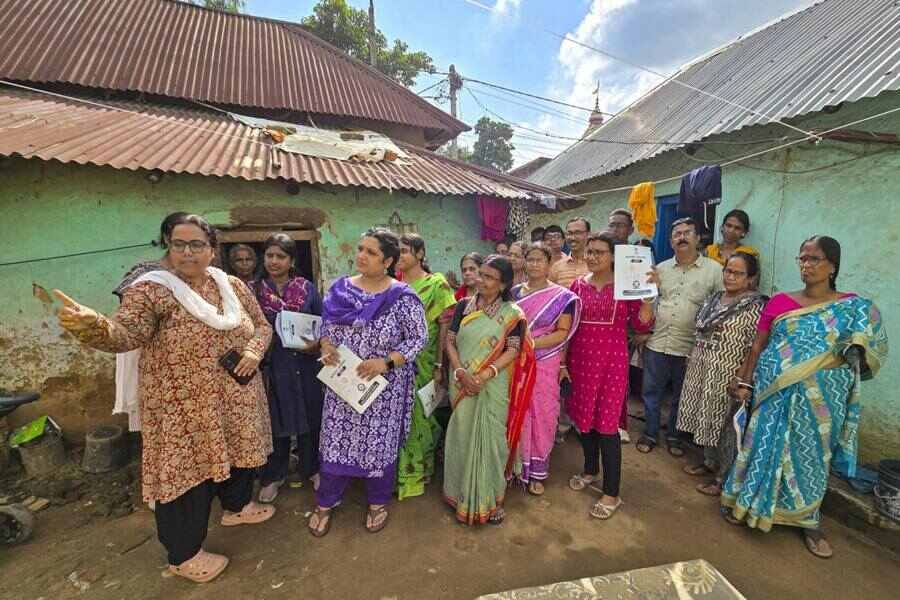
West Bengal has already demonstrated considerable public participation in the census process. More than 53 lakh households reportedly completed self-enumeration, placing the state at the top nationally in terms of the number of households completing the online exercise. The door-to-door Houselisting and Housing Census began on August 16 and is scheduled to continue until September 14. Enumerators are visiting households to collect information relating to housing conditions, amenities, assets, family particulars and economic activities.
This achievement makes the question of manpower even more important. If technology and self-enumeration can reduce the workload, the administration should examine whether the remaining human resources can be drawn from departments and institutions whose regular functioning will not be seriously disrupted.
The High Court’s suggestion to consider personnel from municipalities, panchayats and non-teaching education staff is therefore practical rather than obstructive. Local government employees already possess experience in dealing with households, addresses, local records and community-level administration. Their involvement could potentially reduce the dependence on teachers while ensuring that census work is completed efficiently.
Teachers, on the other hand, perform a responsibility that cannot simply be postponed. A teacher’s absence affects an entire classroom. If several teachers from the same institution are simultaneously assigned outside duties, students may lose valuable instructional time, practical classes may be disrupted and the burden may fall disproportionately on the remaining staff.
The Court’s example of assigning only a proportion of available teachers is particularly significant. If a school has 20 teachers, for instance, assigning five while allowing the other 15 to continue teaching would be less disruptive than removing the entire teaching workforce. But even such an arrangement should be based on the actual strength, timetable and academic requirements of each institution rather than on a uniform formula imposed from above.
There is another issue that deserves attention: timing. Census operations should not automatically be scheduled during regular school hours if alternative arrangements are possible. Administrative convenience cannot always take precedence over classroom instruction. If census officials can establish shifts before or after school hours, or create flexible working arrangements, the conflict between the two public responsibilities could be substantially reduced.
The question of consultation between the Centre and the state government is equally important. Education is administered through a complex institutional framework involving central, state and local authorities. When a nationwide exercise requires a large number of state-level personnel, coordination is essential. The authorities must know the academic calendar, school timings, examination schedules and other institutional obligations before issuing deployment instructions.
The issue is particularly sensitive because the census is expected to be a technology-driven exercise. The Census 2027 HLO App is reportedly being used for data collection and is designed to operate offline, allowing enumerators to record information without continuous internet connectivity and synchronise it later. Such technological support should ideally make the exercise more flexible, not simply transfer the burden to teachers.
The reported self-enumeration figures also offer an important lesson. Around 93 per cent of those who began the online process in West Bengal reportedly completed it successfully. This indicates that citizens are capable of participating in a modern census when the process is accessible and properly explained. The administration should therefore continue expanding public awareness and digital assistance rather than relying excessively on schoolteachers as the default field workforce.
At the same time, it would be wrong to portray census duty itself as an unnecessary responsibility for teachers. Teachers have historically contributed to several public programmes, including elections and other administrative exercises. Their participation can be valuable because they are educated, organised and accustomed to maintaining records. The real question is not whether teachers can perform census duties, but when, how many and under what conditions they should be deployed.
A sensible policy would therefore establish clear safeguards. First, schools should retain sufficient teaching staff at all times. Second, census assignments should avoid examinations and other critical academic periods. Third, teachers should not be deployed when equivalent non-teaching personnel are available. Fourth, working hours should be designed to minimise interference with classroom teaching. Finally, each school should have a designated administrative mechanism for raising concerns where census deployment threatens normal academic functioning.
The administration must also remember that census data are useful only when they are collected accurately. Overburdening enumerators, whether teachers or other employees, can affect the quality of the information being gathered. An employee rushing from a classroom to fieldwork, or from fieldwork back to school responsibilities, may face unreasonable pressure. Better staffing is therefore not simply a matter of employee welfare; it is directly connected with the reliability of census data.
The High Court’s direction regarding the presence of a competent state officer is also noteworthy. Court proceedings involving complex administrative coordination require the relevant government authorities to be properly represented. When questions concern the functioning of schools across the state, the court needs access to officials who can provide precise information and respond to practical concerns.
The controversy should not be reduced to a Centre-versus-state dispute either. Census 2027 is a national exercise, and its success requires cooperation between the Union government, state governments, local bodies, educational institutions and citizens. Political or administrative differences should not become obstacles to accurate enumeration.
The larger principle is simple: public institutions should cooperate without being weakened in the process. A school exists primarily to educate children. A census exists to provide the country with reliable demographic and socioeconomic information. Both are essential public functions. The administration’s responsibility is to design a system in which one does not unnecessarily undermine the other.
West Bengal’s strong response to self-enumeration shows that citizens are willing to participate. The ongoing door-to-door operation demonstrates the importance of trained field personnel. The High Court’s questions provide an opportunity to reconsider how those personnel are selected and deployed.
The government should therefore treat the Court’s observations not as an administrative obstacle but as an opportunity to improve the census mechanism. Municipal and panchayat personnel, non-teaching education staff and other suitable government employees should be assessed before teachers are assigned. Where teachers are indispensable, their deployment should be limited, carefully scheduled and coordinated with school requirements.
A successful census is one that reaches every eligible household without leaving another public service struggling behind. Census 2027 must count households accurately, but policymakers must also count the cost of taking teachers away from classrooms. The ultimate measure of good governance is not simply whether a target is achieved; it is whether it is achieved intelligently, fairly and without compromising another essential responsibility.
Qalam Times News Network believes that teachers should assist the nation when genuinely necessary, but they should not become the administration’s automatic manpower reserve. The classroom must remain protected, and census planning must be built around that reality.