


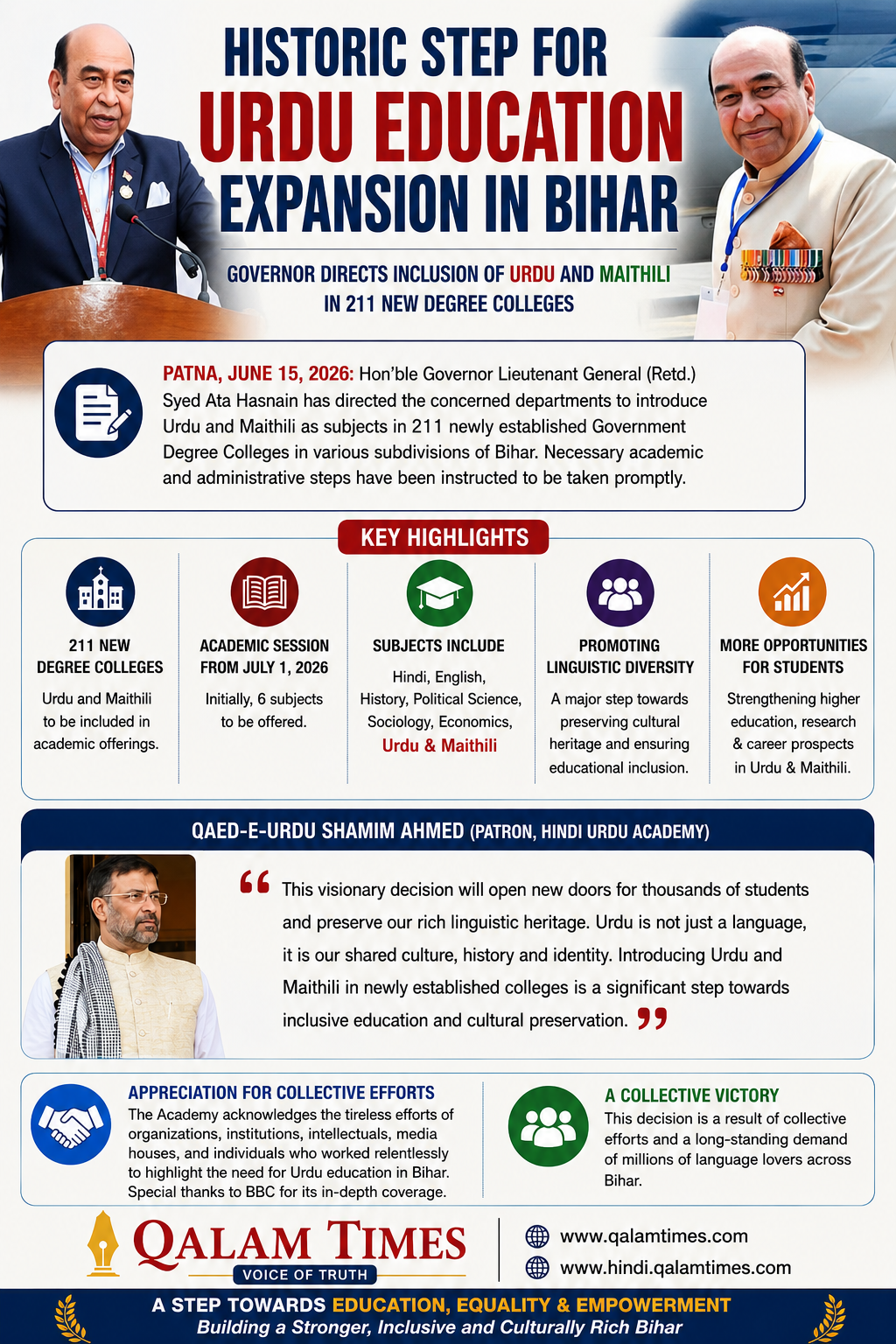
Urdu Education Expansion receives a major boost in Bihar as Governor Syed Ata Hasnain directs 211 newly established degree colleges to introduce Urdu and Maithili studies. Hindi Urdu Academy welcomes the historic decision.
Hindi Urdu Academy Welcomes Decision, Calls It a Milestone for Linguistic Inclusion and Higher Education
Qalam Times News Network
Patna, June 16, 2026
Urdu Education Expansion has received a significant boost in Bihar after Governor Lieutenant General (Retd.) Syed Ata Hasnain directed authorities to introduce Urdu and Maithili studies in the state’s newly established government degree colleges from the upcoming academic session.
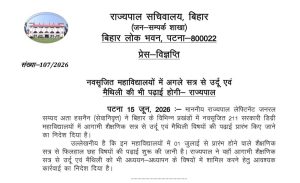
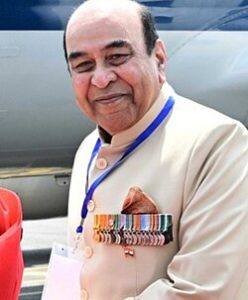
The decision marks a major step toward strengthening Bihar’s rich multilingual heritage and ensuring greater representation of regional and cultural languages in higher education. According to an official communication issued by Raj Bhavan, the Governor instructed concerned departments to take necessary measures for the inclusion of Urdu and Maithili among the subjects offered in 211 newly established government degree colleges across various subdivisions of the state.
A New Chapter for Linguistic Diversity
Under the current plan, academic activities in the newly established colleges are scheduled to begin from July 1 with six subjects initially being offered. These include Hindi, English, History, Political Science, Sociology, and Economics. However, the Governor has now directed that Urdu Education Expansion and Maithili studies should also be incorporated into the curriculum through the required academic and administrative processes.
The move is being viewed as an acknowledgment of Bihar’s linguistic diversity and a response to the longstanding demand of students, educators, literary organizations, and language activists who have consistently advocated for broader opportunities for Urdu and Maithili learners in higher education.
Academy Appreciates Governor’s Initiative
Welcoming the decision, the Hindi Urdu Academy expressed profound gratitude to Governor Syed Ata Hasnain, describing the move as historic and visionary.
Academy Patron Qaed-e-Urdu Shamim Ahmed said that the Governor’s intervention has provided fresh hope to thousands of students who wish to pursue higher education through Urdu. He noted that Urdu is not merely a language but a vital part of India’s composite culture, literary heritage, and social history. According to him, introducing Urdu in newly established colleges will help preserve linguistic traditions while creating academic and career opportunities for future generations.
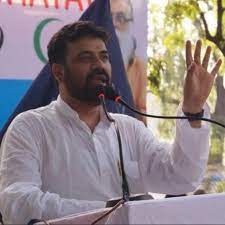
Shamim Ahmad further stated that the decision reflects a genuine commitment to educational inclusivity and cultural preservation. He added that the Governor’s initiative would encourage young scholars to engage more deeply with Urdu literature, research, translation studies, journalism, and other emerging academic fields.
The Academy also acknowledged the contributions of various social organizations, educational institutions, intellectuals, and language activists who worked persistently to highlight the need for Urdu’s inclusion in higher education institutions.
Academy representatives further noted that several individuals working quietly behind the scenes played an important role by communicating with policymakers and presenting the ground realities of Urdu education in Bihar before the authorities. Their efforts, they said, contributed positively to the final outcome.
Leaders of the Academy Extend Gratitude
The Academy’s General Secretary, Dr. Mohammad Farooque, termed the decision a landmark development for language education in Bihar. He said the introduction of Urdu and Maithili in the new colleges would not only strengthen linguistic rights but also create new opportunities for students seeking higher studies in these languages.
Dr. Farooque observed that for many years, students from Urdu-speaking backgrounds faced limited options for pursuing advanced studies in their mother tongue. The Governor’s directive, he said, would help address this gap and encourage greater academic participation among minority and regional language communities.
Meanwhile, Professor Dr. Md. Ehsan, President of the Bihar State Committee of the Academy, described the decision as a positive example of inclusive governance. He said that educational policies become meaningful when they reflect the linguistic and cultural realities of society. The inclusion of Urdu and Maithili, he added, will strengthen Bihar’s educational landscape and enrich its intellectual traditions.
Longstanding Demand Finally Addressed
Educationists believe that the introduction of Urdu and Maithili in the newly established colleges could significantly improve access to higher education for students from language-based communities. It is also expected to promote research, literary studies, and academic scholarship in both languages.
Observers note that the decision fulfills a longstanding aspiration of millions of language lovers across Bihar and reinforces the state’s historic role as a center of learning, literature, and cultural diversity.
As the new academic session approaches, stakeholders hope that the implementation process will move swiftly and that adequate faculty, infrastructure, and academic resources will be made available to ensure the successful introduction of the two languages.