

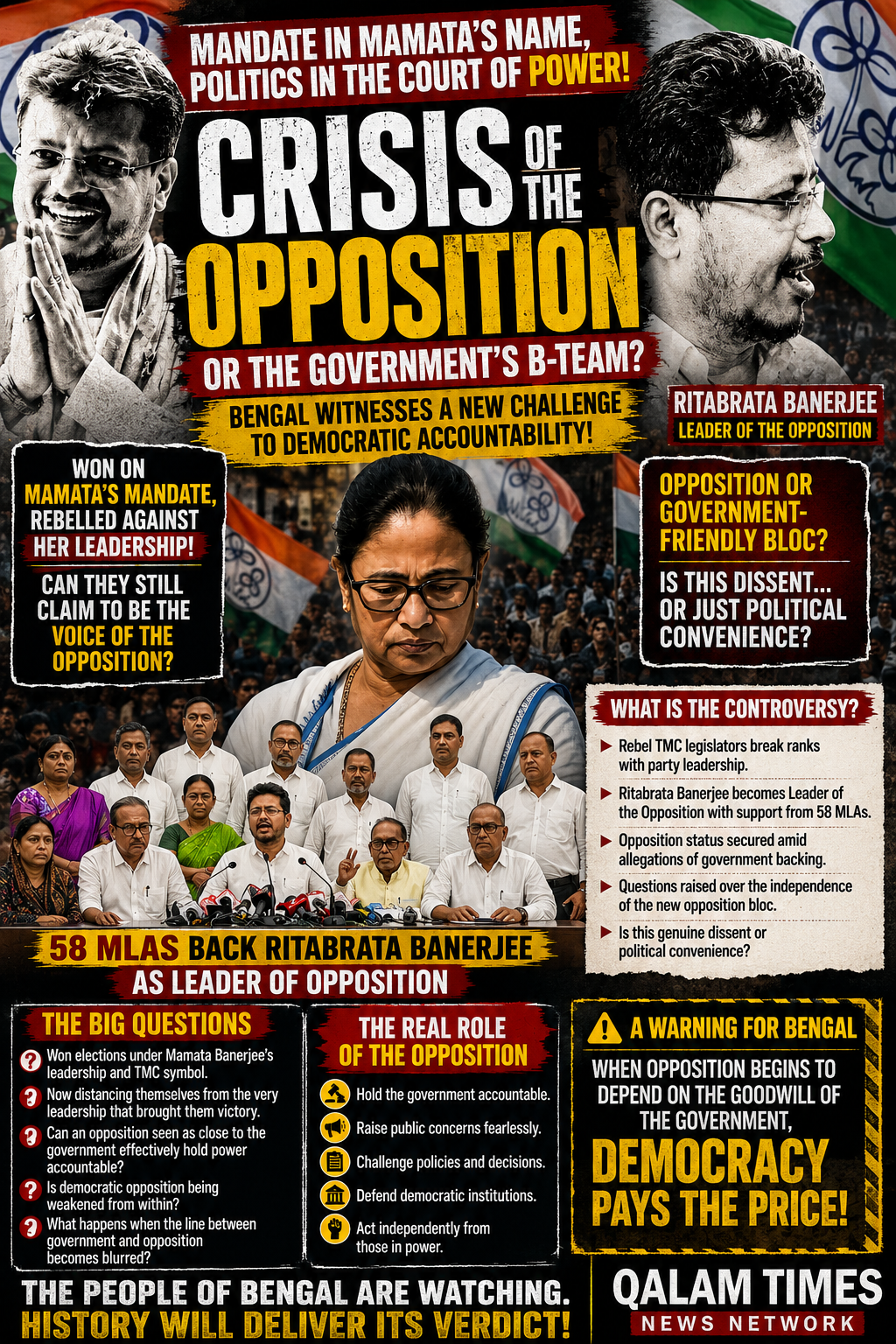
Opposition or Political Opportunism? West Bengal’s new opposition bloc led by Ritabrata Banerjee and Sandipan Saha faces growing questions over credibility, public mandate and democratic accountability after breaking away from the Trinamool Congress.
Ritabrata Banerjee, Sandipan Saha and their supporters may have secured the title of Opposition, but can they win the trust of the people who elected them under Mamata Banerjee’s banner?
Qalam Times News Network
Kolkata | June 5, 2026
There are moments in politics when legal legitimacy and moral legitimacy stop being the same thing. West Bengal is witnessing one such moment today.
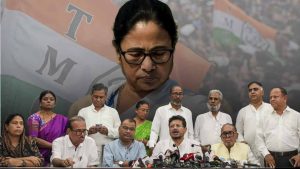
A group of legislators led by Ritabrata Banerjee and Sandipan Saha has emerged from within the Trinamool Congress and now occupies the Opposition benches in the Assembly. On paper, they may have the numbers. They may have the Speaker’s recognition. They may even claim constitutional legitimacy. But a far more important question remains unanswered: Do they possess the moral authority to call themselves the voice of the opposition?
The people of West Bengal did not elect these legislators as independent political giants. They were elected under the banner of the Trinamool Congress. They campaigned with the image of Mamata Banerjee. They sought votes in her name. They benefited from the organizational machinery, political credibility and public trust built by the party leadership over decades.
Today, many of those same leaders are presenting themselves as an alternative power centre while continuing to rely on the political capital that they never built on their own.
This is not merely a rebellion. It is a direct challenge to the mandate that voters delivered.
The controversy becomes even more serious because the emergence of this new opposition bloc appears to coincide with an increasingly comfortable relationship with the very establishment it is expected to challenge. An opposition that is perceived to be enjoying political space through the goodwill of the government inevitably invites suspicion.
The role of an opposition is not to coexist comfortably with power. Its role is to confront power, question power and expose the failures of power.
Yet what Bengal is witnessing today appears to be something entirely different.
While Mamata Banerjee remains the face that carried the party through elections, several leaders who owe their political survival to that very leadership now seek to rewrite the political narrative. They want the benefits of the Trinamool legacy without accepting the discipline, accountability and leadership that came with it.
The irony is impossible to ignore.
The same politicians who fought elections under the Trinamool symbol now wish to convince voters that they represent a new political future. The same leaders who relied on Mamata Banerjee’s popularity now seek to distance themselves from the political structure that brought them victory.
Democracy does not merely require an opposition. It requires a credible opposition.
Without credibility, opposition becomes performance.
Without independence, opposition becomes convenience.
Without public trust, opposition becomes a title without substance.
The people of West Bengal deserve an opposition that stands fearlessly against the government—not one that faces constant questions about its political motivations.
The Assembly may have recognized a new Leader of the Opposition.
History and the people of Bengal, however, will deliver the final verdict.