


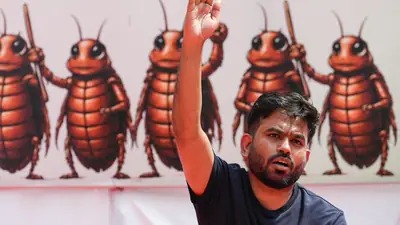
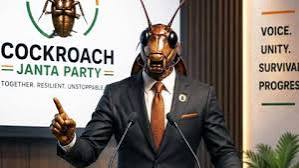
Cockroach Janata Party has evolved from a viral social media satire into a nationwide youth movement against unemployment, alleged exam irregularities and corruption. The campaign is attracting thousands of supporters and is now exploring political participation.
What began as an online satirical campaign has rapidly evolved into a nationwide youth movement against unemployment, alleged examination irregularities and corruption, with growing political ambitions.
Qalam Times News Network
New Delhi | July 6, 2026
Cockroach Janata Party Emerges as a Symbol of Youth Anger
Cockroach Janata Party has transformed from a social media satire into one of the most talked-about youth-led movements in India. Initially created as an online response to controversial remarks allegedly made about unemployed young people, the campaign has now moved beyond digital platforms, drawing thousands of students, graduates and professionals to the streets. At New Delhi’s Jantar Mantar, protesters continue to gather with copies of the Indian Constitution, satirical placards and symbolic cockroach masks, demanding accountability, transparency and employment opportunities.

The movement was launched on May 16 by Abhijeet Dipke, a 30-year-old communications professional educated at Boston University. Living in the United States at the time, Dipke said he decided to convert what he viewed as an insult directed at unemployed youth into a symbol of resistance. Cockroach Janata Party was initially intended as satire, but its overwhelming public response quickly revealed the depth of frustration among India’s younger generation over rising unemployment and alleged irregularities in competitive examinations, particularly medical entrance tests.
Within days of its launch, the movement’s Instagram account attracted millions of followers, eventually surpassing the online reach of several established political organisations. Encouraged by the unprecedented response, Dipke returned to India and organized public gatherings across multiple states before supporters established an ongoing protest at Jantar Mantar, despite administrative restrictions on demonstrations.
Most participants are students preparing for competitive examinations or recent graduates struggling to find employment. Protesters argue that shrinking job opportunities, repeated allegations of recruitment irregularities and lack of institutional accountability have left an entire generation uncertain about its future. Many participants describe the campaign as a platform that finally gives voice to concerns they believe have been ignored for years.
Academics and civil society observers have also taken note of the movement’s rapid growth. Several education experts say they have not witnessed such large-scale student mobilization in recent years without direct backing from traditional political organizations. They believe the movement reflects genuine public frustration rather than conventional party politics. However, many analysts also caution that the absence of a clearly defined leadership structure and formal organizational framework could become a significant challenge as the campaign expands.
Rejecting criticism that the movement lacks ideological direction, Dipke maintains that its foundation rests on constitutional values, secularism, social justice and democratic accountability. According to him, the movement draws inspiration from the ideas of Dr. B. R. Ambedkar, Mahatma Gandhi and Jawaharlal Nehru, while encouraging young citizens to participate actively in democratic processes.
The organization currently functions through decentralized decision-making, with volunteers participating in open online discussions and local coordination. Students, teachers, doctors, artists, workers and retired citizens have all joined the protests, making the campaign socially diverse. Supporters believe this flexible structure encourages wider participation, while critics argue it may hinder long-term political stability.
Supporters Begin Building Independent Political Platforms
The movement has also inspired individuals to take independent political initiatives. Among them is Vikas Kumar, who reportedly resigned from his job to participate actively in the protests. He has announced plans to establish his own political organization under the name Apna Bharat Sena Party (ABS Party).
According to Vikas, his proposed party aims to represent unemployed youth, students and ordinary citizens who feel disconnected from existing political alternatives. He says people from various backgrounds—including artists, labourers and professionals—have been joining demonstrations at Jantar Mantar, reflecting the movement’s growing social reach.
Despite its remarkable rise in a short period, political observers remain divided over the movement’s future. While many acknowledge that it has successfully captured widespread youth dissatisfaction, they believe its long-term electoral impact will depend on whether it can develop a coherent organizational structure, consistent leadership and a sustainable political vision.